
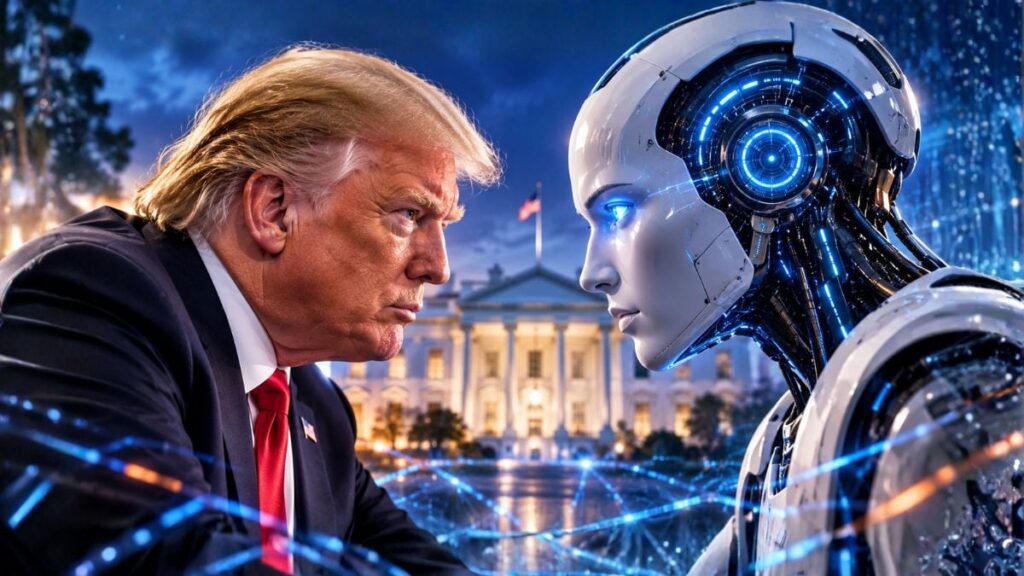

U.S. President Donald Trump announced the creation of the Super Intelligence Force (SIF), a new federal government group tasked with coordinating the United States’ strategy around the development of artificial intelligence.
Trump made the announcement this Sunday, October 4, through a post on Truth Social, after the White House brought together executives from some of the world’s leading artificial intelligence and technology companies.
The new force will seek to keep the United States as the global leader in what Trump calls “super intelligence.”
The SIF will be led by Jay Clayton, Director of National Intelligence, along with other senior U.S. government officials.
The group will also engage with technology companies, consumers, public interest organizations and sectors considered critical to the country’s infrastructure.
What Will Donald Trump’s Super Intelligence Force Do?
The Super Intelligence Force’s main role will be to coordinate federal government efforts related to artificial intelligence and its development in the United States.
According to Trump, the goal is to ensure that the country maintains its global leadership in the technology while also ensuring that its advances help protect the interests of Americans.
The force will work with different sectors, including artificial intelligence companies, critical infrastructure providers, consumers, public interest organizations and religious groups. The intention is to centralize government involvement at a time when AI capabilities are advancing rapidly.
The announcement comes after Trump met with executives from companies including OpenAI, Anthropic, Google, Meta and Nvidia, among others.
During that meeting, the companies agreed to a series of voluntary commitments related to safety and controls for the development of their systems.

Who Is Jay Clayton, Head of the Super Intelligence Force?
Jay Clayton is currently the Director of National Intelligence of the United States. He took office on August 3, 2026, after being confirmed by the Senate. He is the ninth official to hold the position since the creation of the Office of the Director of National Intelligence.
Before joining the intelligence community, Clayton built a career in finance and law. From 2017 to 2020, he served as chairman of the Securities and Exchange Commission (SEC) during Trump’s first administration. Before joining the SEC, he was a partner at Sullivan & Cromwell and an adjunct professor of law at the University of Pennsylvania.
His academic background combines engineering, economics and law. He earned a bachelor’s degree in engineering from the University of Pennsylvania, economics degrees from the University of Cambridge and a law degree from the University of Pennsylvania.
Now, in addition to his responsibilities as head of the U.S. intelligence community, Clayton will lead federal coordination on artificial intelligence.
Who Will Join Jay Clayton?
The Super Intelligence Force will not consist of Clayton alone. Trump also appointed Andrew Ferguson, chairman of the Federal Trade Commission; Emil Michael, Under Secretary of War for Research and Engineering and Chief Technology Officer at the Pentagon; and Scott Kupor, Director of the Office of Personnel Management.
The group will report directly to President Donald Trump and White House Chief of Staff Susie Wiles.
The creation of the SIF represents another step by the Trump administration to involve the federal government in the development of artificial intelligence. The force will have to coordinate different government agencies while maintaining communication with the companies developing the technology.
For now, the U.S. government presents the initiative as a mechanism to strengthen the country’s leadership in AI while also addressing the risks and challenges that could come with its expansion.
Add a stronger SEO introductionReduce repetition about AI leadership
U.S. President Donald Trump announced the creation of the Super Intelligence Force (SIF), a new federal government group tasked with coordinating the United States’ strategy around the development of artificial intelligence Read More