
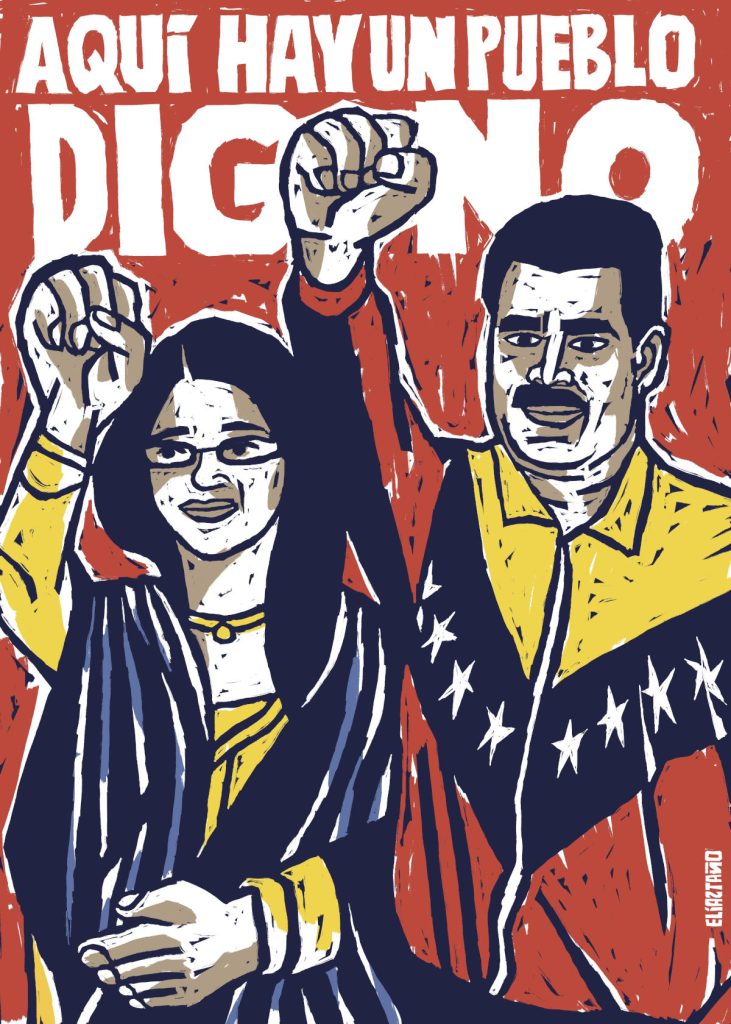
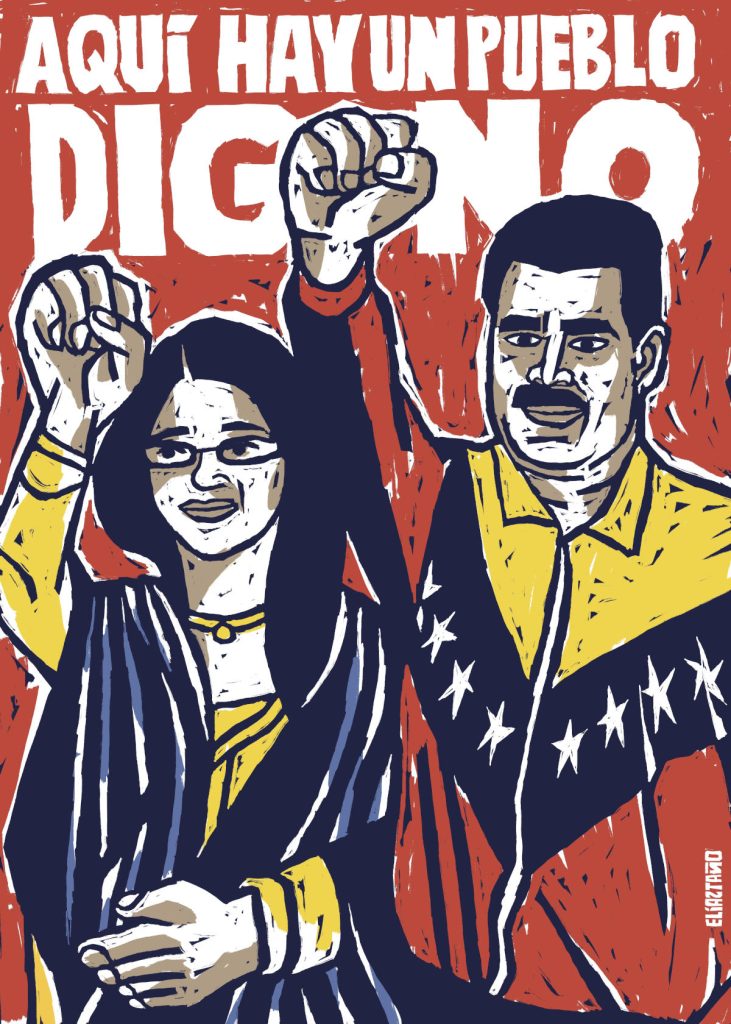
Elías Taño (Tenerife), Aquí hay un pueblo digno [Here Is a Dignified People], 2026.
Greetings from the Nuestra América Desk at Tricontinental: Institute for Social Research,
On January 3, 2026, the United States executed a large-scale military operation against Venezuela, dubbed “Operation Absolute Resolve” by Washington. This act of war by the world’s leading military power against the Bolivarian Revolution left a toll of at least 100 people dead—among them 32 Cuban internationalists—more than a hundred wounded, damage to the country’s military and civil infrastructure (such as medicine warehouses for kidney patients), and the abduction of President Nicolás Maduro and First Lady and National Assembly Member Cilia Flores, who currently remain kidnapped as prisoners of war in New York City.
However, contrary to what any political analyst or historian might have thought, the revolutionary government was not overthrown. It remains standing and heads an organized resistance to preserve peace, stability, and the country’s sovereignty. This apparently paradoxical fact reveals the internal contradictions of the imperial project and the strength of processes rooted in popular organization.
The brutality of the attack may have surprised us, but there had been clear signs announcing it. Project 2025, drafted by the Heritage Foundation and its allies to prepare an army of bureaucrats ideologically committed to the second Trump Administration, recommended a “re-hemisphering” of the continent. The National Security Strategy, published weeks earlier, revived the Monroe Doctrine and added a Trump Corollary: the United States will take all necessary measures—including the unilateral use of military force—to ensure that no foreign power can seize the resources of the American continent that it considers to be in its interest. In practice, this means it will condition the sovereignty of the nations of the continent on their willingness to serve the needs of the superpower.
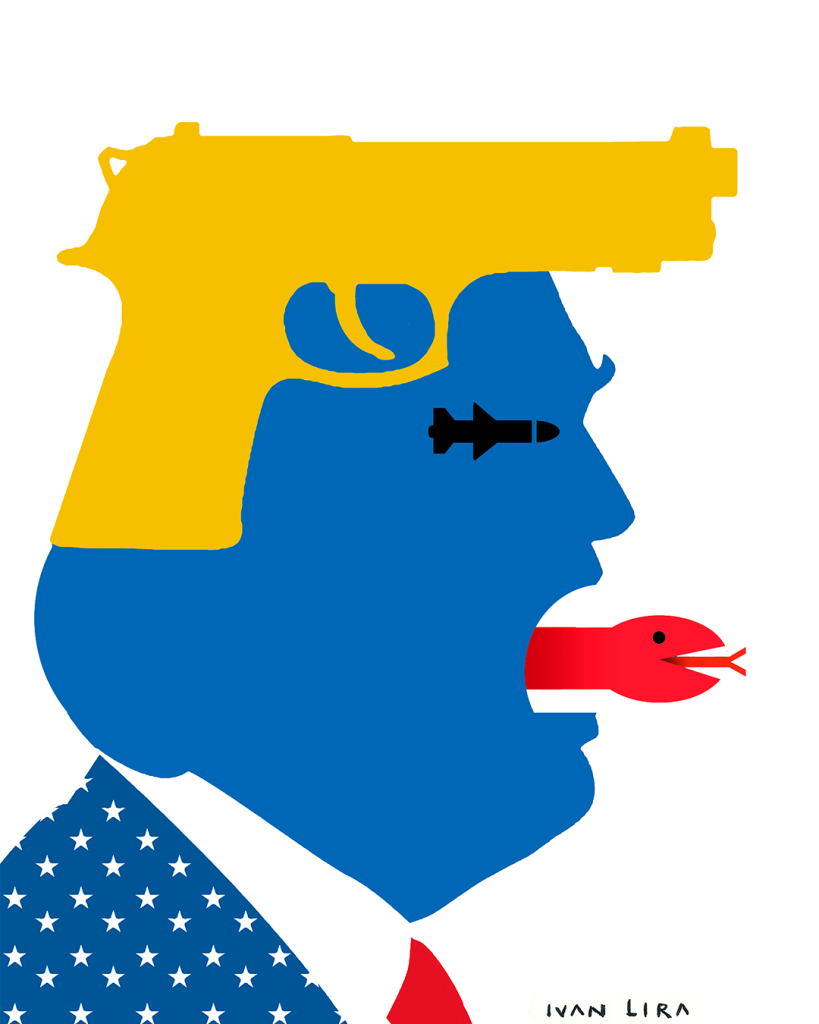
Iván Lira (Venezuela), Dtrump, 2025.
From the new Trump Corollary to the Monroe Doctrine, we can extract 3 lessons:
1. The offensive of hyper-imperialism is brutal and seeks to impose a new world order through force: It began in September 2025 with extrajudicial executions of alleged drug traffickers on the high seas—some of them Colombian and Trinidadian fishermen, as denounced by the President of Colombia, Gustavo Petro—and opened this year with a military attack that, in less than two hours, violated the United Nations Charter, the Rome Statute, and the United States Constitution itself, which reserves the exclusive power to declare war for the U.S. Congress.
The policy of “peace through strength” is the new method for advancing the U.S. agenda. Long gone are the attempts to co-opt and instrumentalize multilateral organizations, as well as the so-called “rules-based order” that Washington selectively invoked. It is no longer necessary to keep up appearances. Imperialism relies on its brute force to create a new international order, and anyone wishing to dispute it, must show its own. Meanwhile, the United States is reconfiguring its dominance over the continent: It intervened in the elections in Argentina and Honduras, continues to threaten Colombia and Mexico with anti-narcotics operations in their territories, demands an agreement from Cuba “before it is too late,” expands its military presence in Ecuador, Panama (seeking to exercise control over the Canal) and Haiti (pushing a “gang suppression force” through the UN), and most recently, issued an ultimatum to Denmark and other NATO partners to cede control of Greenland or it will take it “the hard way.”
2. The new mood of the Global South is strengthened by concrete gains of the people, not by idealism or fearfulness: Despite overwhelming military power, the United States did not militarily occupy Venezuela nor overthrow the government. The country’s stability has been guaranteed by the Bolivarian Revolution, an alternative project to the imperialist logic which managed to consolidate itself through territorial organization (communes), productive creativity, political participation, and social consciousness.
There is a new mood in the Global South that is contrary to unilateral action and supports cooperation through multilateralism and regional unity to confront it. Solidarity plays a fundamental role, and the defense of Venezuela’s sovereignty was felt in places as distant as Kerala, Rome, Pretoria, and Havana, to name a few of the hundreds of places that demonstrated their rejection of the U.S. attack. What these peoples are defending is the right for real and transformative political alternatives to exist. It is these projects that can lead a new future for the Global South. In December, a BRICS People’s Summit was held in Rio de Janeiro, where Brazil’s Landless Workers’ Movement (MST) and other movements defended the elaboration of concrete proposals to carry out cooperative and social enterprise projects. It is real transformations—and not proposals that are unachievable due to their idealism, or that are timid in contesting schemes of domination—that generate stability and unity.
3. The new right occupies increasingly more space but is easily discardable in the hyper-imperialist offensive. The United States surprised many by imposing an increase in tariffs against Brazil and unilateral coercive measures against the judge who sentenced Jair Bolsonaro to prison. Through threats on social media and in the press, the Trump administration accused Brazilian institutions and the government itself of persecuting its main ally in the country.
However, with Bolsonaro convicted, hyper-imperialism quickly changed its strategy, fostering a dialogue with Lula. In a similar operation, María Corina Machado, who received the Nobel Peace Prize after being nominated by the Secretary of State himself, was discarded as a political option in Venezuela for lacking sufficient support or legitimacy. While the right-wing is occupying spaces left open by the weaknesses of the popular camp, hyper-imperialism will not hesitate to discard them in any strategic situation. This reveals that we must urgently work for a common minimum project that allows popular causes to advance without depending on the internal contradictions of the enemy camp.
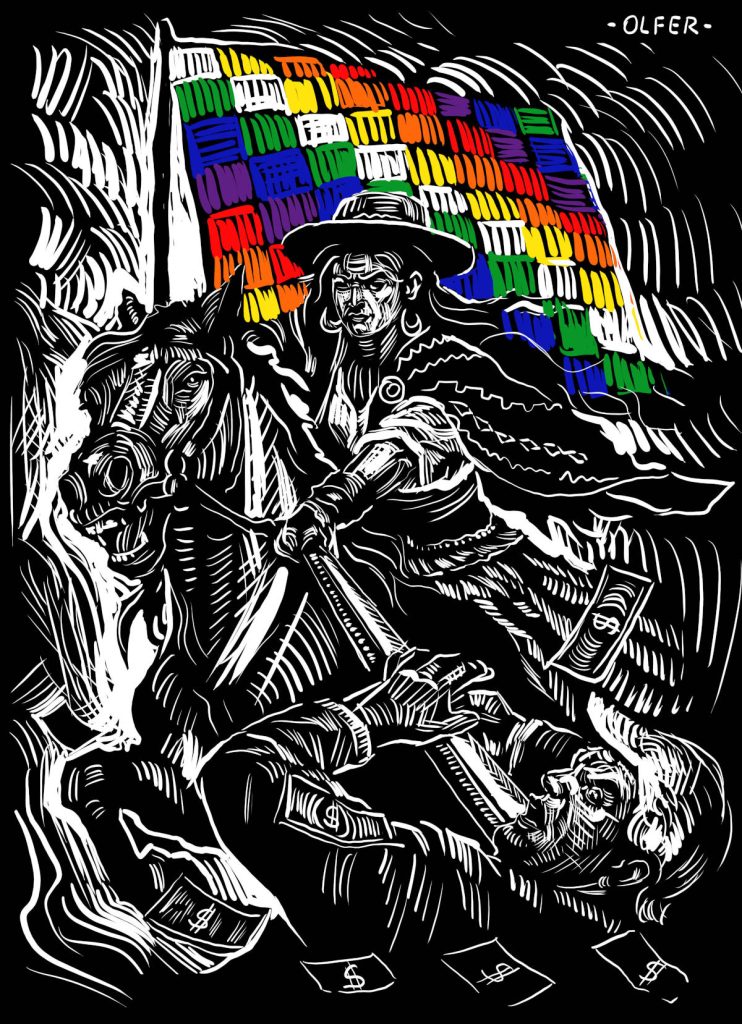
Olfer Leonardo (Perú), Abyayala contra Trump [Abyayala Against Trump], 2026.
In The Eighteenth Brumaire of Louis Bonaparte, Marx reminds us that “men make their own history, but they do not make it as they please; they do not make it under self-selected circumstances, but under circumstances existing already”. After this abrupt start to 2026, let us assume our historical tasks in the face of the circumstances we have had to undergo:
1. Multipolarity is not enough; we must seek the “balance of the universe”: Two hundred years ago, the Amphictyonic Congress of Panama took place. It attempted to create the unity of the American continent to safeguard its independence and sovereignty. Unlike the Pan-Americanism promoted from Washington, this congress did not intend to impose tutelage, but rather bet on achieving what Bolívar conceived as the balance of the universe: “…all these parts [of the world] must try to establish a balance between themselves and Europe, to destroy the preponderance of the latter.” The world order built after the Anti-Fascist World War divided the world into zones of influence to be distributed in the Cold War. What we need to build today, more than plain multipolarity, is a balance between all international actors that guarantees cooperation, just and shared development, and the resolution of major threats such as war and climate change.
2. Our struggle must be common and simultaneous: Sixty years ago, the Tricontinental Conference of Havana was held, where for the first time the struggles of what we now call the Global South were united. There, Commander Fidel Castro presented in his closing speech a formula that is more relevant than ever:
“In Latin America, there must not be even one, or two, or three peoples fighting alone against imperialism. The imperialists’ correlation of forces on this continent, the nearness of their home territory, the zeal with which they will try to defend their dominions in this part of the world require, on this continent, more than anywhere else, a common strategy, a joint, simultaneous struggle.”
During May 2026, and within the framework of the centennial of Fidel, the IV Continental Assembly of ALBA Movements will be held in Cuba. It will be the ideal setting for grassroots movements and popular organizations of the continent, with a realistic view of the challenges, to trace a new strategy of common and simultaneous struggle to preserve sovereignty and dignity in the face of the hyper-imperialist advance.
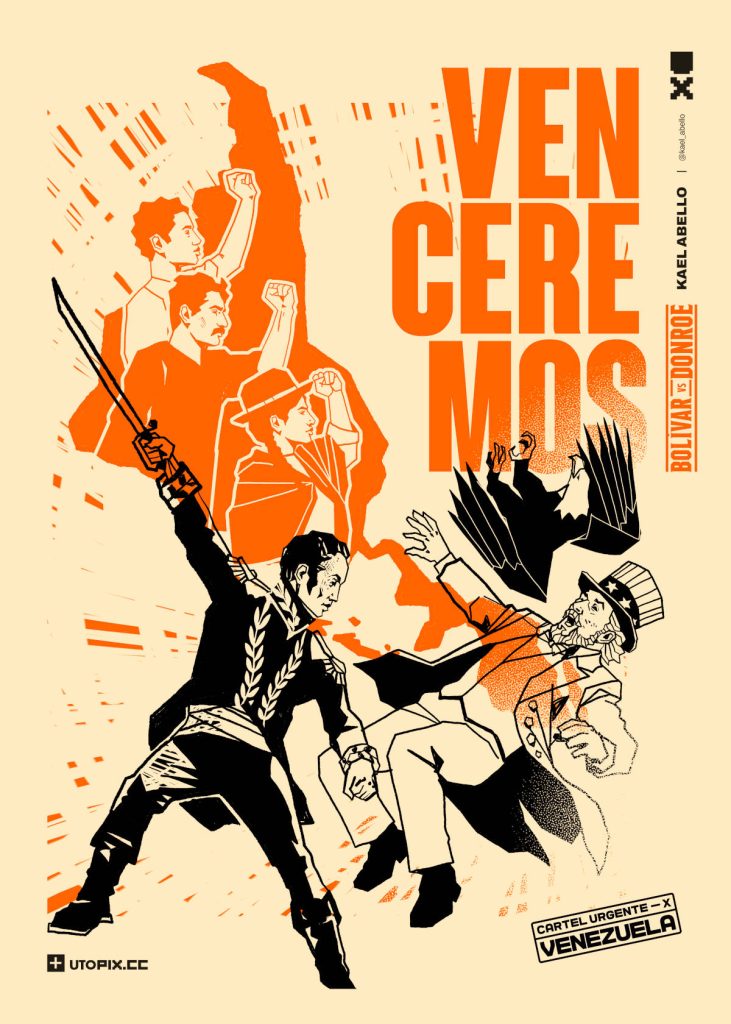
Kael Abello (Venezuela), Venceremos: Bolívar vs Donroe [We Shall Overcome: Bolívar vs Donroe], 2026.
A message from Bolívar: In 1825, a few months after the Battle of Ayacucho which forever sealed South American independence from the Spanish empire, France was contemplating an invasion of Colombia. Bolívar, in command of Peru, sent a harsh letter to Santander in Colombia, charged with realism, pragmatism, and, above all, strategic vision.
Given the military superiority of the French, he recommended not resisting frontally to avoid more destruction to the country. He preferred to retreat to the south and undertake guerrilla warfare; and within a year or two, start the active war that would bring victory. Bolívar advocated for the unity of the Panama Congress and for strengthening alliances with foreign powers, while contemplating astute measures. “Even if I sacrifice my popularity and my glory, I want to save Colombia from its extermination in this new war. I will be happy if I succeed and, if I fail as well, because I will have taken the last step for salvation.”
The scenario today, frankly, is not encouraging. The military incursion in Venezuela and the kidnapping of its president has been a hard blow, as have the threats to other countries throughout the region, electoral defeats, economic and social challenges, and the absence of a common minimum project for the new times.
But at the same time, Nuestra América is not a subjugated region. Patience must be strategic and determination unwavering, even in the face of adversity. It is time to build a new, more favorable moment based on the achievements accomplished. As the Liberator wrote in his letter, “we must know how to lose at the beginning, to know how to win later.”
Greetings to all,
Carlos Ron
 |
Carlos Ron is Co-Coordinator of the Nuestra América Office of Tricontinental: Institute for Social Research. |
On January 3, 2026, the United States executed a large-scale military operation against Venezuela, dubbed “Operation Absolute Resolve” by Washington. This act of war by the world’s leading military power against the Bolivarian Revolution left a toll of at least 100 people dead—among them 32 Cuban internationalists—more than a hundred wounded, damage to the country’s military and civil infrastructure (such as medicine warehouses for kidney patients), and the abduction of President Nicolás Maduro and First Lady and National Assembly Member… Read More