

The Twenty-Fourth Art Bulletin (February 2026)

Listen to ‘Plantar para Colher e Alimentar: Tem Muita Terra Sem Gente, Tem Muita Gente Sem Terra’.
‘The word “culture” comes from agriculture’, Patrícia Lafalce, Carnaval director of Acadêmicos do Tatuapé, a samba school in São Paulo’s working-class eastern zone, told me. We spoke in the artistic director’s office, where singers, dancers, and musicians were busily preparing for a rehearsal ahead of Carnaval week. Downstairs, hundreds of community members were already eagerly gathering, dressed in the school’s colours – blue, white, and a lot of glitter.
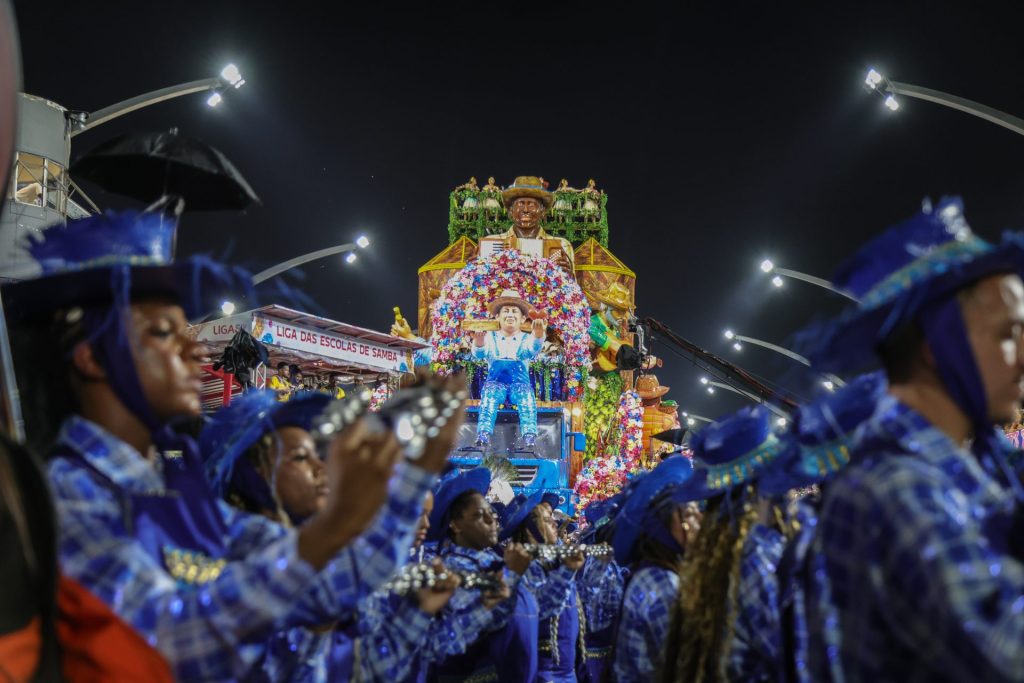
Photo credit: Priscilla Ramos of the MST.
More than a linguistic definition, her observation is a materialist one – that culture, at its roots, is about the production and reproduction of life, from cultivating the land to nourishing our bodies and spirits to the formation of new human beings. On 13 February, the first day of Carnaval, Tatuapé paraded through São Paulo’s Sambódromo do Anhembi to a samba-enredo (Carnaval theme song) titled ‘Plantar para Colher e Alimentar: Tem Muita Terra Sem Gente, Tem Muita Gente Sem Terra’ (Plant to Harvest and Feed: There Is So Much Land Without People, and So Many People Without Land). Created in collaboration with the Movimento dos Trabalhadores Rurais Sem Terra (Landless Workers’ Movement, MST), one of the world’s largest social movements, the song emerges at a significant moment: as the MST approaches its fifth decade of struggle for popular agrarian reform, Brazil continues to confront extreme land concentration upheld by the country’s right-wing forces, large landowners, and agribusiness.
Roughly 2,000 singers, dancers, musicians, and community members marched with Tatuapé, dressed in fantasias (elaborate Carnaval costumes) and riding atop carros alegóricos (towering ornate floats), propelled by the thunder of the bateria (the school’s percussion ensemble). Alongside them was an entire ala (wing) of more than sixty militantes – movement organisers – and peasant families from MST encampments and settlements. In the audience were hundreds more, wearing the emblematic MST cap, specially made for Carnaval in Tatuapé colours and glitter. On it was written, ‘Plantar para colher e alimentar’ (Plant to harvest and feed), carrying their message from the settlements to the streets of São Paulo and onto the national airwaves, where Brazil’s massive popular spectacle – watched by some 45 million television viewers – became a stage for the struggle for agrarian reform.
Samba as a Voice of the Marginalised

Photo credit: Priscilla Ramos.
Though Carnaval today is a commercialised billion-dollar industry, its roots – and those of samba – can be traced to urban working-class communities and struggles. The first samba schools emerged in Rio de Janeiro in the late 1920s, though the genre itself can be traced to the living rooms of people like Tia Ciata (Aunt Ciata, 1854–1924), an Afro-Brazilian community leader credited with nurturing samba’s emergence by hosting musicians and composers in her home in Rio de Janeiro’s Pequena África (Little Africa) neighbourhood, a historic community that that was home to many Africans after the 1831 ban on the transatlantic slave trade.
These schools were community organisations made up largely of the descendants of formerly enslaved Africans from Angola and Congo who migrated from rural plantations to the urban peripheries after abolition in 1888. They carried with them not only their labour but also their music, religious practices, and forms of communal self-organisation and mutual aid. Samba was born from these migrations and has maintained its race and class origins, as well as its connection to rural life and forms of collective organisation.
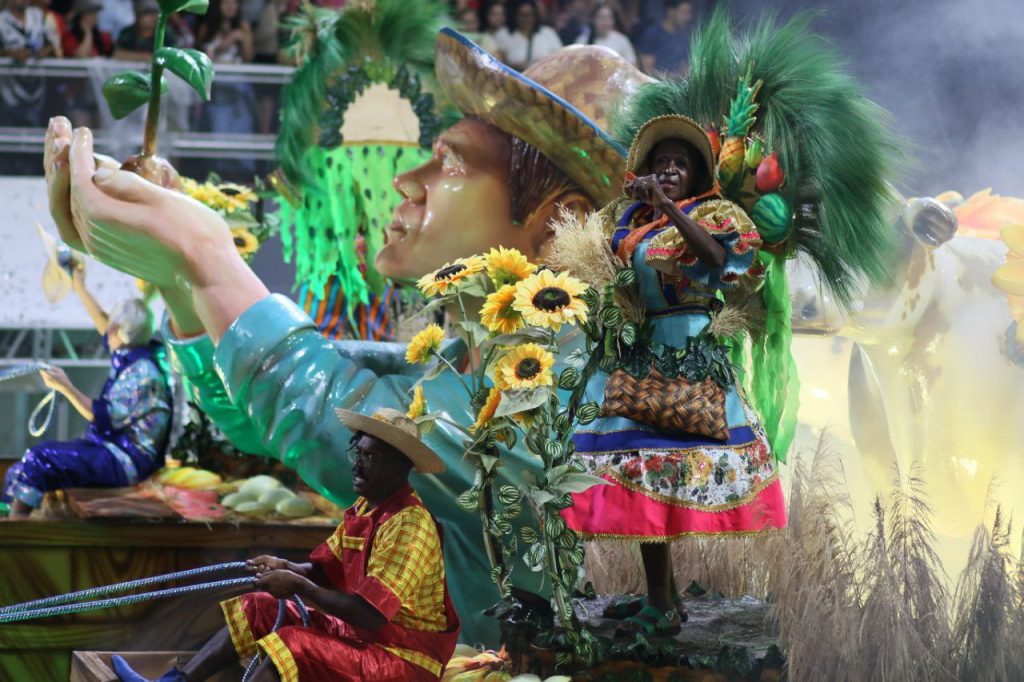
Photo credit: Priscilla Ramos.
By foregrounding the land question in this year’s Carnaval, the samba-enredo created by Tatuapé and the MST harkens back to the origin of the genre itself and builds on samba’s legacy of connecting the city to the countryside’s concerns and struggles. ‘We need to eat every day’, Lafalce says. ‘Where does that food come from? Brazil has so much land – if you plant, anything grows’. This question underscores a central contradiction of Brazilian society: despite the country’s vast agricultural wealth and land, many Brazilians still go hungry, and many peasants remain landless. In 2019–2020, Brazil returned to the United Nations Food and Agriculture Organisation ‘hunger map’, which tracks chronic undernourishment. ‘It is unthinkable’, Lafalce said, referring to the more than 30 million people pushed into severe food insecurity during the presidency of right-wing President Jair Bolsonaro (2019–2022) due to austerity policies, the dismantling of social programmes, and the economic impact of the poorly managed COVID-19 pandemic.
‘Our conception of popular agrarian reform is precisely about connecting the countryside and the city’, Carla Loop of the MST’s Culture Collective told me. For the MST, agrarian reform must include confronting where food comes from, especially in cities, as well as the environmental destruction driving climate catastrophe and the violence that expels rural families into precarious urban existence. Loop argues that samba songs like the MST’s collaboration with Tatuapé can ‘invite urban society to reflect on consumption and the social relations behind it’. The seed of this collaboration was planted in an evocative phrase that the MST has amplified in its urban solidarity work, ‘Se o campo não planta, a cidade não janta’ (If the countryside doesn’t plant, the city doesn’t eat).
With Every Hoe Raised, Freedom Blossomed
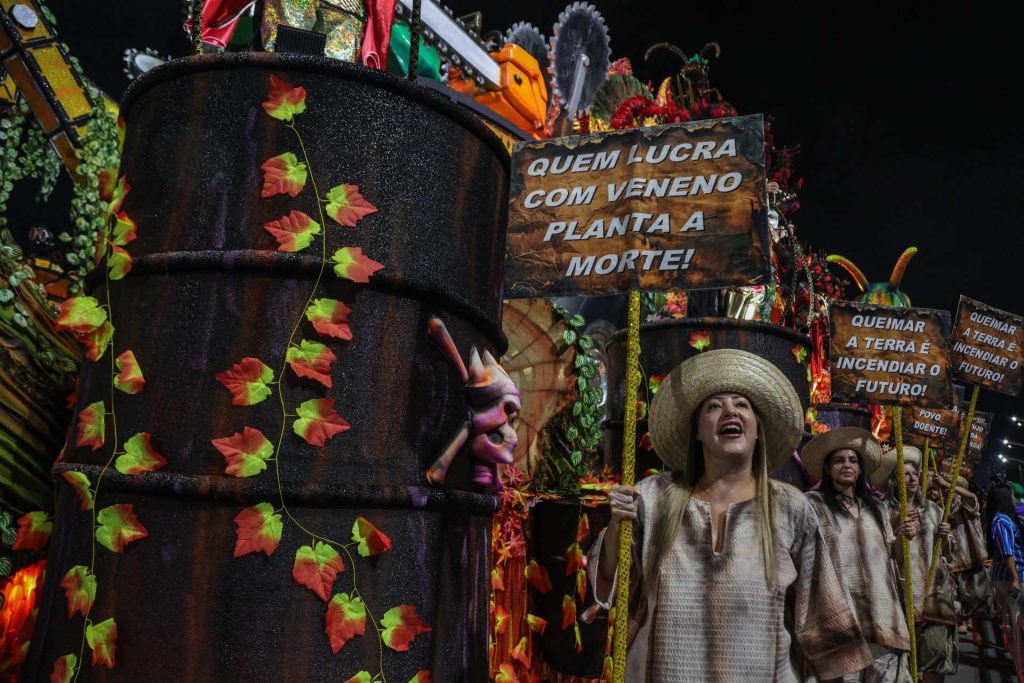
Photo credit: Priscilla Ramos.
Tatuapé has historically uplifted political themes in its Carnaval songs. ‘That is precisely the point’, Loop explains; ‘It allowed us to burst the bubble’. Through this collaboration, the MST and Tatuapé brought popular agrarian reform into communities beyond their usual base while centring ‘trans people, gay people, Black people, white people, sanitation workers, doctors, businesspeople, artists, people from encampments and settlements – everyone together’.
However, creating the ‘democratic space’ that Lafalce described and taking a clear political position also had consequences. In a country where agribusiness wields enormous political and media power, collaborating openly with the MST – a movement that challenges the plantation model through land reform and agroecology – made Tatuapé a target. The school faced internal disagreements and external pressures, including threats of delayed public funding to other financial repercussions. Yet the community held firm, choosing the MST collaboration out of twenty-one submissions through an internal vote in which each department participated.
‘Plantar para Colher e Alimentar’ fuses two entries and unites eighteen composers into a single voice. That voice sings the history of the land in Brazil, beginning with creation and the sacred origins of cultivation, then turning to the colonial violence that followed:
| Tupã! Num sopro de ternura Concebeu a agricultura para os filhos desse chão. Mas veio o invasor e a terra então sangrou Negro plantou resistência Canudos semeou a rebeldia Cada enxada levantada Liberdade florescia |
Tupã,1 in a breath of tenderness, conceived agriculture for the children of this soil. But the invader came and the land bled. Black people planted resistance. Canudos2 sowed rebellion. With every hoe raised, freedom blossomed. |
Carried by the samba-enredo, the parade advances like a moving mural. Each ala has its own colours, gestures, and costumes, and together they ‘illustrate’ the song’s chapters as they pass, punctuated by the carros alegóricos that bring the metaphor to life. The song traces the peoples – Indigenous, African, migrant – who built Brazil and cultivated its land, from the colonial extraction of sugar, coffee, and cotton to the primary contradiction facing the country today: ‘Mas a ganância por terra sem gente / Faz muita gente sem terra chorar!’ (The greed for land without people makes so many landless people weep). The bateria’s pulse pushes the school forward, and the chorus of thousands carries the refrain down the avenue as each wing passes. The Tatuapé-MST collaboration shows agribusiness, with its pesticides and deforestation – despite the industry’s slogan ‘agro is pop, agro is tech, agro is everything’ – for what it is: destruction dressed as progress.
And then comes the turn. In a samba school parade, the bateria can drop into a sudden break, a held breath that spotlights a line before the drums surge back in. The porta-bandeira (flag-bearer) and her mestre-sala (partner) – performing a ceremonial duet at the heart of the school’s presentation – lead into the MST’s answer: agroecological production of organic rice and cacao, and sementes crioulas (heirloom seeds) preserved against corporate monoculture. The song continues, ‘Mãos calejadas no cultivo da semente /… Floresce da terra a fé dessa gente’ (Calloused hands cultivate the seeds / and from the earth, the faith of these people blossoms). The final float, the Festa da Partilha (Feast of Sharing), presents an MST settlement, a vision of collective production. The song continues, ‘Viver é partilhar e nada em troca esperar!’ (To live is to share and expect nothing in return!).
Joy as a Form of Struggle

Photo credit: Priscilla Ramos.
The samba parade was part of a rigorous competition between thirty-two samba schools in the Liga Independente das Escolas de Samba de São Paulo (League of Independent Samba Schools of São Paulo). Each school is scored based on enredo (theme), samba-enredo, harmony, parade movement, bateria, porta-bandeira and mestre-sala, lead group, carros alegóricos and other scenic elements, fantasias, and overall unity. This major annual production is a pillar of Brazil’s mass popular culture, and the MST is not shying away from it. While the movement has a long history of organising in samba and Carnaval – from participating in other parades to creating its own samba school, Unidos da Lona Preta (United of the Black Tarp, named for the black tarp tents used in MST encampments during land occupations) – the collaboration with Tatuapé brought that cultural work to a new level.
‘It is a great demonstration of the construction of cultural hegemony’, Loop told me. ‘An entire community sings the project of popular agrarian reform and transforms it into art – more than 2,000 people involved during an entire year’. She highlights the capacity of the Brazilian people, and across Latin America, to transform pain into music, fantasy, and irony that ‘remains in collective memory’. After all, as Loop insists, ‘The struggle is not made only through suffering. Joy is also a form of struggle’.
In Other News…

21 February marked Red Books Day, the anniversary of the first publication of Marx and Engels’ Communist Manifesto (1848). For this year’s Red Books Day, Tricontinental: Institute for Social Research and the International Union of Left Publishers created a calendar to honour Fidel Castro on the 100th anniversary of his birth and the 60th anniversary of the Tricontinental Conference in Havana. It brings together original works by twelve international cultural workers, all inspired by the concept of the ‘Battle of Ideas.’ Please download it, share it, and organise an exhibition of the artworks featured in the spirit of Fidel Castro’s internationalism and the enduring Cuban Revolution.
Warmly,
Tings Chak
Art Director, Tricontinental: Institute for Social Research
Notes
1Tupã is deity in Indigenous Guaraní mythology.
2Canudos refers to a brutally repressed nineteenth century peasant uprising in Bahia.
For this year’s Carnaval in Brazil, the MST and Tatuapé, one of São Paulo’s samba schools, collaborated on a samba-enredo (Carnaval theme song) calling for popular agrarian reform. Read More