

ABSTRACT
Aim
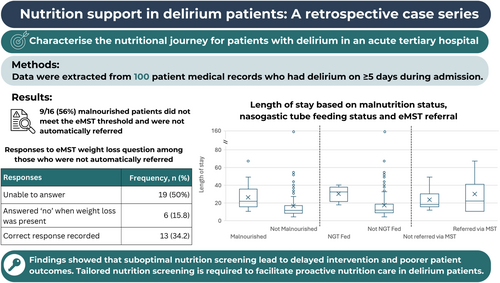
Malnutrition and delirium are highly prevalent and closely linked, with poor nutritional status increasing delirium risk, and delirium worsening nutritional intake. This study aimed to characterise the nutritional journey for patients with delirium in an acute tertiary hospital.
Methods
A retrospective case series was conducted across six general medical units at Austin Hospital, Victoria, between January and July 2024. Of the 157 patients with a positive Confusion Assessment Method score for ≥ 5 days, 100 were randomly selected. Data were extracted from medical records, including demographics, admission details, delirium characteristics, nutrition screening and assessment, and nutrition interventions. Patient-journey timelines were constructed to illustrate key events from hospital admission to discharge. Referral and assessment timelines and length-of-stay data were analysed using Mann–Whittney U test.
Results
Sixteen percent of patients with delirium were malnourished. 44% were automatically referred to a dietitian via the malnutrition screening tool, while 56% did not meet referral thresholds. 50% (19/38) of assessments completed in malnourished patients recorded that patients were unable to answer the weight loss question. 15.8% (6/38) of patients responded ‘no’ to the weight loss question despite documented evidence of weight loss. Malnourished patients with delirium had a longer length of stay than patients with delirium who were not malnourished (median 22.0 days, IQR 15.9–33.8 vs median 11.8 days, IQR 8.6–17.0; p < 0.001).
Conclusion
This study highlights issues of suboptimal screening, delayed intervention, and poorer outcomes in those with delirium. Hospitals should improve nutrition screening and referral pathways to facilitate proactive nutrition intervention in patients with delirium.
Journal of Human Nutrition and Dietetics, Volume 39, Issue 5, October 2026. Read More