
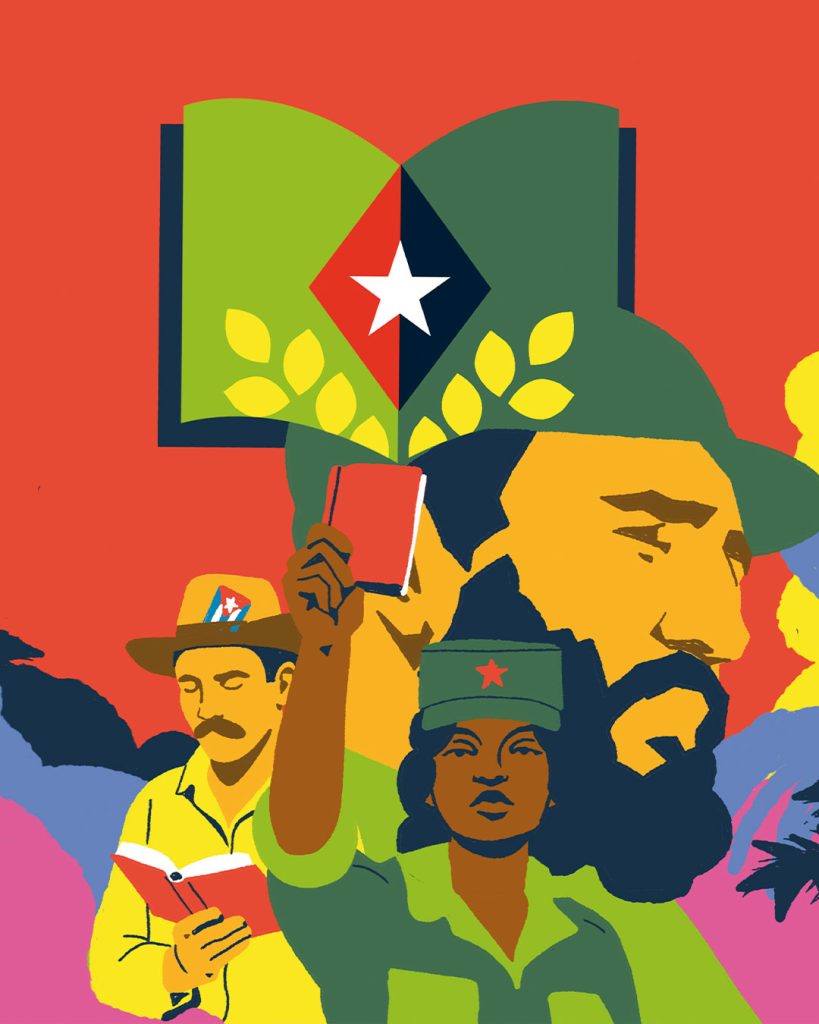
Illustration by Kael Abello (Venezuela/Utopix) for the Red Books Day 2026 calendar.
Greetings from the Nuestra América desk of Tricontinental: Institute for Social Research.
One of the core values of neoliberalism is individualism, and it has shaped the generations that emerged since its global implementation. Margaret Thatcher’s famous phrase serves as the ideological synthesis of this project, which sought to undermine all forms of collective life: “There is no such thing as society. There are individual men and women.” In social terms, this is one of the foundations of the current phase of capitalism, which concentrates wealth in the hands of a few while making life increasingly unsustainable for the majority of the world’s population. This accumulation logic can only be sustained by increasingly authoritarian and violent policies, exemplified by various far-right regimes worldwide, but primarily by the leading imperialist power: the USA. Its government sponsors the genocide of the Palestinian people, the kidnapping of a legitimately elected president, and the murderous economic blockade against Cuba in an attempt to stifle that revolutionary experience, alongside many other wars around the globe.
In contrast, the working classes and the peoples of the world resist collectively through their organization in movements, parties, unions, and collectives. These groups aim to fight against inequalities of all kinds—social, gender, sexual, racial, and class-based. In Nuestra América, this tradition of struggle dates back to the colonial period when Europeans invaded our territories to steal our wealth, meeting fierce resistance from the original peoples who lived here, as Eduardo Galeano eloquently demonstrated in his classic, Open Veins of Latin America.
The historical project for the emancipation of workers is primarily based on the social theory developed by Karl Marx and Friedrich Engels, two German revolutionaries whose main concern and life goal was to destroy capitalism and build a society that was not based on the exploitation of one human being by another.
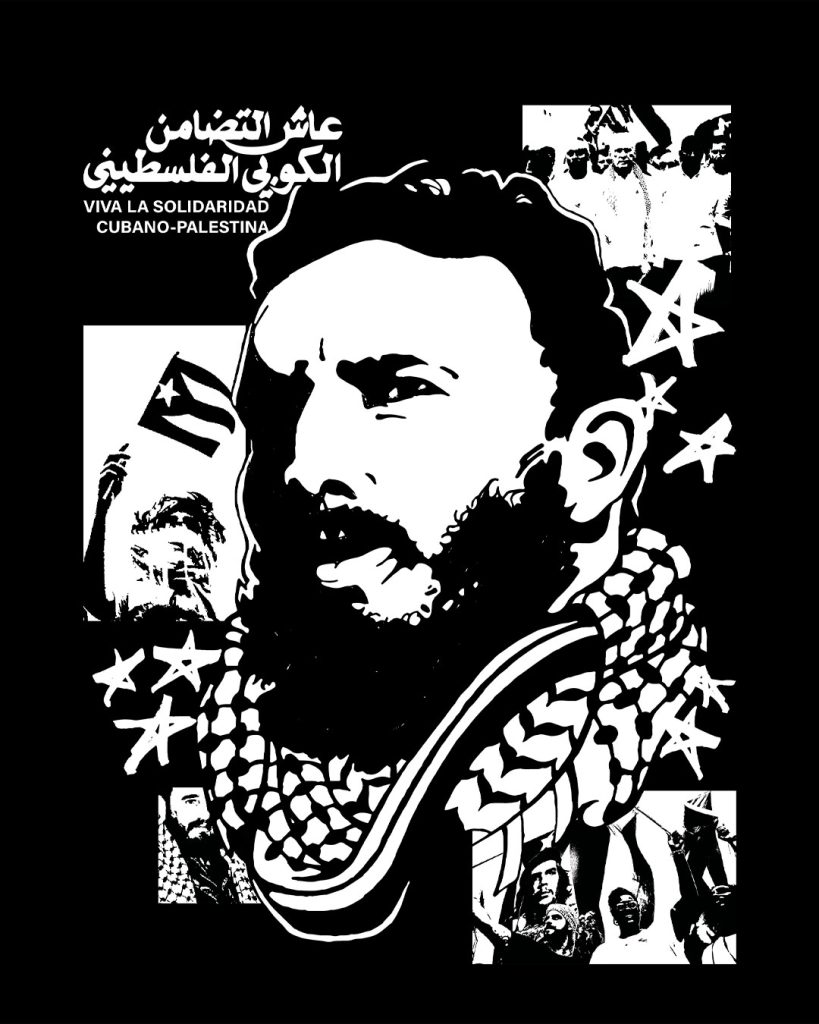
Illustration by shenby g (United States) for the Red Books Day 2026 calendar.
On February 21, 1848, in London, a small pamphlet of fewer than 30 pages was published changing the history of society and social struggles: The Communist Manifesto. In this short text, written as a political program for an international workers’ organization—the Communist League—the two authors analyzed the then-nascent capitalism, highlighting its potential and its limits. There, they primarily emphasized the possibility and the necessity of workers organizing to build a new society.
Since then, this text has inspired all revolutionary processes, whether in Russia, China, Cuba, Vietnam, Nicaragua, or the liberation struggles of the African continent, among many others. In the countries of the Global South, the development of this tradition was enriched by the specific elements of each region’s struggle, becoming a synthesis of political practice and revolutionary theory. This recalls V.I. Lenin’s formulation: “Without revolutionary theory, there can be no revolutionary movement.”
In Nuestra América, the Peruvian José Carlos Mariátegui provided a creative interpretation of the Marxist tradition, concluding that our socialism cannot be “a copy or imitation. It should be a heroic creation” of our peoples. This construction has been forged through the historical experiences of Cuba, Chile, Nicaragua, and Venezuela, and the resistance struggles of the peoples of our continent.
This tradition remains alive in Nuestra América through the organized action of rural and urban popular movements, which keep the flame of revolution and the historical project of the workers alive through organization and popular struggle. These social forces also understand as fundamental what Fidel Castro, Commander-in-Chief of the Cuban Revolution, called the “Battle of Ideas”—the struggle for hearts and minds to build a new society.
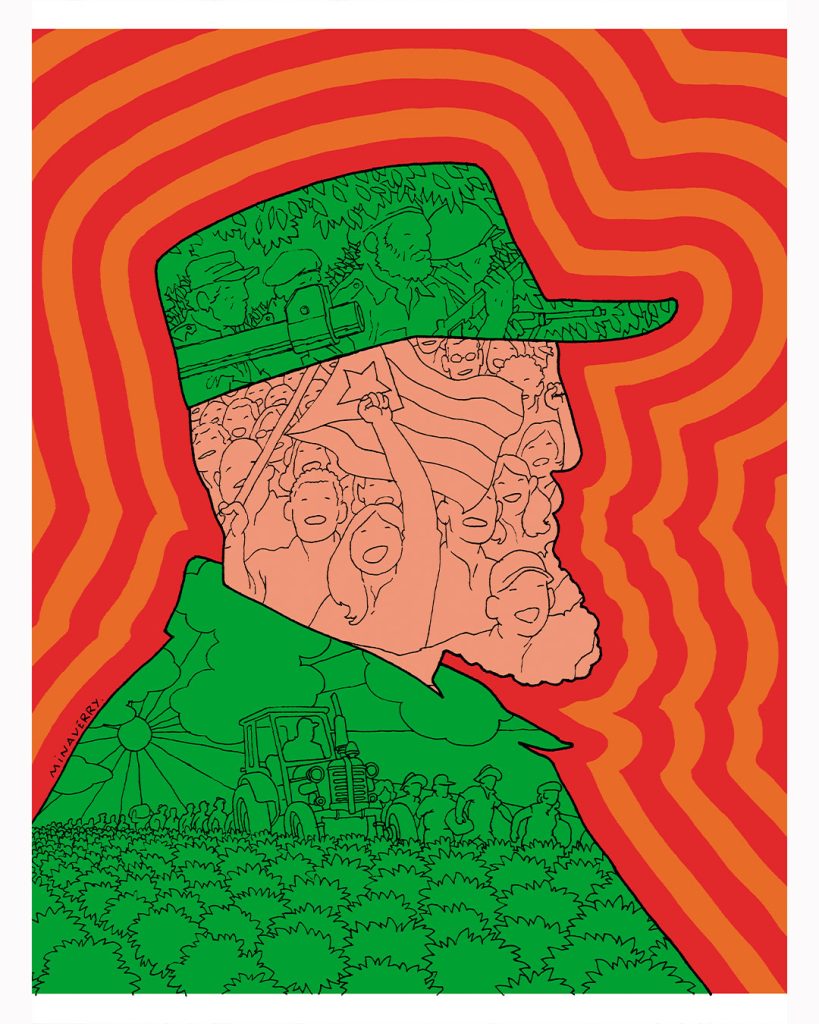
Illustration by Ignacio Minaverry (Argentina) for the Red Books Day 2026 calendar.
Martha Harnecker, one of the leading Marxists of Nuestra América, dedicated her life to reflecting on various revolutionary processes to advance social transformation on our continent. After the implementation of neoliberalism and analyzing the temporary defeat of leftist forces in our region, she identified three major crises: the project crisis, the program crisis, and the organization crisis. Overcoming these three crises is both a practical and theoretical challenge.
Inspired by this tradition of struggle, various popular organizations around the world—following the call of leftist publishers organized in the International Union of Left Publishers—began celebrating Red Books Day in 2020. This is a day to celebrate the leftist culture embodied in books that question the logic of capital, announce the construction of a new society, and contribute to overcoming capitalism. It is also a date to challenge, in practice, the value of individualism emphasized by neoliberalism and to reclaim collective life. It is a day for gathering, where people meet to collectively read “Red Books” that fuel our indignation and our struggle.
In these six years, different people across all regions of the world, from Chile to South Korea, have participated in the celebration of Red Books Day, strengthening a leftist culture and a set of ideas that prioritize life, the human being, and the collective.
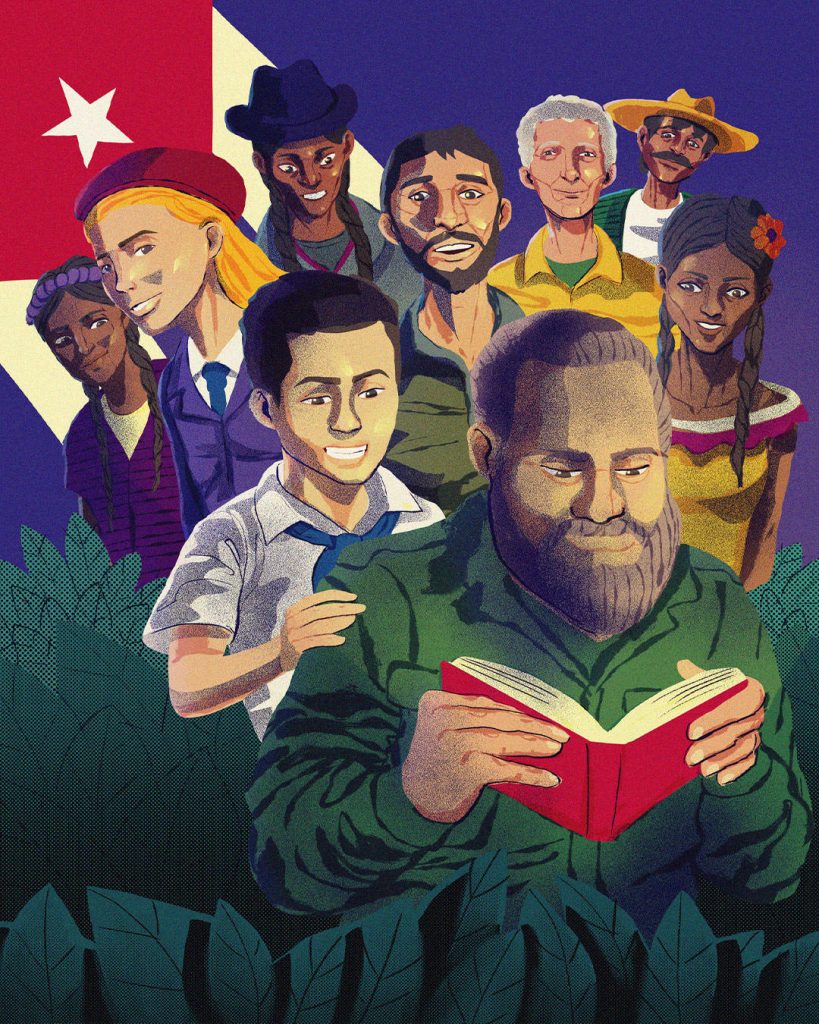
Illustration by César Mosquera (Venezuela/Utopix) for the Red Books Day 2026 calendar.
In 2026, we also celebrate the centenary of Fidel Castro and the 60th anniversary of the Tricontinental Conference held in Havana. At the same time, we remain on extreme alert against imperialist offensives, such as the genocide in Gaza, the invasion of sovereign countries, and the kidnapping of presidents. In this sense, we invite everyone to join this initiative to celebrate collective life—reclaiming a central value of the society we wish to build—and to spread the ideas that challenge the death regime of capital and announce the hope of a new society.
This is a vital way to strengthen the struggle of our peoples and the spirit of internationalism, recalling two formulations by José Martí, the apostle of Cuban independence: “Barricades of ideas are worth more than barricades of stone” and “Homeland is humanity.” Gathering to read “Red Books” on February 21 carries this meaning, keeping alive our hope for the construction of a society where we no longer live through the exploitation of one human being by another, but, as Marx formulated: “From each according to his ability, to each according to his needs!”
Greetings to all,
Miguel Yoshida
 |
Miguel is a member of the Nuestra America desk in Brazil, a researcher at the Art Department of the Tricontinental Institute and an editor at Expressão Popular. |
For the last six years, different people across the world have participated in Red Books Day, strengthening leftist culture and ideas which prioritize life, the human being and the collective. Read More