
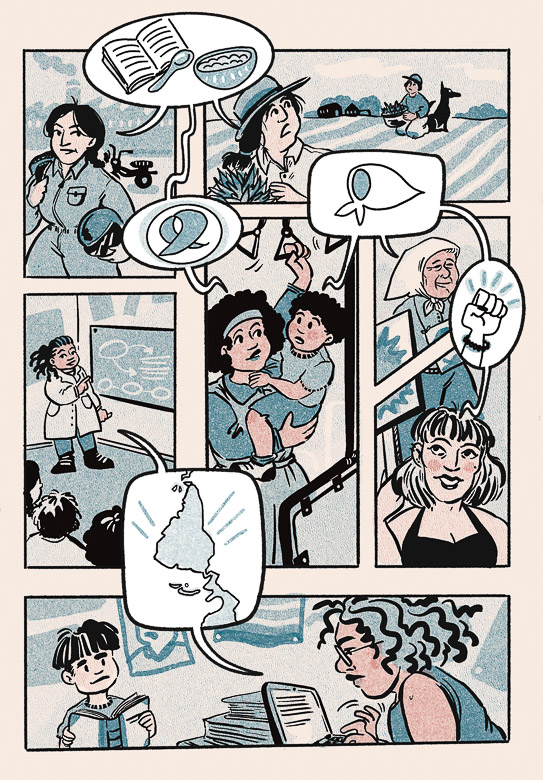
The works in this dossier include illustrations and excerpts from longer comics – snapshots of scenes of struggle, care work, invisible labour, militancy, and instances of ‘putting one’s body on the line’ (poner el cuerpo). The creators of these works are Latin American women and members of the LGBTQIA+ community who seek to defend and tell their own stories in the face of the far right’s many-pronged agenda in the region.
The selection was made in collaboration with Feminismo Gráfico (Graphic Feminism), a collective dedicated to compiling, recovering, and showcasing Argentinian women creators of comics and graphic humour from the early twentieth century to the present. Feminismo Gráfico builds a critical genealogy of the comics medium from a feminist perspective, contesting meanings in a popular language that has long been undervalued and centring the experiences of women and dissident genders and sexualities. Visit their archive at feminismografico.com.
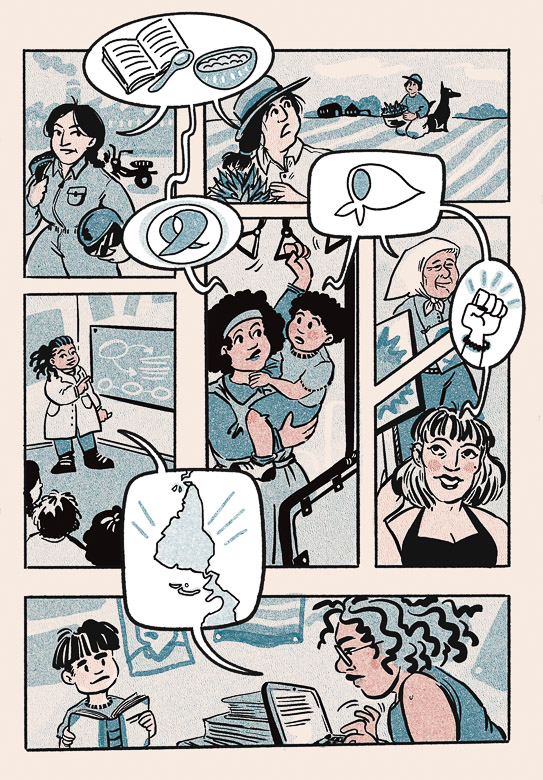
Dani Ruggeri (Argentina), Colectivo (Collective), 2026.
Introduction
Since 2016, marches against sexual and gender diversity1 have swept across Latin America. They feature women dressed in pink and men in blue to underscore traditional gender roles. The marches have been accompanied by a strong social media presence, with hashtags such as #NoALaIdeologíaDeGénero (‘No to gender ideology’), #ConMisHijosNoTeMetas (‘Don’t mess with my children’), #AMisHijosLosEducoYo (‘I will educate my children’), and #ConLosNiñosNo (‘Not with children’).
These campaigns, which have their roots in the United States in the 1970s and reemerged in the twenty-first century, are part of an anti-gender, anti-feminist wave driven by Christian fundamentalism. This wave has swept across Catholic-majority countries in Western Europe such as Spain and Italy; across Eastern Europe, from Croatia and Hungary to Poland and Slovenia; and beyond Europe, from Australia to Sub-Saharan Africa. In many countries, efforts to sabotage comprehensive sex education and restrict access to contraceptives and safe abortion are widespread (for instance, more than half of the countries in Sub-Saharan Africa criminalise sexual and gender diversity).2 Alongside this conservative wave, Latin America experienced an intense transnational cycle of feminist mobilisation (2015–2019). This cycle of feminist mobilisation also strained the limits of state institutions and often outpaced the agendas of the region’s progressive governments, pressing demands that went further than those governments were willing or able to pursue.
Today’s far right is international and ascendant, from the Philippines and Hungary to India and Argentina. In this dossier, we examine how, in Latin America, its tentacles intertwine with those of global, regional, and local ultraconservative organisations – both religious and secular – to promote an agenda against the rights of women and sexually and gender-diverse people. Our main lens for analysing how this agenda operates in different countries is The Con Mis Hijos No Te Metas (‘Don’t Mess with My Children’) campaign, which is active across most of the region. We look at six Latin American countries to show how this campaign operated between 2016 and 2025: Peru, where it originated; Ecuador, where it was first exported and took hold under an economically and politically progressive government; Argentina, home to the strongest feminist movements in the region, where major legal and institutional advances have been achieved for the rights of women and sexually and gender-diverse people; Chile, where the massive popular uprising of 2019 failed to consolidate broad gains even as the feminist movement managed to achieve some; and El Salvador, among the most conservative countries on sexual and reproductive rights. El Salvador shares with Brazil – also analysed here – a strong presence of evangelical fundamentalist movements and the fact that, although the Con Mis Hijos No Te Metas campaign has played a limited role, other mechanisms and closely related campaigns have.
Part 1 The Women’s Question in Latin America: Between Democratic Transition and Neoliberal Consolidation
The women’s movement in Latin America emerged in the 1970s and 1980s as part of the struggles against dictatorships, structural inequalities, and neoliberalism, bringing together demands around gender violence, reproductive rights, the recognition of care work, and political participation. It developed in conversation with the UN’s global agenda on women’s rights and in – often contentious – dialogue with trade-union, peasant, and human rights movements. In the 1980s and 1990s, the movement’s demands were partially incorporated into public policy as governments adopted gender policies and set up specialised state agencies. But this institutionalisation took place in contradiction with neoliberal hegemony, which imposed structural adjustment, eroded the state’s capacity to provide social welfare, and exalted the market as the organising force of social life – changes that disproportionately affected women, especially poor and racialised women.3
In this period, austerity and reduced funding for social welfare shifted the burden of social reproduction to households.4 This has intensified the often invisible exploitation of domestic and care work, mostly carried out by women:5 what Nancy Fraser calls a ‘care crisis’, i.e., the rising care needs under deteriorating social and institutional conditions.6 This overload serves capital by securing the daily reproduction of the labour force at no direct cost to the state or the employer, deepening exploitation in the service of capital accumulation.7
In parallel, neoliberalism’s expansion of informal and precarious work hit women hardest, since the absence of state support limited – and continues to limit – both their access to labour markets8 and their ability to remain in stable jobs. In Latin America and the Caribbean, women are concentrated in low-paid sectors with high turnover and a lack of basic protections while they continue to perform unpaid, invisible domestic and care work.9 In 2023, 26% of women had no income of their own, compared to only 10% of men.10 As households became shock absorbers for the crisis, rhetoric about ‘family values’, ‘resilience’, and ‘individual responsibility’ legitimised the retreat of the state and naturalised the expectation that families shoulder the consequences of unemployment and precarity.11
The reconfiguration of the neoliberal state’s role also reshaped social relations. Communities and sectors of civil society took on some of this work, expanding the domestic sphere beyond the household and further feminising social reproduction.12 These narratives and the effects of state retrenchment are uneven. On the one hand, they were articulated through the idea of ‘female entrepreneurship’ as a symbol of autonomy that masks structural inequalities. On the other, women’s politicisation in working-class neighbourhoods – and the collectively self-managed strategies built in the face of crisis – created a field of dispute with neoliberalism in which women played a central role.13 By shifting attention to individual effort, this rhetoric obscured the material conditions of women’s exploitation – yet it also surfaced in the everyday community work through which women survived and sustained social life.14
The Expansion of Rights in the Wake of Neoliberal Crisis
In the first decades of the twenty-first century, social mobilisation and conflict undermined the legitimacy of neoliberalism, giving rise to a cycle of contestation – most pronounced between 2000 and 2013 – and to progressive governments that, to varying degrees, enjoyed the support of organised social movements.15 During the height of Latin America’s progressive governments (2000–2015), states expanded the institutional recognition of women’s rights and the rights of sexually and gender-diverse people, partially incorporating a gender perspective into public policy. Specialised ministries and agencies were created, laws against gender-based violence were enacted, redistributive pension reforms were implemented, sexual and reproductive health programmes were established, and comprehensive sex education was expanded. In some cases, gender identities, civil unions, and marriage equality were recognised: in others – such as Argentina – an employment quota for trans people was established.16 These policies drew on international human rights frameworks such as the Convention on the Elimination of All Forms of Discrimination Against Women (CEDAW), the Belém do Pará Convention, and the Beijing+10 process while also reflecting the growing influence of transnational feminist organising in the region.
Despite the advances of Latin America’s progressive cycle, gender equality faced persistent obstacles, such as charity-based approaches, informal employment among women, insufficient funding for gender-equality programmes, and efforts by conservative, religious, and business alliances to block initiatives such as sex education and the recognition of care work. The gap between the formal expansion of programmes and their limited transformative impact on women’s lives shows how economic, cultural, and patriarchal power constrained the state’s capacity throughout the period. Data from 2023 confirms this: women held only 35.8% of seats in national parliaments, and 3,897 femicides were recorded across the region.17
Feminist Uprisings Against Neoliberalism
Around the mid-2010s, the exhaustion of Latin America’s progressive cycle opened a new phase of political reconfiguration in the region. The structural limitations of post-neoliberal projects – dependence on extractive rents, the persistence of regressive fiscal regimes, and limited productive transformation – undermined their redistributive capacity and social legitimacy. This process was accompanied by a renewed neoliberal offensive aimed at restoring the power of finance capital and reinstating market logic as the organising principle of social life.
From this period – and even more so in the following decade – popular, community-based, and trade-union feminist currents, together with movements for sexual diversity and reproductive rights, revitalised feminist politics. They linked struggles against patriarchal violence, femicide, labour precarisation, the devaluation of care work, racism, and extractivism. Mass mobilisations for the right to abortion and international feminist strikes exposed the connection between the exploitation of women’s work and the structural violence of capitalism and patriarchy.
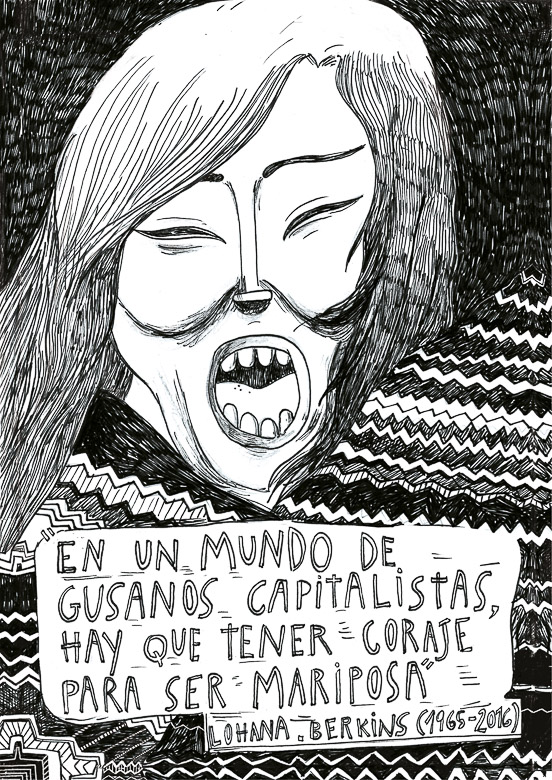
Valeria Reynoso (Argentina), excerpt from Sé vos (Be Yourself), 2017, Editorial In Bocca al Lupo.
The text in the image is a direct quote from Lohana Berkins (1965–2016): ‘In a world of capitalist worms, you have to have the courage to be a butterfly’. Berkins was an Argentinian travesti-trans18 leader, founder of Asociación de Travestis, Transexuales y Transgéneros de Argentina (Argentinian Association of Travestis, Transsexuals, and Transgender People, ATTTA) and a key driving force behind Argentina’s Gender Identity Law of 2012 (Law 26.743).
Part 2 The Moral Panic of the Contemporary Far Right
Over the last decade, a wave of terror has swept across Latin America. The bodies of women and sexually and gender-diverse people – especially the poor and racialised – have been among the main targets of hate speech and violence. With the advance of neoliberalism, the continent’s traditional right entered a crisis: incapable of responding to working-class discontent, it gave way to a new right that has captured the hearts and minds of the population.19 Allied with Christian fundamentalism, the contemporary far right has penetrated working-class households – even the most impoverished – through a highly didactic discourse centred on the defence of the family and the construction of an enemy to be destroyed. For the contemporary far right, everything outside heteronormativity is cast as an evil force to be fought in defence of the ‘traditional’ family.
There is a long history in the region of using the idea of the traditional family to discipline bodies and subjectivities, fragment popular sectors, and create internal enemies that divert attention from the structural causes of inequality. In the 1920s and 1930s, particularly in Argentina and Brazil, Catholic integralism sought to impose Catholicism as a guide for state policy and promoted the idea of the Christian family in opposition to divorce, abortion, and euthanasia. The 1960s saw the rise of liberation theology, in which Christians from various countries took up struggles for social and gender justice. At the same time, the ultraconservative movements Tradición, Familia y Propiedad (Tradition, Family, and Property, founded in Brazil in 1960) and Sodalicio de Vida Cristiana (Sodalitium of Christian Life, founded in Peru in 1971) emerged, promoting traditional families and gender roles. The military dictatorships of the 1970s and 1980s were based on the US national security doctrine, which used traditional morality and Catholic values as the basis for social control, the imposition of order, and the justification of repression against the enemy, historically identified with communism. In this logic, family stability became synonymous with national stability.
Following the end of the progressive cycle, the agenda against the rights of women and sexually and gender-diverse people in Latin America became part of the far right’s ideological offensive, which seeks to legitimise intensified exploitation under hyper-imperialist capitalist crises. This agenda is led by religious and secular organisations aligned with Christianity – both Catholic and Protestant – alongside NGOs, political parties, and business groups. The ideological and conceptual foundation of the agenda’s proposals comes from two sources: the Catholic Church, which developed the concept of ‘gender ideology’, and Christian fundamentalist currents, especially neo-Pentecostal ones.
Gender Ideology
The Catholic Church’s formulation of so-called ‘gender ideology’ – which seeks to present the analytical concept of gender as an ideological distortion of reality – took shape in the 1990s. The argument is based on the Vatican’s ideas about the perfect complementarity between two sexes, held to be exclusively male and female, and on whose union the survival of the species depends.20 From this perspective, to speak of gender as a category with multiple social and cultural dimensions is to break with the supposed natural binary order and represents an attack not only on the family and society, but on the very survival of humanity. According to this logic, marriages between people of the same sex also constitute a threat to the species.
During the same period, the Vatican resisted efforts to incorporate the category of gender into UN human rights world summits. It did so first in alliance with conservative governments in Latin America (such as Honduras, El Salvador, and Nicaragua) and later with majority-Muslim countries (such as Egypt, Pakistan, Iran, Algeria, Morocco, and Sudan).21
Evangelical Fundamentalism
Evangelical fundamentalism continues to oppose social, scientific, and political advances – as it has since its emergence in the United States in the late nineteenth-century – casting them as enemies in a war between good and evil.22 Alongside non-religious actors, it has also set its sights on the bodies of women and sexually and gender-diverse people, stoking moral panic while deploying other strategies. This is best understood through two currents: the theology of domination, which seeks to undermine secularism, and the theology of prosperity, which reinforces individualism. The theology of domination, developed by fundamentalists in the United States in the 1970s, seeks to establish a theocracy in contemporary society by advancing the claimed predestination of Christians to occupy leadership positions – including the presidency, ministries, parliaments, national and local governments, and the higher courts – and thereby influence public affairs through Christian domination.23
The theology of prosperity holds that ‘success in life’ and obtaining material goods are the product and sign of divine blessing. This tenet plays a key role in legitimising neoliberalism ‘by idealising and even religiously consecrating socioeconomic differences among people’.24
Both theological currents are mobilised as part of US imperialism to contain left revolutionary movements as well as feminist and progressive religious currents in the region (especially liberation theology) that seek social justice through collective action.25
The Contemporary Far Right
Wherever it emerges, the contemporary far right seeks to build a mass social base rooted in the dominant ‘majority’ identities – often framed as Christian, nationalist, and ‘pro-family’ – by demonising those it designates as a ‘minority’.26 While right-wing governments implement fiscal austerity, the far right blames minorities for the effects of structural adjustment. Unemployment is blamed on immigrants, not on the use of public resources to subsidise large corporations while neglecting education and infrastructure – two key factors for job creation. The far right blames feminism for the breakdown of the family but ignores the challenges families face under the siege of capitalist exploitation and extractivist plunder: the lack of employment that drives emigration, conflicts and violence that displace populations, and, increasingly, the effects of the climate catastrophe produced by industrial capitalism.
In addition, ‘communism’ and everything that the far right associates with that ideology – the broader left, progressivism, social justice movements, feminism, sex-gender dissidents – are folded into a single, corrupting enemy that must be fought in order to achieve a full and satisfying life. Through a warmongering, persecutory discourse, this far right has managed to co-opt concepts highly valued by the progressive camp, such as freedom and democracy, turning people against those who, in practice, genuinely defend them.
In Latin America, this advance is the result of highly coordinated funding, grassroots work, and a ubiquitous media presence. Neo-Pentecostal churches from the US in particular have received vast resources to establish themselves in Latin America, with a particular focus on popular sectors.27
Digital Technologies, Social Media, and Fake News
Driven by attention metrics designed to maximise advertising revenue, digital platforms favour controversial, emotionally appealing content, making them an ideal vehicle for mobilising false narratives about gender. These narratives matter because the dispute over gender issues is not only about religious interpretation, but also about shaping the social imaginary and public policies, especially in education. Meanwhile, measures such as the state regulation of digital platforms and fact-checking face serious constraints of scale and are themselves mired in disputes over who has authority and what counts as truth.28
Fake news and post-truth politics on social media are not simply lies, but strategies with specific aims: to interfere in public decision-making, mobilise affects, and shape political identities. Within the broad spectrum of the contemporary far right, conservative Christian groups – especially evangelical ones –29 tend to amplify misinformation about the scope and objectives of gender policies and comprehensive sex education. Televangelism, via live web broadcasts and WhatsApp, opens the door to the ‘evangelisation of misinformation’,30 in which leaders and community members who disseminate unverified narratives are perceived as reliable sources.
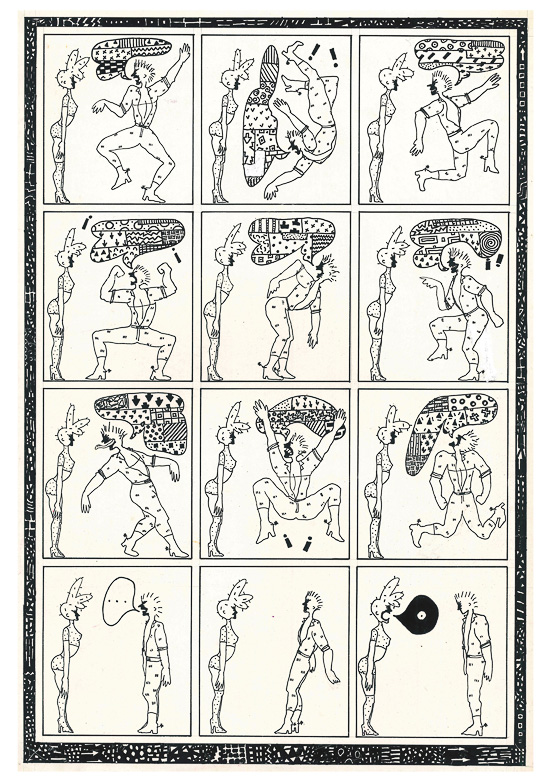
Paula Socolovsky (Argentina), excerpt from the comic Las vengadoras de Alicia (Alicia’s Avengers), c. 1988.
The image is part of a series made in response to the femicide of Uruguayan Alicia Muñiz, who was killed by Argentinian boxing champion Carlos Monzón, and the impact her death had on the artist.
Part 3 Con Mis Hijos No Te Metas
Con Mis Hijos No Te Metas (‘Don’t Mess with My Children’) is an ultraconservative campaign that rapidly spread across Latin America starting in 2016. Because no single organisation controlled the label, groups across the region could organise under the name Don’t Mess with My Children. The campaign operates as a decentralised network, organising marches and sit-ins, maintaining alliances and an active lobby with right-wing actors in parliaments and state institutions, engaging the news media, and building a significant presence on social media.
From early on, Don’t Mess with My Children brought together a wide range of groups led by evangelical and Catholic churches and conservative organisations. These groups oppose secular and science-based education about sexual and reproductive rights in schools; women’s sovereignty over their bodies, including the right to abortion; and the rights of sexually and gender-diverse people, especially same-sex marriage. They also blame ‘cultural Marxism’ for any advances in these rights and demonise communism. Don’t Mess with My Children thus encompasses far more than what its champions describe as parents’ right to educate their children.
The slogan #ConMisHijosNoTeMetas (#Don’tMesswithMyChildren) first appeared in Colombia in August 2016 during a wave of protests in several cities against sex-education booklets that included a gender-equality perspective, which the Constitutional Court of Colombia framed as part of a non-discriminatory education that respects students’ identity and sexual orientation.31 These protests, in turn, were inspired by demonstrations in Mexico months earlier against marriage equality.
The campaign as such emerged in November 2016 in Lima, Peru, in response to education reforms introduced by President Pedro Pablo Kuczynski’s administration, which had incorporated gender equality and gender identity into school curricula.32 Amplified by secular and religious right-wing political figures alike, the slogan gained traction on social media and went viral. It first reached Ecuador and soon spread to at least a dozen countries in the region.33
The Don’t Mess with My Children campaign argues that public policies that promote gender equality and comprehensive sex education ‘indoctrinate’ children into gender ideology. In their view, this ideology denies the biological differences between men and women and corrupts childhood innocence, allegedly by turning children into homosexuals or transgender people, categories these groups frame as ‘abnormalities’ or ‘aberrations’. Supported by misinformation, fake news, and alarmist rhetoric circulated above all on social media, this narrative resonated deeply among traditional and religious sectors. Its claims rest on biological determinism, which naturalises sexual difference and pathologises sexual and gender diversity as ‘unnatural’.34 The campaign also rejects the secularisation of the state and demands that it not intervene in the regulation of domestic life and education. In the latter sphere, it promotes privatisation, public disinvestment in education infrastructure, and the reification of the home as the privileged site of education.
Transnational Character
Don’t Mess with My Children has operated transnationally from the outset, with multiple networks across the region. In 2016, amid conservative mobilisations against marriage equality, right-wing NGOs convened in Mexico City to create the Frente Latinoamericano por el Derecho a la Vida y a la Familia (Latin American Coalition for the Right to Life and the Family), which focuses on rejecting gender ideology.35 Organisations and political figures from Colombia, Mexico, El Salvador, Peru, and Brazil participated, including the Colombian member of parliament Ángela Hernández of the right-wing Partido de la Unión por la Gente (People’s Union Party), an ally of former President Álvaro Uribe. Hernández helped organise the first march in Colombia where the Don’t Mess with My Children slogan appeared and later travelled to Peru to help launch the campaign there.36
In 2017, pastors Aarón Lara and Gilberto Rocha Margaín, of Mexico’s Iniciativa Ciudadana por la Vida y la Familia (Citizen Initiative for Life and the Family), launched the Congreso Iberoamericano por la Vida y la Familia (Ibero-American Congress for Life and the Family, CIVF). Christian Rosas, a Peruvian evangelical, founder of Don’t Mess with My Children in Peru, and a lobbyist for illegal mining, served on the CIVF’s advisory committee and ran its training centre. His compatriot Milagros Aguayo, a pastor and member of Peru’s Congress from the Christian fundamentalist party Renovación Nacional (National Renovation), served as the vice president.37
The fourth CIVF, held in 2020 in Peru, aimed to turn local initiatives into a continental strategy to contest the agenda for the rights of women and sexually and gender-diverse people, combining advocacy in international bodies with efforts to build a common political and parliamentary platform, organise a youth movement, and link NGOs and Christian social assistance networks. In 2018, Ecuador hosted the first Convención Internacional por la Familia (International Convention for the Family), featuring the authors of El libro negro de la nueva izquierda (The Black Book of the New Left, 2008),38 Nicolás Márquez and Agustín Laje of Argentina, who are now key ideologues of President Javier Milei’s far-right government and its ‘cultural battle’ strategy.39
The Conservative Political Action Conference (CPAC), founded in the United States in the 1970s, is one of the main gatherings of the transnational conservative movement and regularly features figures such as Donald Trump, Steve Bannon, and Ted Cruz.40 Since 2017, CPAC has pursued a strategy of global expansion through regional branches, with chapters in countries governed by conservative and far-right forces. The first branch was established in Japan in 2019, followed by others in Brazil, Australia, and South Korea. In 2022, CPAC was held in Hungary and promoted by Viktor Orbán, the Hungarian prime minister and a leading figure of European ultranationalism alongside Santiago Abascal, the leader of the Spanish far-right party Vox.
In recent years, CPAC has also become a platform where the Latin American far right and conservative right converge, bringing together right-wing presidents, representatives of global finance, ultra-Catholic activists, and evangelical leaders. People such as Eduardo Bolsonaro (son of former President Jair Bolsonaro), Javier Milei, Chilean far-right leader José Antonio Kast, and Salvadoran President Nayib Bukele often play a prominent role. These gatherings showcase rhetoric that frames feminism and gender ideology as threats to the social order.41 During CPAC 2024, for example, Bukele argued that incorporating gender ideology into school curricula was an attack on traditional family and religious values.42
Financing
Across Latin America, funding from ultraconservative groups based in the United States and Europe has enabled local organisations linked to Don’t Mess with My Children to organise congresses, workshops, and media campaigns.
Available reporting suggests that international financiers include the Population Research Institute (PRI), which maintains a global network of ‘pro-life’ groups in eighty countries. One report states that in 2014 PRI allocated $174,000 to support ‘research and education activities’ in South America, accounting for 75% of its global funding.
The same report also points to a number of Chilean NGOs and Catholic universities with ties to international right-wing lobbies such as Alliance Defending Freedom (ADF), Political Networks for Values, the PRI, and Advocates International.43 In Chile, Don’t Mess with My Children spokespeople and the Bus de la Libertad (Freedom Bus), a touring campaign that arrived from Spain, were financed by the Spanish organisation HazteOir.org (MakeYourselfHeard.org), which coordinates the global online mobilisation platform CitizenGO.44 ADF, for its part, supports ‘pro-life’ organisations through financing, training, and legal support. In 2014, it reportedly invested around $146 million in Latin America, Europe, and Asia, including by training lawyers aligned with Christian fundamentalism.45 Christian Rosas has reported being trained by ADF.46 Programmes such as the Blackstone Legal Fellowship – a three-month scholarship for young Christian lawyers – pursue similar aims, building a pipeline of Christian fundamentalist lawyers.47
In Ecuador, there is documented evidence of local support for Don’t Mess with My Children from medium and large companies, including Corporación Favorita (retail), Tía (retail), Centro Comercial Iñaquito (retail), Junta de Beneficencia de Guayaquil (lottery), PRONACA (food), Novacero (steel), Guitarras Vogel (musical instruments), and HCJB (evangelical broadcaster).48 International support has also been documented from Sodalicio de Vida Cristiana, also present in Argentina, Chile, and Colombia, which has been undergoing dissolution since 2025.49
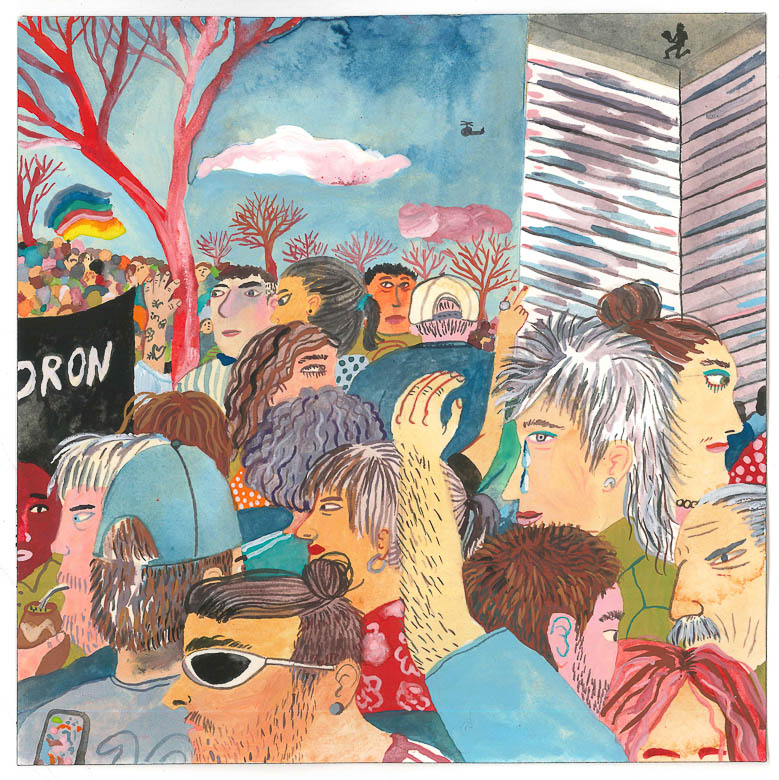
Powerpaola (Ecuador), Crying, 2022.
Part 4 Consolidating Electoral Power
The Don’t Mess with My Children campaign fed the region’s ‘third wave of neoconservative activism’ against feminist and LGBTQIA+ agendas.50 Despite the heterogeneity of these currents of ‘heteropatriarchal activism’, they share key features: they organise around political parties, increasingly align with far-right and neoliberal projects that seek to reduce the role of the state and public institutions, and are increasingly internationally coordinated.51
The fundamentalist networks organised around the Don’t Mess with My Children campaign are part of a long-standing expansion of religious and conservative influence in the Latin American public sphere. In countries such as Brazil and Peru, since the 1980s legislators linked to religious fundamentalism have promoted initiatives to restrict sexual and reproductive rights and reinforce traditional conceptions of the family. They have built a capacity to lobby and shape policy, particularly in the fields of education, health, and the legal regulation of sexuality (sex education, reproduction, and LGBTQIA+ rights), moving from the margins towards a more central role in state institutions.
Over the last decade, these neoconservative actors have not only occupied institutional spaces but also coordinated advocacy around a common, clearly identifiable, transnational agenda, with Don’t Mess with My Children serving as a vehicle for political and symbolic coordination. In this new cycle, legislative action has focused on halting or reversing advances in the right to abortion, constraining the rights of sexually and gender-diverse people, and delegitimising comprehensive sex education and state intervention in education, framed as state ‘indoctrination’ and a threat to parental authority. In Peru, Ecuador, Chile, and Argentina, the campaign has been used to contest existing laws and block new regulations through the strategic deployment of legal language and rights claims, particularly appeals to the ‘preferential right of parents’ and to the family as the moral nucleus of society. This discourse has resonated among precarious working-class sectors, for whom the family has become the principal – and sometimes the only – space of material and symbolic security amid social uncertainty. This defence of the heteropatriarchal family has even meant rejecting state policies that prevent intrafamilial violence.52
In Peru, conservative groups linked to Don’t Mess with My Children opposed a decree aimed at preventing family violence, arguing that its language of ‘democratic families’ distorted the traditional family, encouraged state interference in private life, and undermined ‘the true family’.53 In Chile in 2024, Don’t Mess with My Children spokesperson Ingrid Bohn opposed the ‘non-sexist education’ provision of Law No. 21.675 (the comprehensive law on the prevention of violence against women), which requires state-recognised schools to incorporate gender equality and the prevention of gender-based violence into their internal rules and protocols. Bohn warned of what she called the state’s ‘obsession’ with introducing sex education ‘from the most tender age’.54
In Brazil, the Movimento Escola Sem Partido (School without a Party Movement, ESP) – which emerged in 2004 and resembles Don’t Mess with My Children – began to institutionalise its agenda in 2014 and has since worked with allied legislators to introduce several bills to curb gender ideology, accusing schools and teachers of ideological indoctrination. These bills called for the monitoring of public school teachers in order to censor any explicit expression of progressive ideological, political, or religious views. The first two bills were proposed by the sons of former far-right President Jair Bolsonaro.55
Similar coercive measures have been taken in El Salvador, where Nayib Bukele’s government has intensified its campaign against gender ideology. In 2022, the government ordered the withdrawal of all materials on comprehensive sex education and the prevention of gender-based violence following conservative denunciations on social media. The censorship extended to the healthcare system: content on sexual diversity was removed and forms that recorded sexual orientation and gender identity were revised.56
In Argentina, Javier Milei’s government released a draft of the Educational Freedom Bill (Ley de Libertad Educativa) in 2025, which establishes the ‘preferential role of the family as the natural and primary agent, with the right and duty to guide the upbringing of its children’ (Art. 4) and authorises the US-style model of homeschooling.57 If passed, it would give the family and the market priority over the state in education, relegating the latter to a subsidiary role: supporting demand-side funding and promoting competition among institutions for students and resources. Rather than funding educational institutions, public funds would be redirected to families who decide where to spend them.
Another defining feature of this cycle, alongside a radicalised legislative agenda aimed at reconfiguring society around neoconservative values, is its explicit drive for electoral intervention and its incorporation into the contemporary far right’s efforts to win and consolidate power in Latin America. Conservative and religious groups linked to Don’t Mess with My Children have tended to be most effective in the electoral arena when they embed themselves in broader right-wing coalitions, adopting hybrid identities – sometimes primarily religious, sometimes explicitly anti-gender – rather than creating their own electoral vehicles and intervening independently. In turn, the growing social and ideological influence of these fundamentalist currents has infused neoliberal projects with a renewed messianic mission, now framed as moral guardianship and the restoration of authority – including through the patriarchal family.
The case of Jair Bolsonaro illustrates this dynamic. His embrace of culture-war issues around morality, gender, and sexuality, largely absent from his earlier political trajectory, embedded him in the evangelical imaginary and helped secure a significant share of the evangelical vote in 2018 – especially among Black working-class women.58 By contrast, in Peru, although Don’t Mess with My Children was highly visible in the streets and on social media, it failed to translate that presence into electoral strength.59 Likewise, in Argentina, a coalition led by Don’t Mess with My Children failed to make inroads in the 2019 elections.60
Since 2018, dynamics similar to those seen in Brazil have emerged in Argentina, Chile, Ecuador, Peru, and El Salvador, though with uneven results. In these countries, networks linked with Don’t Mess with My Children negotiate electoral support, secure spots on legislative slates, influence government programmes, and participate in official events. In Peru, some Don’t Mess with My Children leaders back presidential candidates in exchange for spots on parties’ parliamentary candidate lists.61
In Argentina, although religious fundamentalists lacked a unified strategy in the 2023 presidential elections, Javier Milei’s victory was bolstered by the support of evangelical pastors – including coordinated preaching drives in working-class neighbourhoods – and by his adoption of a messianic narrative common in fundamentalist circles. Milei’s libertarian government came to power with a homophobic discourse and a denialist stance on human rights and social inequality. Upon taking office, he eliminated the Ministerio de las Mujeres, Géneros y Diversidad (Ministry of Women, Genders, and Diversity) and the Instituto Nacional contra la Discriminación, la Xenofobia y el Racismo (National Institute against Discrimination, Xenophobia, and Racism), and he downgraded and defunded institutions devoted to promoting human rights, gender equality, and support for people with disabilities. In the 2025 elections, fundamentalist evangelical forces expanded their parliamentary representation, mostly under Milei’s party, La Libertad Avanza (Freedom Advances). After the elections, the government advanced its fundamentalist libertarian project of neoliberal education reform.
Something similar happened in Chile’s 2025 presidential election as right-wing candidates ran on conservative platforms with anti-gender agendas. José Antonio Kast, elected president in December 2025, campaigned on a programme that cast the family as society’s fundamental unit and affirmed parents’ ‘preferential right’ to choose regarding their children’s education and school.62 He has also proposed closing the Ministerio de la Mujer y la Equidad de Género (Ministry of Women and Gender Equity). Johannes Kaiser, the other ultraconservative candidate, devoted a section of his campaign – dubbed ‘Cultural Battle’ – to combating gender ideology.63 Evelyn Matthei, the only woman right-wing candidate, offered a less radical campaign centred on returning the choice of educational models to families ‘according to their values’ and casting the family as a ‘nucleus of social cohesion’.64
Neoconservative activism has managed to shape right-wing politics in countries across the region and, in some cases, has even influenced progressive forces. For this reason, Don’t Mess with My Children cannot be understood solely as a cultural or moral campaign but as a nodal point in a wider political process that extends beyond electoral politics. It seeks to contest hegemony, redefine the role of the state – especially in education and gender policy – and forge alliances between religious fundamentalist currents and the far right in the region. Its capacity to adapt to different national contexts, its insertion into institutions, and its growing electoral prominence signal a conservative offensive that is no longer limited to resisting progressive change but which aims to dominate and structurally reorder the Latin American political field.
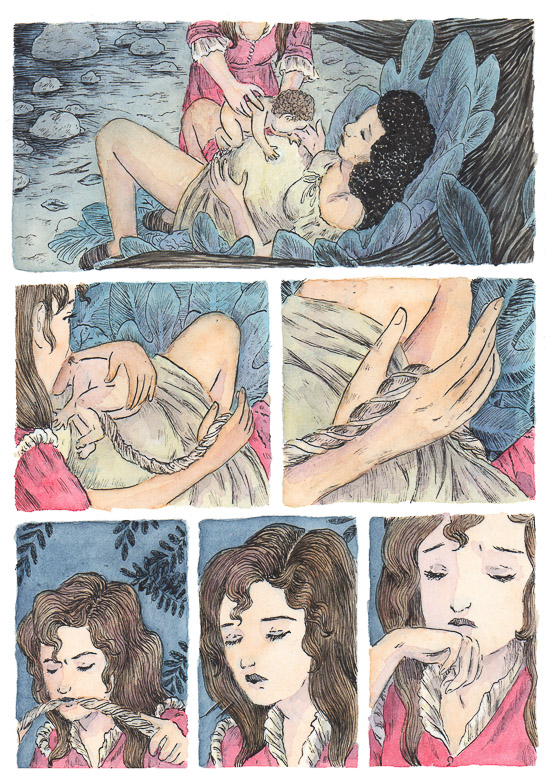
Maelitha (Argentina), excerpt from the comic Mi cuerpo, un bosque (My Body, a Forest), 2019, Barro Editora.
In this work, the author explores themes such as choosing to become pregnant, deciding to give birth, mothering, and the collective socialisation of care work.
Conclusion
The contemporary resurgence of conservative forces and the far right cannot be understood solely as an electoral shift but also as a profound reconfiguration of disputes over the social order. Their offensive against women, sexually and gender-diverse people, and feminist currents is a strategic instrument for restoring the gender, racial, and class hierarchies that underpin their project of a hyper-authoritarian reorganisation of capitalism. Far from a set of ‘cultural’ positions, the anti-gender crusade operates as a mass political technology capable of articulating social frustrations, economic discontent, and identity anxieties produced by decades of neoliberalism. In this sense, the anti-gender agenda serves as the ideological cement of new radicalised right-wing formations, fabricating internal enemies, delegitimising democratising gains, and eroding the institutional foundations of equality.
After a decade of economic stagnation in Latin America, the neoliberal project has been relaunched alongside resurgent conservative forces, shifting responsibility for its own failures onto feminist currents and sex-gender dissidents who are portrayed as internationally mobilised ‘anti-system’ actors adept at interpellating new generations. This renewed complicity between capitalism in crisis and patriarchy is backed by the efforts of transnational organisations and marked by the protagonism of religious fundamentalisms, which share the objective of reclaiming conservative morality and the family as their terrain. The joint efforts of transnational organisations in league with religious fundamentalist groups have fuelled social polarisation – especially through social media – that hinders the expansion of rights and uses fear and misinformation as tools of mobilisation. In this way, they join transnational actors in a battle of ideas that not only contests cultural and religious terrain but also shapes political dynamics on a continental scale against gender equality and the rights of sexually and gender-diverse people.
The political impact of the anti-gender rights agenda manifests in its capacity to shape legislative debates and electoral processes and to drive institutional setbacks. These forces have managed to halt or slow legislation that protects sex education, the right to abortion, and gender quotas. They have also hampered or blocked inclusive educational policies and obstructed the expansion of sexual and reproductive rights, contributed to the dismantling or defunding of institutions dedicated to women’s rights and gender equality, and influenced presidential elections in Brazil, Argentina, Ecuador and Costa Rica.
However, the expansion of these right-wing forces does not happen on neutral terrain but within a society that has been reshaped by a cycle of feminist mobilisation that developed political imaginaries through street protests, popularised new rights-based demands, and forged a radical critique of structural violence. The conservative reaction therefore also expresses the tacit recognition of the political potency of these movements. The attacks aimed at defunding equality policies, criminalising identities, and disarticulating community networks seek precisely to dismantle the social infrastructures of the reproduction of life that feminist currents have made visible and strengthened.
Thus, the current dispute goes beyond policy and institutions: it is about the very definition of the civilisational project. While the far right pushes an authoritarian restoration that recentres the heterosexual family, gender subordination, the destruction of the welfare state, and an exclusionary productive order, Global South feminist currents – with their emphasis on social reproduction, material justice, and collective autonomy – propose a reorganisation of society centred on life itself rather than capitalist accumulation. The outcome of this confrontation is not predetermined, but it will shape the ability of the majority to imagine and build emancipatory futures in the face of the multiple crises we currently face.
The case of Don’t Mess with My Children in Latin America reveals how control over education, the family, sexuality, and women’s bodies is instrumental to the economic model of hyper-imperialism, which requires individualism, competition, and the naturalisation of hierarchies. This pattern transcends Latin America and requires further study across the Global South. How do these networks operate in Africa, where anti-LGBTQIA+ laws advance alongside extractivist projects? How are they replicated in Asia, where setbacks in reproductive rights intersect with labour precarisation and territorial dispossession? What strategies are deployed by Global South youth growing up amid unfulfilled promises and climate crisis? Mapping these intersections is fundamental: the battle for the rights of women and sex-gender dissidents is inseparable from anti-imperialist, anti-capitalist, and anti-colonial struggles. This dossier invites deeper global connections: it calls for an investigation into how contemporary capitalism insists on these moral crusades across different geographies and for the forging of collective responses from popular movements in defence of dignity, autonomy, and the right to live a full life.
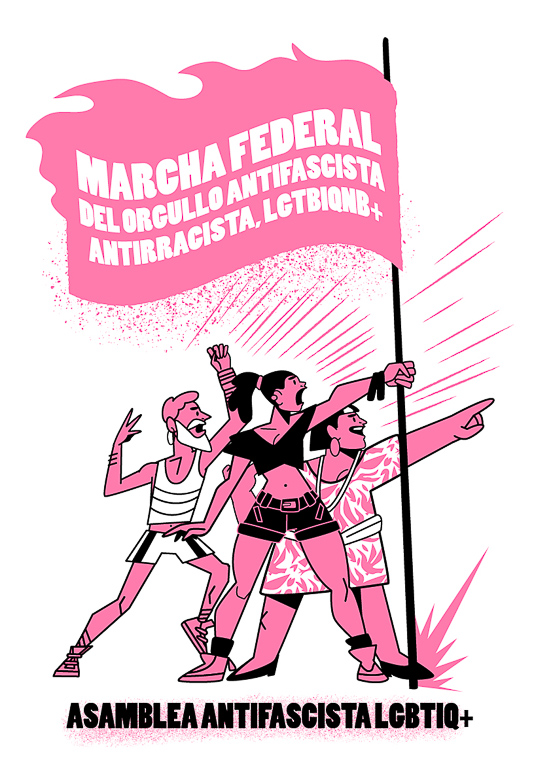
Patricio Oliver (Argentina), poster for the Marcha Federal del Orgullo Antifascista, Antirracista, LGTBIQA+ (Federal March for Antifascist, Antiracist, LGBTQIA+ Pride), 2025.
Notes
1 Translator’s note: The Spanish text alternates between ‘diversidades’ (diversities), ‘diversidades sexo genéricas’ (sex-gender diversities), and ‘disidencias sexo genéricas’ (sex-gender dissidencies’). In Latin American Spanish, ‘diversidades’ is frequently used as shorthand for sexual and gender diversity and, by extension, for people who are sexually and gender diverse. To reflect this usage and maintain fidelity to the authors’ framing, we translate ‘diversidades’ and ‘diversidades sexo genéricas’ as ‘sexually and gender-diverse people’. also used in public health and human rights settings in English, avoids introducing a ‘minority’ framing that is not necessarily present in the source). Where the Spanish uses ‘disidencias’, we render it as ‘sex-gender dissidents’ to preserve the authors’ emphasis on political dissent rather than identity categories.
2Corrêa, ‘A “política do gênero”’.
3Anzorena, Mujeres en la trama del estado.
4Safa, ‘Mudanças nos papéis de gênero na América Latina e no Caribe’.
5 Women devote 12%–24% of their time to unpaid care work, compared with 3%–12% for men. See CEPAL, La Agenda 2030 para el Desarrollo Sostenible y la Agenda Regional de Género en América Latina y el Caribe: indicadores de género a 2024 [The 2030 Agenda for Sustainable Development and the Regional Gender Agenda in Latin America and the Caribbean: Gender Indicators as of 2024], (Santiago: Comisión Económica para América Latina y el Caribe, 2024), https://oig.cepal.org/es/documentos/la-agenda-2030-desarrollo-sostenible-la-agenda-regional-genero-america-latina-caribe-0. In Latin America and the Caribbean, unpaid care work is valued at 15.9%–25.3% of GDP, around 75% of which corresponds to women. See Julio Bango and Patricia Cosani, with the collaboration of Viviana Piñeiro, Rumo à construção de sistemas integrais de cuidados na América Latina e no Caribe: elementos para sua implementação [Towards the Construction of Comprehensive Care Systems in Latin America and the Caribbean: Elements for Their Implementation], (Santiago: Comisión Económica para América Latina y el Caribe and UN Women, November 2021) https://lac.unwomen.org/sites/default/files/2023-01/rumo_construcao_sistemas_integrais_cuidados.pdf.
6Fraser, ‘A crise do cuidado vista a fundo’.
7Vogel, Marxismo e a opressão às mulheres; Federici, O ponto zero da revolução.
8 In Latin America, although women’s educational attainment is similar to or higher than men’s, women’s labour force participation (51.6%) remains far below men’s (76.9%). See ‘CEPALSTAT, Población de 20 a 24 años con secundaria completa por sexo y área’ [Population Aged 20–24 with Complete Secondary Education, by Sex and Area], Portal de datos y publicaciones estadísticas [Statistical Databases and Publications], (Santiago: Comisión Económica para América Latina y el Caribe, n.d.), https://statistics.cepal.org/portal/cepalstat/dashboard.html?indicator_id=2119&area_id=2548&lang=es, and CEPAL, La Agenda 2030 para el Desarrollo Sostenible y la Agenda Regional de Género en América Latina y el Caribe: indicadores de género a 2024, 10.
9Safa, ‘Mudanças nos papéis de gênero na América Latina e no Caribe’.
10CEPAL, La Agenda 2030 para el Desarrollo Sostenible y la Agenda Regional de Género.
11Biroli, Família: Novos Conceitos.
12Bascuas and Barón, ‘Nexos entre demandas, definiciones y financiamiento’.
13Andújar, Mujeres piqueteras.
14Fraser, ‘A crise do cuidado vista a fundo’; Hirata and Kergoat, ‘Novas configurações da divisão sexual do trabalho’.
15Ouviña and Thwaites Rey, ‘El ciclo de impugnación al neoliberalismo en América Latina; Ouviña, ‘Estado, impugnación neoliberal y revueltas populares en América Latina’; Gago, La potencia feminista. O el deseo de cambiarlo todo.
16 Due to discrimination, there is little aggregated, comparable regional data on sexually and gender-diverse populations. However, Latin America and the Caribbean accounted for 73% of reported murders of trans people worldwide in 2024, 93% of them against racialised people. In the same year, for the seventeenth consecutive year, Brazil topped the country rankings, with 30% of reported cases. See Trans Murder Monitoring, ‘Trans Murder Monitoring 2024’, (Berlin: Transgender Europe, n.d.), https://www.tgeu.org/trans-murder-monitoring/.
17CEPAL, La Agenda 2030 para el Desarrollo Sostenible y la Agenda Regional de Género.
18The Spanish term travesti is retained as a loanword. In Latin American contexts, travesti is a specific, often reclaimed identity category and political subject position that is not fully interchangeable with ‘transgender’ and should not be confused with ‘transvestite’ in English.
19Katz, América Latina na encruzilhada global.
20Bracke and Paternotte, ¡Habemus género!
21Corrêa, ‘A “política do gênero”’.
22Tricontinental, Fundamentalismo e imperialismo en América Latina.
23 For example, Loren Cunningham and Bill Bright’s ‘Seven Mountains Doctrine’ calls for establishing the ‘Kingdom of God’ on Earth by occupying and hegemonising the ‘seven mountains of society’: 1) family, 2) church, 3) education, 4) media and communication, 5) arts and sport, 6) economy and science, and 7) government. See Loren Cunningham, ‘Transcript of Interview of Loren Cunningham on Original 7 Mountains Vision’, 19 November 2007, https://archive.is/e9zT6, and Tricontinental: Institute for Social Research, Fundamentalismo e imperialismo en América Latina: Acciones y Resistencias [Fundamentalism and Imperialism in Latin America: Actions and Resistance], dossier no. 59, December 2022, https://thetricontinental.org/es/dossier-59-fundamentalismo-religioso-e-imperialismo-latinoamerica/.
24Motta and Amat y León, ‘Perú: ‘Ideología de género’; our translation.
25Bermúdez, ‘El Salvador: Religión e Identidad Política’; Barrera Rivera, ‘Apuntes del surgimiento del fundamentalismo religioso en Centroamérica’; Tricontinental, Fundamentalismo e imperialismo en América Latina.
26Tricontinental, ‘Ten Theses on the Far Right of a Special Type.
27Cunha, A explosão gospel; Tricontinental, Fundamentalismo e imperialismo en América Latina.
28Cunha, A explosão gospel.
29 Between 1995 and 2023, Latin America underwent a major religious shift: the number of people who identify as Catholic fell from 80% to 54%, while those who identify as evangelical rose from 6% to 23%, and those with no religious identification went from 4% to 19%. See Latinobarómetro, Informe 2024 [2024 Report], (Santiago: Corporación Latinobarómetro, 2024), https://www.latinobarometro.org/latinobarometro-2024.
30 For example, a study in Brazil found that 49% of evangelicals surveyed reported receiving false content, and 77.6% said it circulated in WhatsApp groups linked to their faith community. See Cunha, Magali do Nascimento, ‘Para além de uma estratégia eleitoral: as fake news na pauta dos poderes da República – Parte 1: O fenômeno da desinformação – uma introdução’ [Beyond an Electoral Strategy: Fake News on the Agenda of the Branches of Government – Part 1: The Phenomenon of Disinformation – An Introduction], Religião e Poder, 3 December 2021, https://religiaoepoder.org.br/artigo/para-alem-de-uma-estrategia-eleitoral-as-fake-news-na-pauta-dos-poderes-da-republica/.
31Martínez Osorio, ‘¡Con mis hijos no te metas: no a la ideología de género!’.
32Castro, ‘La alianza internacional de conservadores’.
33Pina, ‘Do México ao Uruguai, campanha contra “ideologia de gênero”’.
34Motta and Amat y León, ‘Perú: ‘Ideología de género’,100; 119–120.
35Semana, ‘Proponen frente latinoamericano contra la ideología de género’; López Pacheco and Jairo Antonio, ‘La (re)irrupción del discurso de la “ideología de género”’.
36Martínez Osorio, ‘¡Con mis hijos no te metas: no a la ideología de género!’; Castro, ‘La alianza internacional de conservadores’.
37Sarmiento, ‘El profeta de los mineros’; Castro, ‘La alianza internacional de conservadores’.
38 A polemical book by Argentine writers Nicolás Márquez and Agustín Laje that portrays ‘gender ideology’ as a project of cultural subversion (‘cultural Marxism’).
39Viteri, Políticas antigénero en América Latina.
40Parker, CPAC: The origins and the role of the conference in the expansion and consolidation of the conservative movement, 1974–1980.
41Abbott, ‘The Other Americans’.
42Revelo-Imery, El gobierno salvadoreño intensifica su lucha contra la ideología de género; UOL Notícias, Cruzada de Bukele contra ideología de género.
43Ramírez, ‘Radiografía a la red que impulsa la arremetida política de los evangélicos en Chile’.
44Datta, Tip of the Iceberg; Barrios, ‘CitizenGo: Cuál es el rol de la ONG del “Bus de la Libertad”’.
45Loza and López, ‘Rights at Risk in Latin America’, 55–74; Morán Faúndes and Peñas Defago, ‘Rights at Risk’, 241–270.
46Castro, ‘La alianza internacional de conservadores’.
47Sohr, Martinetti, and Fernández (Chequeado – Argentina); Chitiva and Arbélaez (La Silla Vacía – Colombia); Diniz (Lupa – Brasil); Longo and Quintela (Ocote – Guatemala) and Díaz (OjoPúblico – Perú), ‘Como grupos internacionais se articulam para disseminar desinformação sobre gênero na América Latina’.
48Burneo Salazar, ‘Ecuador: La fabricación de la “ideología de género”’; Viteri, Políticas antigénero en América Latina: Ecuador.
49Maher, Fundamentalismos religiosos, derechos y democracia; Ponce Ycaza and León Cabrera, ‘Una decena de acusaciones de abuso sexual en una iglesia católica de Guayaquil’.
50Morán Faúndes and Peñas Defago, ‘Una mirada regional de las articulaciones neoconservadoras’, 241–270.
51Biroli, Família: Novos Conceitos; Kalil, ‘Políticas antiderechos en Brasil’, 35–53.
52Teixeira, A Mulher Universal; Pochmann, O neocolonialismo à espreita.
53Araujo, ‘Não se meta com meus filhos’.
54León, ‘Defensoría de la Niñez defiende educación no sexista ante el TC’.
55Garcia and Dias, ‘O movimento Escola sem Partido’.
56Revelo-Imery, El gobierno salvadoreño intensifica su lucha contra la ideología de género; Agence France-Presse, ‘Organizações LGBTQIA+ exigem lei de identidade de gênero em El Salvador’.
57Government of Argentina, Ley de Libertad Educativa.
58Balloussier, ‘Cara típica do evangélico brasileiro é feminina e negra’.
59Cunha, A explosão gospel.
60In Argentina in 2019, evangelical and Catholic sectors, secular ‘pro-life’ organisations, anti-democratic former military personnel, and other ultraconservative forces formed the Frente NOS (Us Coalition) to contest national and provincial elections. It presented itself as an alternative centred on opposing abortion and defending the traditional family against gender ideology See Verónika Ferrucci, ‘Un pastor evangélico – y sus banderas antiderechos – en la legislatura cordobesa’ [An Evangelical Pastor – and His Anti-Rights Banners – in the Córdoba Legislature], La Tinta, 2 March 2021, https://latinta.com.ar/2021/03/02/pastor-evangelico-antiderechos-legislatura/. After a poor electoral performance – 1.71% of the vote – and subsequent legal troubles and internal disputes, it dissolved in 2023. See National Judiciary (Argentina), ‘Oficio Electrónico Judicial’ [Judicial Electronic Order] (DEO no. 9642363), file CNE 3116/2020: ‘Alianza Frente NOS Orden Nacional y otro c/ NOS – Distrito CABA y otros s/ fórmula petición – oposición al uso del nombre “NOS”’ [NOS Coalition National Level and another v. NOS – CABA District and others, petition formula – opposition to the use of the name ‘NOS’], 10 May 2023, https://drive.google.com/file/d/1sMA5QDRlpda5taVHuNFpWXV2JFCqEHLL/view.
61Motta and Amat y León, ‘Perú: ‘Ideología de género’, 112.
62Kast, ‘La fuerza del cambio’.
63Kaiser, ‘Programa de Gobierno 2026–2030 Defiende la verdad’, 14.
64Matthei, ‘Bases programáticas de la candidatura presidencial de Evelyn Matthei’, 10.
Bibliography
Abbott, Jeff, ‘The Other Americans: CPAC Comes to Latin America’, The Progressive Magazine, 23 November 2022, https://progressive.org/latest/other-americans-cpac-comes-to-latin-america-abbott-231122/.
Agence France-Presse, ‘Organizações LGBTQIA+ exigem lei de identidade de gênero em El Salvador’ [LGBTQIA+ Organisations Demand a Gender Identity Law in El Salvador], 17 May 2024, https://noticias.uol.com.br/ultimas-noticias/afp/2024/05/17/organizacoes-lgbtqia-exigem-lei-de-identidade-de-genero-em-el-salvador.htm?cmpid=copiaecola.
Andújar, Andrea, Mujeres piqueteras: la repolitización de los espacios de resistencia en la Argentina (1996–2001) [Piquetera Women: The Repoliticisation of Spaces of Resistance in Argentina, 1996–2001], CLACSO, 2005, https://bibliotecavirtual.clacso.org.ar/ar/libros/becas/semi/2005/poder/andujar.pdf.
Angélica Motta and Oscar Amat y León, ‘Perú: ‘Ideología de género’: fundamentalismos y retóricas de miedo’ [Peru: ‘Gender Ideology’: Fundamentalisms and Rhetorics of Fear], in Ana González Vélez, Laura Castro, Cristina Burneo Salazar, Angélica Motta and Oscar Amat y León, Develando la retórica del miedo de los fundamentalismos. La Campaña ‘Con Mis Hijos No Te Metas’ en Colombia, Ecuador y Perú [Unveiling Fundamentalist Rhetorics of Fear: The ‘Con Mis Hijos No Te Metas’ Campaign in Colombia, Ecuador, and Peru], (Lima: Centro de la Mujer Peruana Flora Tristán, 2018), https://www.mujeresdelsur-afm.org/wp-content/uploads/2018/12/Develando-la-Ret%C3%B3rica-del-Miedo-de-los-Fundamentalismos.pdf.
Anzorena, Claudia, Mujeres en la trama del estado. Una lectura feminista de las políticas públicas [Women in the Web of the State: A Feminist Reading of Public Policies], (Mendoza: EDIUNC, 2013).
Araujo, Viviane, ‘Não se meta com meus filhos: gênero, família e discurso conservador na crise democrática latino-americana’ [Don’t Mess with My Children: Gender, Family, and Conservative Discourse in the Latin American Democratic Crisis], Revista Transversos, Universidade Estadual do Rio de Janeiro, 2020, https://www.e-publicacoes.uerj.br/transversos/article/view/50331/33221.
Balloussier, Anna Virginia, ‘Cara típica do evangélico brasileiro é feminina e negra, aponta Datafolha’ [The Typical Face of the Brazilian Evangelical Is Female and Black, Datafolha Finds], Folha de São Paulo, 13 January 2020, https://www1.folha.uol.com.br/poder/2020/01/cara-tipica-do-evangelico-brasileiro-e-feminina-e-negra-aponta-datafolha.shtml.
Barrera Rivera, Dan Abner, ‘Apuntes del surgimiento del fundamentalismo religioso en Centroamérica y su relación con los derechos humanos’ [Notes on the Emergence of Religious Fundamentalism in Central America and Its Relationship to Human Rights], Revista Latinoamericana de Derechos Humanos, San José, v. 35u, n. 1, 19–33, 2024, https://www.revistas.una.ac.cr/index.php/derechoshumanos/article/view/19256.
Barrios, Alondra, ‘CitizenGo: Cuál es el rol de la ONG del “Bus de la Libertad” que ahora protestará ante la OEA’ [CitizenGo: What Role Does the ‘Bus of Freedom’ NGO Play, Now Set to Protest Outside the OAS?], EMOL, 2 June 2018, https://www.emol.com/noticias/Internacional/2018/06/02/908416/CitizenGo-Cual-es-el-rol-de-la-organizacion-responsable-del-Bus-de-la-Libertad.html.
Bermúdez, Álvaro, ‘El Salvador: Religión e Identidad Política’ [El Salvador: Religion and Political Identity], in José Luis Pérez Guadalupe y Sebastián Grundberger (eds.), Evangélicos y poder en América Latina [Evangelicals and Power in Latin America], (Lima: Konrad Adenauer Stiftung and Instituto de Estudios Social Cristianos, 2018), 283–316, https://www.kas.de/documents/269552/0/Evang%C3%A9licos+y+Poder+en+Am%C3%A9rica+Latina%2C+1era.+Edici%C3%B3n.pdf/e6c0dfac-bbe0-ca5c-8552-6ea4d4971183?version=1.0&t=1614902171236.
Biroli, Flávia, Família: Novos Conceitos [Family: New Concepts], (São Paulo: Fundação Perseu Abramo, 2014), https://redept.org/uploads/biblioteca/colecaooquesaber-05-com-capa.pdf.
Burneo Salazar, Cristina, ‘Ecuador: La fabricación de la “ideología de género”’ [Ecuador: Manufacturing ‘Gender Ideology’], in González Vélez, Ana Cristina, Laura Castro, Cristina Burneo Salazar, Angélica Motta and Oscar Amat y León, Develando la retórica del miedo de los fundamentalismos. La Campaña ‘Con Mis Hijos No Te Metas’ en Colombia, Ecuador y Perú [Unveiling Fundamentalist Rhetorics of Fear: The ‘Con Mis Hijos No Te Metas’ Campaign in Colombia, Ecuador, and Peru], (Lima: Centro de la Mujer Peruana Flora Tristán, 2018).
Castro, Jonathan, ‘La alianza internacional de conservadores’ [The International Alliance of Conservatives], Transnacionales de la Fe, 12 August 2019, https://lamalafe.lat/2019/08/14/la-alianza-internacional-de-conservadores/.
CEPAL, La Agenda 2030 para el Desarrollo Sostenible y la Agenda Regional de Género en América Latina y el Caribe: indicadores de género a 2024 [The 2030 Agenda for Sustainable Development and the Regional Gender Agenda in Latin America and the Caribbean: Gender Indicators as of 2024], (Santiago: Comisión Económica para América Latina y el Caribe, 2024), https://oig.cepal.org/es/documentos/la-agenda-2030-desarrollo-sostenible-la-agenda-regional-genero-america-latina-caribe-0.
CEPALSTAT, ‘Población de 20 a 24 años con secundaria completa por sexo y área’ [Population Aged 20–24 with Complete Secondary Education, by Sex and Area], Portal de datos y publicaciones estadísticas [Statistical Databases and Publications], (Santiago: Comisión Económica para América Latina y el Caribe, n.d.), https://statistics.cepal.org/portal/cepalstat/dashboard.html?indicator_id=2119&area_id=2548&lang=es.
Corrêa, Sonia, ‘A ʻpolítica do gêneroʼ: um comentário genealógico’ [The ‘Politics of Gender’: A Genealogical Commentary], Cadernos Pagu 53 (State University of Campinas, Centre for Gender Studies – PAGU: 2018), https://www.scielo.br/j/cpa/a/vwdzHh6pHS6ZBVskqfLrqrg/?lang=pt.
Cunha, Magali do Nascimento, A explosão gospel: um olhar das ciências humanas sobre o cenário evangélico no Brasil [The Gospel Explosion: A Human-Sciences Look at Brazil’s Evangelical Scene], (Rio de Janeiro: Mauad X, 2007).
Cunha, Magali do Nascimento, ‘Para além de uma estratégia eleitoral: as fake news na pauta dos poderes da República – Parte 1: O fenômeno da desinformação – uma introdução’ [Beyond an Electoral Strategy: Fake News on the Agenda of the Branches of Government – Part 1: The Phenomenon of Disinformation – An Introduction], Religião e Poder, 3 December 2021, https://religiaoepoder.org.br/artigo/para-alem-de-uma-estrategia-eleitoral-as-fake-news-na-pauta-dos-poderes-da-republica/.
Datta, Neil, Tip of the Iceberg. Religious Extremist Funders against Human Rights for Sexuality and Reproductive Health in Europe 2009–2018, (Brussels: European Parliamentary Forum for Sexual and Reproductive Rights, 2021), https://www.epfweb.org/sites/default/files/2021-06/Tip%20of%20the%20Iceberg%20June%202021%20Final.pdf.
Federici, Silvia, O ponto zero da revolução: trabalho doméstico, reprodução e lutas feministas [Revolution at Point Zero: Housework, Reproduction, and Feminist Struggle], (São Paulo: Elefante, 2019).
See Verónika Ferrucci, ‘Un pastor evangélico – y sus banderas antiderechos – en la legislatura cordobesa’ [An Evangelical Pastor – and His Anti-Rights Banners – in the Córdoba Legislature], La Tinta, 2 March 2021, https://latinta.com.ar/2021/03/02/pastor-evangelico-antiderechos-legislatura/.
Fraser, Nancy, ‘A crise do cuidado vista a fundo’ [A Close Look at the Care Crisis], Editora Elefante, 26 September 2023, https://editoraelefante.com.br/nancy-fraser-a-crise-do-cuidado-vista-a-fundo/.
Gago, Verónica, La potencia feminista. O el deseo de cambiarlo todo [Feminist Power: Or the Desire to Change Everything], (Madrid: Traficantes de Sueños, 2019), https://traficantes.net/sites/default/files/pdfs/TDS_map55_La%20potencia%20feminista_web.pdf.
Government of Argentina, Ley de Libertad Educativa [Educational Freedom Bill], (Buenos Aires: Gobierno de la República Argentina, n.d.), https://www.argentina.gob.ar/sites/default/files/le_de_libertad_educativa.pdf.
Helena Hirata and Danièle Kergoat, ‘Novas configurações da divisão sexual do trabalho’ [New Configurations of the Sexual Division of Labour], Cadernos de Pesquisa (Fundación Carlos Chagas), 13 December 2007, https://www.scielo.br/j/cp/a/cCztcWVvvtWGDvFqRmdsBWQ/abstract/?lang=pt.
Hernán Ouviña y Mabel Thwaites Rey, ‘El ciclo de impugnación al neoliberalismo en América Latina: auge y fractura’ [The Cycle of Challenge to Neoliberalism in Latin America: Rise and Rupture], in Estados en disputa. Auge y fractura del ciclo de impugnación al neoliberalismo en América Latina [States in Dispute: Rise and Rupture of the Cycle of Challenge to Neoliberalism in Latin America], (Buenos Aires: El Colectivo, 2019).
Jorgelina Loza and Magdalena López, ‘Representaciones y repertorios de expresiones conservadoras organizadas contra el aborto en Argentina (2018-2020)’ [Representations and Repertoires of Organised Conservative Expressions Against Abortion in Argentina, 2018–2020], in Ailynn Torres Santana (ed.), Derechos en riesgo en América Latina. 11 estudios sobre grupos neoconservadores [Rights at Risk in Latin America: 11 Studies on Neoconservative Groups], (Quito: Fundación Rosa Luxemburg / Ediciones Desde Abajo, 2020), 55–74.
José Manuel Morán Faúndes and María Angélica Peñas Defago, ‘Una mirada regional de las articulaciones neoconservadoras’ [A Regional Look at Neoconservative Networks], in Ailynn Torres Santana (ed.), Derechos en riesgo en América Latina. 11 estudios sobre grupos neoconservadores [Rights at Risk in Latin America: 11 Studies on Neoconservative Groups], (Quito: Fundación Rosa Luxemburg / Ediciones Desde Abajo, 2020), 241–270.
Julio Bango and Patricia Cosani, with the collaboration of Viviana Piñeiro, Rumo à construção de sistemas integrais de cuidados na América Latina e no Caribe: elementos para sua implementação [Towards the Construction of Comprehensive Care Systems in Latin America and the Caribbean: Elements for Their Implementation], (Santiago: Comisión Económica para América Latina y el Caribe and UN Women, November 2021) https://lac.unwomen.org/sites/default/files/2023-01/rumo_construcao_sistemas_integrais_cuidados.pdf.
Kaiser, Johannes, ‘Programa de Gobierno 2026–2030 Defiende la verdad. Johannes Kaiser. Partido Nacional Libertario’ [Government Programme 2026 – 2030: Defend the Truth. Johannes Kaiser. National Libertarian Party], 2025, https://johanneskaiser.cl/2025/08/22/kaiser-se-la-juega-un-programa-que-incomoda-a-la-izquierda-y-a-la-derecha/.
Kalil, Isabela, ‘Políticas antiderechos en Brasil: neoliberalismo y neoconservadurismo en el gobierno de Bolsonaro’ [Anti-rights Policies in Brazil: Neoliberalism and Neoconservatism in the Bolsonaro Government], in Ailynn Torres Santana (ed.), Derechos en riesgo en América Latina. 11 estudios sobre grupos neoconservadores [Rights at Risk in Latin America: 11 Studies on Neoconservative Groups], (Quito, Ediciones desde Abajo, 2020), 35–53. https://sxpolitics.org/wp-content/uploads/sites/3/2020/12/DerechosenRiesgoenAmericaLatina.pdf.
Kast, José Antonio, ‘La fuerza del cambio. Bases programáticas de la candidatura de José Antonio Kast para Chile’ [The Force of Change: Programmatic Bases of José Antonio Kast’s Candidacy for Chile], August 2025, https://kast.cl/wp-content/uploads/2025/08/Programa_Jose_Antonio_Kast_R.pdf.
Katz, Claudio, América Latina na encruzilhada global [Latin America at the Global Crossroads], (São Paulo: Expressão Popular, 2024).
Latinobarómetro, Informe 2024 [2024 Report], (Santiago: Corporación Latinobarómetro, 2024), https://www.latinobarometro.org/latinobarometro-2024.
León, Pilar, ‘Defensoría de la Niñez defiende educación no sexista ante el TC: “No restringe el derecho de los padres de educar’’’ [Children’s Ombudsman Defends Non-sexist Education Before the Constitutional Court: ‘It Does Not Restrict Parents’ Right to Educate’], DiarioUChile, 26 March 2024, https://radio.uchile.cl/2024/03/26/defensoria-de-la-ninez-defiende-educacion-no-sexista-ante-el-tc-no-restringe-el-derecho-de-los-padres-de-educar/.
López Pacheco, Jairo Antonio, ‘La (re)irrupción del discurso de la “ideología de género” en América Latina. Protestas, atención del público y respuestas gubernamentales’ [The Re-emergence of ‘Gender Ideology’ Discourse in Latin America: Protests, Public Attention, and Government Responses], Estudios Políticos (Universidad de Antioquia), no. 60, January–April 2021, 145–177.
Loren Cunningham, ‘Transcript of Interview of Loren Cunningham on Original 7 Mountains Vision’, 19 November 2007, https://archive.is/e9zT6.
Maher, Mónica A. (coord.), Fundamentalismos religiosos, derechos y democracia [Religious Fundamentalisms, Rights, and Democracy], (Quito: FLACSO Ecuador, 2019).
Maisa Bascuas and Camila Barón, ‘Nexos entre demandas, definiciones y financiamiento: un análisis comparado de las propuestas de sistemas de cuidados en Argentina, Colombia y Chile’ [Links Between Demands, Definitions, and Financing: A Comparative Analysis of Proposals for Care Systems in Argentina, Colombia, and Chile], (Ciudad Autónoma de Buenos Aires: CLACSO; Panamá: ONU MUJERES, 2025), https://biblioteca-repositorio.clacso.edu.ar/bitstream/CLACSO/253213/1/InformeONU-Nexos.pdf.
Martínez Osorio, Margarita, ‘¡Con mis hijos no te metas: no a la ideología de género!’ [Don’t Mess With My Children: No to Gender Ideology], De Justicia, 15 May 2017, https://www.dejusticia.org/con-mis-hijos-no-te-metas-no-a-la-ideologia-de-genero/.
Matthei, Evelyn, ‘Bases programáticas de la candidatura presidencial de Evelyn Matthei’ [Programmatic Bases of Evelyn Matthei’s Presidential Candidacy], 2025, https://centrocompetencia.com/wp-content/uploads/2025/09/Programa_Evelyn_Matthei_2025.pdf.
Miliandre Garcia and Jennifer Dias, ‘O movimento Escola sem Partido: entre o controle político da atividade docente e as tentativas inconstitucionais de retomada da censura’ [The Escola sem Partido Movement: Between Political Control of Teaching and Unconstitutional Attempts to Restore Censorship], Revista Brasileira de Educação, v. 29, 2024, https://doi.org/10.1590/S1413-24782024290055.
National Judiciary (Argentina), ‘Oficio Electrónico Judicial’ [Judicial Electronic Order] (DEO no. 9642363), file CNE 3116/2020: ‘Alianza Frente NOS Orden Nacional y otro c/ NOS – Distrito CABA y otros s/ fórmula petición – oposición al uso del nombre “NOS”’ [NOS Coalition National Level and another v. NOS – CABA District and others, petition formula – opposition to the use of the name ‘NOS’], 10 May 2023, https://drive.google.com/file/d/1sMA5QDRlpda5taVHuNFpWXV2JFCqEHLL/view.
Ouviña, Hernán, ‘Estado, impugnación neoliberal y revueltas populares en América Latina’ [State, Challenge to Neoliberalism, and Popular Uprisings in Latin America], in Conflicto Social. Revista del Instituto de Investigaciones Gino Germani, Facultad de Ciencias Sociales [Social Conflict: Journal of the Gino Germani Research Institute, Faculty of Social Sciences], vol. 15, no. 28, Buenos Aires, July–December 2022, 7–36.
Parker, Daniel, CPAC: The origins and the role of the conference in the expansion and consolidation of the conservative movement, 1974–1980, PhD dissertation in Political Science, University of Pennsylvania, 2015, https://repository.upenn.edu/server/api/core/bitstreams/ef9d7cd8-554f-4a62-86b9-00023e68d1bf/content.
Pina, Rute, ‘Do México ao Uruguai, campanha contra “ideologia de gênero” mobiliza conservadores’ [From Mexico to Uruguay, Campaign Against ‘Gender Ideology’ Mobilises Conservatives], Brasil do Fato, 1 December 2017, https://www.brasildefato.com.br/2017/11/29/do-mexico-ao-uruguai-campanha-contra-ideologia-de-genero-mobiliza-conservadores/.
Pochmann, Márcio, O neocolonialismo à espreita: mudanças estruturais na sociedade brasileira [Neocolonialism Lurking: Structural Changes in Brazilian Society], (São Paulo: Sesc, 2021).
Ponce Ycaza, Isabela and José María León Cabrera, ‘Una decena de acusaciones de abuso sexual en una iglesia católica de Guayaquil sigue sin resolverse’ [A Dozen Allegations of Sexual Abuse in a Catholic Church in Guayaquil Remain Unresolved], GK, 9 May 2018, https://gk.city/casos-abuso-sexual-en-iglesia-catolica-de-guayaquil-sacerdote/.
Pedro Ramírez, ‘Radiografía a la red que impulsa la arremetida política de los evangélicos en Chile’ [An X-ray of the Network Driving Evangelicals’ Political Offensive in Chile], CiperChile, 22 July 2019, https://www.ciperchile.cl/2019/07/22/radiografia-a-la-red-que-impulsa-la-arremetida-politica-de-los-evangelicos-en-chile/.
Revelo-Imery, María, El gobierno salvadoreño intensifica su lucha contra la ideología de género [The Salvadoran Government Intensifies Its Fight Against Gender Ideology], Equality Caucus, 25 March 2024, https://equalitycaucus.org/es/noticias/articulos/el-gobierno-salvadoreo-intensifica-su-lucha-contra-la-ideologa-de-gnero.
Safa, Helen I., ‘Mudanças nos papéis de gênero na América Latina e no Caribe’ [Changes in Gender Roles in Latin America and the Caribbean], Cadernos de Estudos Sociais, Salvador, v. 16, 7–30, Jan./Jun. 1992, https://periodicos.ufba.br/index.php/crh/article/view/18813/12183.
Sarah Bracke and David Paternotte, ¡Habemus género! La Iglesia Católica y ideología de género. Textos seleccionados [Habemus Gender! The Catholic Church and Gender Ideology: Selected Texts], (Rio de Janeiro: Observatorio de Sexualidad y Política, 2018), https://sxpolitics.org/spwprojects/gpal/uploads/ebook-2018-17122018.pdf.
Sarmiento, Jair, ‘El profeta de los mineros’ [The Miners’ Prophet], Wayka, 30 April 2024, https://wayka.pe/christian-rosas-asesor-de-mineros-contacto-a-congresistas-que-impulsaron-ley-a-favor-de-mineria-ilegal/.
Semana, ‘Proponen frente latinoamericano contra la ideología de género’ [They Propose a Latin American Coalition Against Gender Ideology], 13 September 2016, https://www.semana.com/nacion/articulo/frente-latinoamericano-a-favor-de-la-familia-y-contra-la-ideologia-de-genero/493623/.
Sohr, Olivia, Paula Martinetti, and Pablo Fernández (Chequeado – Argentina); María José Chitiva and Natalia Arbélaez (La Silla Vacía – Colombia); Iara Diniz (Lupa – Brasil); María José Longo and Carmen Quintela (Ocote – Guatemala) and Carla Díaz (OjoPúblico – Perú), ‘Como grupos internacionais se articulam para disseminar desinformação sobre gênero na América Latina’ [How International Groups Coordinate to Spread Gender Disinformation in Latin America], Lupa Jornalismo (UOL), 29 June 2023, https://lupa.uol.com.br/jornalismo/2023/06/29/como-grupos-internacionais-se-articulam-para-disseminar-desinformacao-sobre-genero-na-america-latina.
Teixeira, Jacqueline Moraes, A Mulher Universal: corpo gênero e a pedagogia da prosperidade [The Universal Woman: Body, Gender, and the Pedagogy of Prosperity], (Rio de Janeiro: Mar de ideias – Navegação Cultural, 2016).
Trans Murder Monitoring, ‘Trans Murder Monitoring 2024’, (Berlin: Transgender Europe, n.d.), https://www.tgeu.org/trans-murder-monitoring/.
Tricontinental: Institute for Social Research, ‘Ten Theses on the Far Right of a Special Type: The Thirty-Third Newsletter (2024)’, 15 August 2024, https://thetricontinental.org/es/newsletterissue/diez-tesis-sobre-la-extrema-derecha-de-un-tipo-especial/.
Tricontinental: Institute for Social Research, Fundamentalismo e imperialismo en América Latina: Acciones y Resistencias [Fundamentalism and Imperialism in Latin America: Actions and Resistance], dossier no. 59, December 2022, https://thetricontinental.org/es/dossier-59-fundamentalismo-religioso-e-imperialismo-latinoamerica/.
UOL Notícias, Cruzada de Bukele contra ideología de género amenaza aumentar intolerancia en El Salvador [Bukele’s Crusade Against Gender Ideology Threatens to Fuel Rising Intolerance in El Salvador], 1 March 2024, https://noticias.uol.com.br/ultimas-noticias/afp/2024/03/01/cruzada-de-bukele-contra-ideologia-de-genero-ameaca-aumentar-intolerancia-en-el-salvador.htm.
Viteri, María Amelia, Políticas antigénero en América Latina: Ecuador – La instrumentalización de la ideología de género [Anti-gender Politics in Latin America: Ecuador – The Instrumentalisation of Gender Ideology], (Rio de Janeiro: Observatorio de Sexualidad y Política, 2020), https://sxpolitics.org/spwprojects/gpal/uploads/Ebook-Ecuador-20200204.pdf.
Vogel, Lise, Marxismo e a opressão às mulheres: rumo a uma teoria unitária [Marxism and the Oppression of Women: Towards a Unitary Theory], (São Paulo: Editora Expressão Popular, 2022).
Websites and Social Media
Blackstone Legal Fellowship – https://blackstonelegalfellowship.org/what-is-blackstone/
CitizenGO – https://help.citizengo.org/article/906-about-us#second
Con Mis Hijos No Te Metas (Don’t Mess with My Children): Argentina (Facebook) – https://www.facebook.com/ConMisHijosNoTeMetasArgentinaOK; Chile – https://www.conmishijosnotemetas.cl/nosotros-nueva; Ecuador (Facebook) – https://www.facebook.com/conmishijosnotemetasec/?locale=he_IL; El Salvador (Facebook) – https://www.facebook.com/Conmishijosnotemetaselsalvadorsv
Consejo de Resistencia Fe, Vida y Familia (Facebook) – https://www.facebook.com/ConsejoFEVIDAYFAMILIA
Frente Nacional por la Familia (Facebook) – https://www.facebook.com/FrentePorLaFamiliaEC
Christian Rosas (profiles) – https://www.facebook.com/crosas89; https://christianrosas.pe/quien-soy/
An anti-gender crusade is sweeping across Latin America: the far right, religious fundamentalists, and transnational networks are mobilising to roll back feminist gains to consolidate political power. Read More