



Tricontinental: Institute for Social Research in collaboration with the UL (Uralungal Labour Contract Cooperative Society) Research Centre
The artwork in this study was produced by members of Young Socialist Artists (YSA). Since 2020, this group has brought together artists and cultural workers from across India who are embedded in social and political movements in their regions. Most of the YSA members who created the illustrations for this study are from and based in Kerala, where these cooperatives are part of the fabric of everyday life. The illustrations are based on photographs taken by the researchers who produced this text during their field visits.
Ashique Ali Thuppilikkat is the co-founder and director of the SAFAR Foundation, an action research centre based in West Bengal, India. He was active with the student movement at Delhi University and Jawaharlal Nehru University, where he researched cooperatives during his MPhil in political science. He is currently a PhD student at the University of Toronto, Canada, and a researcher at STREET Lab. His research focuses on socio-technical designs for resistance, exploring the intersection of technology and labour/social movement organising.
Aswathi Rebecca Asok is a development economist and law graduate with expertise in interdisciplinary, evidence-based, and policy-oriented research. Over the past nine years, Aswathi has conducted extensive research on Kerala’s development trajectory and explored a wide range of topics such as financial inclusion, poverty, gender, migration, labour, and decentralisation. She was a student activist at multiple universities and campuses in India.
Najeeb VR is a social scientist and research coordinator at the UL Research Centre in Kozhikode, Kerala, where he integrates transdisciplinary approaches to cooperative development, social transformation, and knowledge systems. He is also a member of the expert committee for the 14th Five-Year Plan Subgroup of the Kerala State Planning Board and actively contributes to academic outreach, curriculum development, and public scholarship. He holds a PhD in sociology from Jawaharlal Nehru University and is a recipient of the Revise PhD Fellowship of the Kerala Council for Historical Research.
Vijoo Krishnan is the general secretary of the All India Kisan Sabha (AIKS) and a polit bureau member of the Communist Party of India (Marxist). As a leader of the AIKS, he played a crucial role in the historic farmers’ agitation in Delhi in 2021–2022. Before becoming a full-time political activist, he was the head of the Department of Political Science at St. Joseph’s College, Bangalore. In 1998–1999, he was the president of the Jawaharlal Nehru University Students’ Union. Vijoo is also a photographer who captures the everyday life of the working class.
Nidheesh J Villatt is a member of the All India Kisan Sabha’s Central Kisan Committee as well as the research coordinator of the P Sundarayya Memorial Trust, a research institute that focuses on agrarian issues and movements. Nidheesh is dedicated to studying and building the worker-peasant alliance, with a focus on its political economy and philosophy. He has written about agrarian and industrial class struggles, ‘competition’ under capitalism, political ecology, and Hindutva.
Nitheesh Narayanan is a movement researcher and writer who works at Tricontinental: Institute for Social Research. He studies the history of working-class movements, including cooperatives, and was previously the vice president of the Students’ Federation of India and editor of its journal, Student Struggle. He has a PhD from Jawaharlal Nehru University. He is the author of a number of books in English and Malayalam, including The 1921 Rebellion in Malabar: A Collection of Communist Writings, edited with Vijay Prashad, and If Humanity Is A Country: Cuban Days.
Sarga TK is an assistant professor at Azim Premji University, Bhopal. Her research engages with themes of urban mobility, labour migration, and construction cooperatives, exploring how work and movement shape the urban landscape. She previously taught at Kannur University in Kerala.
Subin Dennis is an economist and a researcher at Tricontinental Institute for Social Research. He worked with the online news portal NewsClick as a correspondent before joining Tricontinental. He was active with the student movement and served as the Delhi state vice-president of the Students’ Federation of India. Subin’s writings in English and Malayalam on issues related to the economy and politics appear in various periodicals and websites. He is currently based in Kerala.
Vijay Prashad is the director of Tricontinental: Institute for Social Research. He is the author of forty books, including The Darker Nations: A People’s History of the Third World, The Poorer Nations: A Possible History of Global South, and (with Grieve Chelwa) How the International Monetary Fund Suffocates Africa. Vijay is an editor at LeftWord Books (New Delhi), Inkani Books (Johannesburg), and La Trocha (Santiago).
Introduction: Possible Communism
But there was in store a still greater victory of the political economy of labour over the political economy of property. We speak of the cooperative movement, especially of the cooperative factories raised by the unassisted efforts of a few bold ‘hands’. The value of these great social experiments cannot be overrated. By deed, instead of by argument, they have shown that production on a large scale, and in accord with the behest of modern science, may be carried on without the existence of a class of masters employing a class of hands; that to bear fruit, the means of labour need not be monopolised as a means of dominion over, and of extortion against, the labouring man himself; and that, like slave labour, like serf labour, hired labour is but a transitory and inferior form, destined to disappear before associated labour plying its toil with a willing hand, a ready mind, and a joyous heart.1
– Karl Marx, Inaugural Address of the International Working Men’s Association, 1864.
Misery greets the planet. Poverty persists for billions of the world’s people. Climate change – the product of capitalist expansionism – threatens the survival of life on Earth. Wars of grotesque proportions creep across the globe in myriad forms, including Israel’s genocide against Palestinians in Gaza, as famines driven by human behaviour plague swathes of the population. It is as if the five horsemen of the apocalypse are no longer sufficient – instead, untold horsemen ride around the planet suffocating the possibilities of human life.
All of this contributes to the sense that nothing other than this nightmare is possible, that alternatives cannot be imagined. When resilient people dare to think of a better future, as they inevitably do, those in power meet them with mockery and strive to snuff them out. It is better for the powerful and the propertied to see to it that no alternative is allowed to flourish. The survival of even one kernel of hope would call into question the claim that History has ended.
One of these kernels is the Indian state of Kerala (population of 35 million), which has a rich history of socialist construction. Ten years after India won its independence in 1947, the Communist Party of India won state elections in Kerala. Right from the start, the left government in Kerala adopted an agenda to smash ancient social hierarchies and customs, provide social goods to the public that were not readily available in the rest of India (including quality public education, health care, and transportation), and construct the basis of working-class and peasant power by defending workers’ rights to organise in unions and build cooperatives. Though the national government in Delhi unconstitutionally removed the communist state government in Kerala in 1959, the agenda set by the left remained largely in place. The left has returned to power periodically (1967–1969, 1980–1981, 1987–1991, 1996–2001, 2006–2011, and 2016–present), each time expanding the agenda of decentralisation, encouraging public action, and building the basis for social democratic state institutions.2 Even when the right came to power in the intervening years, it was not able to undermine the dynamic that had been set in motion by the left governments. It was in this context that the cooperative movement developed in Kerala.
People who are critical of the capitalist system are often as critical of the alternatives being built within the parameters of this system because they argue that such institutions are captive to capitalism’s logic. But this is a flawed assessment of cooperatives, which are – in fact – incubators of different logics of life and work that serve as beacons of inspiration and hope, offering a window into what humanity is capable of once the fetters of capitalism are transcended. Cooperatives provide schools for the working class and peasantry to learn how to build social relations based on a different economic foundation. In his third volume of Capital, Marx wrote:
The cooperative factories of the labourers themselves represent within the old form the first sprouts of the new, although they naturally reproduce, and must reproduce, everywhere in their actual organisation all the shortcomings of the prevailing system. But the antithesis between capital and labour is overcome within them, if at first only by way of making the associated labourers into their own capitalist, i.e. by enabling them to use the means of production for the employment of their own labour. They show how a new mode of production naturally grows out of an old one, when the development of the material forces of production and of the corresponding forms of social production have reached a particular stage.3
Marx’s insight here is crucial. Cooperatives are neither inherently mired in the capitalist law of value, nor are they easily able to transcend it. They are ‘sprouts’, he writes, of an alternative through which the working class can experiment with the annulment of capitalist management. Marx looked with great pride at the workers’ utopia being built in the Paris Commune of 1871, where he saw how the communards developed workers’ cooperatives and other means of building a new society amidst the jubilation of toppling the Second Empire of Louis Napoleon III (1852–1870).4 In The Civil War in France, Marx wrote that during the two months of the commune’s existence, from March to May 1871, the commune was the ‘form at last discovered’ for the future workers’ state. It was in this text that Marx wrote of the insights of cooperatives:
If cooperative production is not to remain a sham and a snare; if it is to supersede the capitalist system; if the united cooperative societies are to regulate national production upon a common plan, thus taking it under their control and putting an end to the constant anarchy and periodical convulsions which are the fatality of capitalist production – what else, gentlemen, would it be but communism, ‘possible’ communism.5
This text, The Cooperative Movement in Kerala, India, is part of a series from Tricontinental: Institute for Social Research called Studies on Socialist Construction. It is about possible communism, the possibilities in our time of a future society. An honest appraisal of a heroic venture, this study shows us that Kerala’s cooperatives have been able not only to survive in a small niche, but also to grow into substantial institutions that have become an integral part of the region’s social life. There are 16,429 registered cooperative societies in Kerala today (12,278 of which are active, 3,354 of which are dormant, and 797 of which are under liquidation).6 Cooperatives operate in a wide range of sectors, from the production and distribution of goods and services to hospitals and restaurants to agricultural production and housing construction. The largest cooperative (although not strictly registered as a cooperative), Kudumbashree, has 4.8 million members, all of whom are women. One in four women in Kerala is a member of this cooperative. There are also many cooperative-like organisations that are registered as charitable societies and trusts, such as the Brahmagiri Development Society, which focuses on agrarian development, and the Janatha Charitable Society, a major milk producer. Most of the active cooperative societies have branches in different parts of the state.
There are, of course, challenges and contradictions, and these are discussed with clarity: there is no sense in exaggerating the possibilities presented by cooperatives that must struggle to survive in a world where the capitalist law of value is the law of the land. Nor is there sense in minimising these cooperatives’ important contributions to the people who live in Kerala – both in material and spiritual terms. These cooperatives are not merely a source of inspiration: they provide a blueprint for cooperatives around the world as seeds of a just future that exist within the confines of capitalism today.
Kerala’s Cooperatives
In 1943, at the 7th Session of the All India Kisan Sabha (AIKS, the country’s largest farmers’ union) in Bhakna Kalan, Punjab, the delegates discussed a range of issues, including the building of cooperatives. In one of their resolutions, the AIKS argued that cooperatives could help the farmers fight the ‘distress and humiliation’ of capitalist and colonial agriculture and enable them to achieve ‘economic, social, and national freedom’. During the deliberations, communist leader EMS Namboodiripad (1909–1998), or EMS as he was called, wrote a note entitled ‘Organisation – Not a Machine’. In the note, EMS pointed out that the resolutions would mean nothing without militant organisation that goes beyond ‘abstract politics’. Cooperatives would need to be built by the peasantry and agricultural workers to expand the democratic revolution and build the confidence of rural workers.7
In October 1956, the Communist Party of India held a meeting in Thrissur, Kerala, that focused on cooperatives. The meeting was chaired by Professor Joseph Mundassery, who would become the first minister of education and cooperation during EMS’s tenure as the chief minister of Kerala (1957–1959), and resolved that rather than allow the cooperatives to become a ‘pocket borough’ of the feudal classes, working people themselves would build them and there would be political education about the role these cooperatives played in building democracy and socialism. The party leadership also emphasised the need for successful rural credit societies and cooperative banks controlled by communists and workers as a way of eliminating the stranglehold of the moneylenders, nourishing agricultural production, and improving the living conditions of peasants and agricultural workers. It is out of this ideological clarity that Kerala’s cooperatives emerged to become a beacon for democratic worker-led cooperatives around the world.
Brief portraits of some of Kerala’s cooperatives make up the rest of this study. These portraits are written by scholars and political leaders who have worked closely with the cooperatives to learn about them and assess them. The data in the essays has been largely accumulated from the cooperatives and from government documents. We are grateful to the UL Research Centre for assisting us with this work.
These essays reveal some important facts:
- The cooperative sector in Kerala would not have flourished without a long history of social reform that created the social basis for cooperation. When news about the Soviet Union trickled into Kerala, people involved in the social reform and anti-caste movements expressed their curiosity about its attempts to reconstruct social and economic relations. This curiosity led to studies about the cooperative movement in the Soviet Union, which were then presented in social reform and anti-caste movements’ public meetings.
- The cooperative sector developed due to the vitality of the class struggle in Kerala, where organised peasants and workers pushed the social reform movement to combine the struggles against caste, landlordism, and colonialism. It was in these struggles that the peasant movement – mainly in northern Kerala – took the initiative to start peasant cooperatives to help the most impoverished amongst them. The emergence of these cooperatives weakened the grip of landlords, who could no longer lend money at usurious rates to the indebted peasantry or continue to be their main provider of consumer goods. Instead, they watched as the peasant cooperatives lifted the confidence of the masses. The success of cooperatives led to their duplication in other parts of the region, building on the organisational habits of mass movements.
- The first communist ministry that came to power in Kerala (1957–1959) received mass support from the mass social reform movement and was bolstered both by the class struggle of previous decades and by the success of the cooperative movement. In turn, the communist government used a part of Kerala’s social wealth to finance the growth of more cooperatives across the state. The government set up coir (coconut fibre), handloom, and toddy (fermented coconut sap that is an alcoholic drink) cooperatives to enhance these sectors of the economy and improve the working conditions and wages of the workers.
- The emphasis on building cooperatives to ensure mass employment and higher wages as well as to improve the efficiency and productivity of different enterprises meant that cooperatives could compete against the private sector.
- The leadership of oppressed castes was drawn to the cooperative system and saw in them an opportunity to realise their independence and emancipation. At the December 1929 Cheramar Samajam Conference, for instance, the organisation’s president, Chaajan, told the two thousand members of the Pulaya community present there that these cooperative societies, along with education programmes and an anti-alcohol campaign, would be crucial for their struggles.8
- The role of political education within cooperatives enabled their members to understand what they were building (socialism) and how what they were building was different – and better – than what the private sector had built (capitalism).
- Without an extensive network of financial cooperatives, the entire sector would have been starved of funds. This system has also depended on the left’s periodic entry into government, which has prevented the large-scale privatisation of Kerala’s credit markets.
- The cooperatives’ democratic structure, alongside the innovation of their members, allows them to diversify their work and adapt to the changing times. When tobacco consumption habits changed, for instance, the Dinesh Beedi9 Workers’ Central Cooperative Society shifted to food production.
- A key element in Kerala’s cooperative movement is its commitment to social change, with an emphasis on using cooperative organisation to transcend patriarchy (through women’s cooperatives), caste hierarchies (through oppressed caste cooperatives), discrimination against tribal or Adivasi communities (through Scheduled Tribe10cooperatives), and discrimination against transgender communities (through transgender cooperatives) as well as to promote equality for people with disabilities.
This study shows how effective these cooperatives have been in promoting a social form of economic activity that offers a counter to the pressures of capitalism. In that regressive form of economic competition, workers’ livelihoods are the first to be dismissed, while profit is enshrined as a god. Kerala’s cooperatives invert this value system, putting the needs – and dignity – of the working class at their heart.
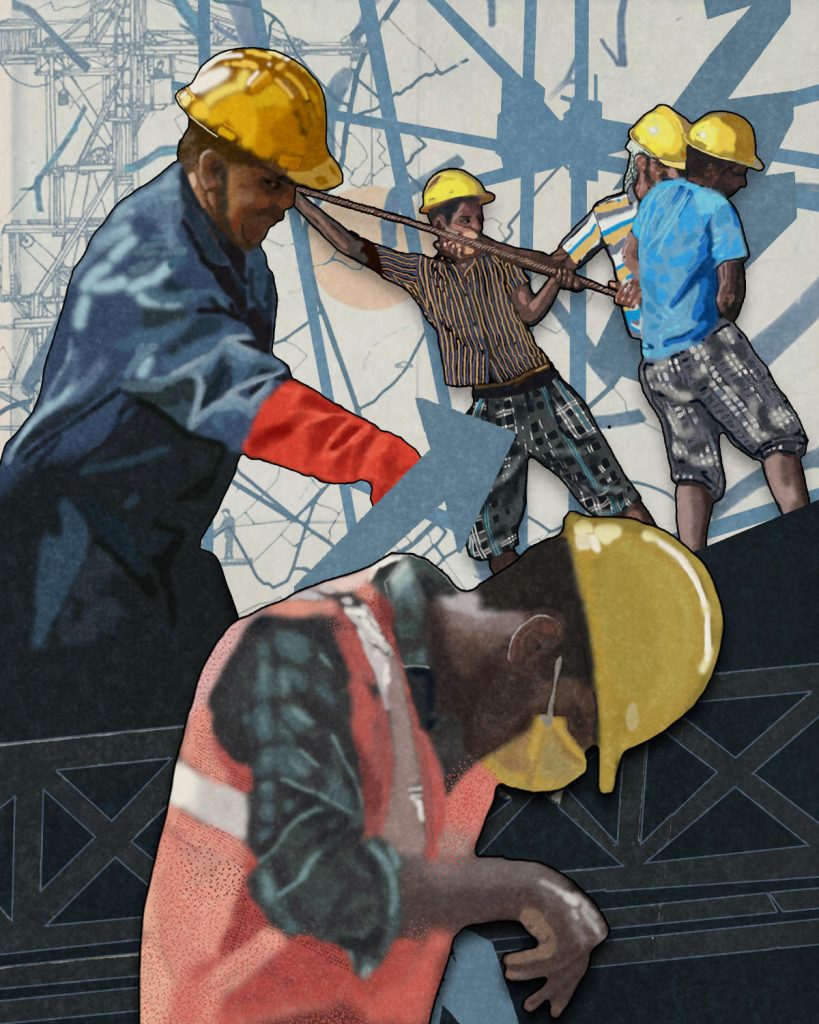
Vanshika Babbar (Young Socialist Artists), Uralungal Cooperative Workers, 2025.
Sahya Tea Cooperative
At the 35th conference of the All India Kisan Sabha (AIKS) in December 2022, every delegate received a pack of Sahya tea along with Kerala’s famous spices and other condiments. It was not until months later, during a visit to Assam to report on the decisions made at the conference, that one of the delegates took note of the brand of tea. Local delegates inquired about it, claiming that it was better than their world-renowned Assam tea. Their query led us on a quest to find out more about the brand and the collective effort that went into its emergence.
In a letter to Wilhelm Bracke on 5 May 1875, Karl Marx wrote, ‘every step of real movement is more important than a dozen programmes’.11 The story of the Sahya Tea Cooperative Factory, located in the remote area of Thankamany in the hilly district of Idukki, Kerala, shows the significance of the ‘real movement’ of socialism. Launched in 2017, the factory was established by the Thankamany Service Cooperative Bank, Ltd (founded in 1966). The Cooperative Bank has 15,000 members, most of them small peasants and workers, and operates in the Kamakshy village panchayat,12 which is mainly inhabited by small tea growers. The Thankamany Cooperative Tea Factory mostly manufactures black, green, and a variety of blended teas.
The cooperative bank and tea factory must be understood within the broader trajectory of Kerala’s communist-led cooperative movement.13 Russia’s 1917 October Revolution had a tremendous impact on Kerala’s progressive movements and helped reshape their orientation within the national movement. In 1934, the strongest sections of these movements formed the All India Congress Socialist Party. Five years later, the party’s Kerala unit went on to transform itself into the Kerala unit of the Communist Party of India, which eventually built the AIKS and a number of trade unions in the region. It was in this period and in this context that the AIKS and other progressive forces began to intervene in the cooperative movement and confront the British strategy of keeping cooperatives insulated from the intensified class struggle that was erupting in the 1930s and 1940s. For instance, as EMS documented, during the People’s War (1941–1945)14 communists pressured the imperialist British government to procure grain from landlords and distribute it through ration shops, which were subsequently converted into producer and consumer cooperative societies.15 Communists in Kerala identified building cooperatives as part of the expanding class struggle, distinct from the benevolent colonial idea of cooperatives derived from the Rochdale Principles, which have served as the primary guidelines for cooperatives since 1844.16
The dialectical relationship between building a strong working-class organisation that opposes imperialism and building cooperatives had already been established in the AIKS’s 1943 resolution on cooperatives, passed at its 7th Session. This resolution called on AIKS cadres to initiate cooperatives as a strategy to combat the economic and social subjugation of the peasantry. The insights from this resolution, particularly EMS’s note ‘Organisation – Not a Machine’, emphasised the necessity of militant class organisation to prevent cooperatives from devolving into ‘abstract politics’ and provided a crucial framework for later discussions on building cooperatives.
By the time communists and cooperative movement leaders convened in Thrissur in October 1956, the focus had shifted from the theoretical foundation laid in 1943 to the practical challenges of implementing this foundation in Kerala.17 During the meeting, participants took stock of the cooperatives’ activities in Kerala and criticised the delusions of Prime Minister Jawaharlal Nehru’s bourgeois landlord regime, which suggested that the creation of cooperatives by itself would lead to socialism. The participants made the point that communists had to be consciously involved in the organisation of cooperatives and enrol large numbers of working people into these and other mass organisations in order to ensure their political education in the process. Reference was made to the successful cooperative rural credit societies and banks, which had eliminated the stranglehold of moneylenders and nourished agricultural production, thereby increasing the income of the peasantry and agricultural workers. What distinguished these cooperatives from unsuccessful ones was the role of communists in ensuring that the cooperative form was not coopted by reactionaries who tried to maintain old forms of rural power.
The Emergence of Small Tea Growers
In the late 1990s, the tea industry underwent a sweeping restructuring driven by the profit fetish of monopoly capital, marked by mergers, acquisitions, and an aggressive focus on brand building. Vertically integrated monopolies such as Unilever and Tata – known as Big Tea – abandoned direct ties to agricultural production and divested from tea estate ownership and management. For instance, in March 2000 Tata acquired Tetley Group, the world’s second-largest tea manufacturer and distributor, for £271 million.18 Both Tata and Unilever, the world’s largest tea company, shifted to creating and marketing new branded teas – including crush, tear, and curl (CTC) as well as blended tea products – aimed at a variety of tastes and price ranges.
This transformation coincided with a financial crisis in tea estates, which grow and process tea and are largely managed by non-monopoly capital. While most estates were sold to smaller firms, the monopoly companies secured their supply through contractual clauses that guaranteed access to sufficient unprocessed tea. As Professor Natalie Langford observes, the industry shifted from ‘vertical integration’ to value chains in which ‘firms have sought to advance their competitive position through the outsourcing of lower value-adding activities’.19 In practice, Big Tea considered agricultural production and estate management the most troublesome links in the chain, as they were heavily regulated by labour and environmental law, and sought to distance themselves from these sectors to avoid class struggle. Instead, they consolidated control over higher value-added activities such as blending, packing, branding, distribution, and sales. Meanwhile, small tea growers rose as the main producers of tea leaves: their share increased from 7% in 1991 to 52% in 2022 and is projected to reach 70% by 2030.
Before the formation of the Sahya Tea Cooperative Factory, the roughly 3,500 small tea growers in the Idukki area operated under the stranglehold of a system run by monopoly firms such as Tata and AVT Beverages (a leading player in southern India). These large companies bought green leaves (freshly plucked, unprocessed tea leaves) from both the farmers and ‘agents’ (intermediaries who often act as buyers on behalf of factories, typically charging a commission on the green leaf collected from small farmers) at ‘an arbitrary rate and [under] humiliating terms and conditions’, a group of farmers told us. Many of the farmers shared stories with us about how companies turned away their green leaves when they tried to bargain for a fair price, inventing superficial excuses which forced the farmers – who had carried the leaves from far away – to dispose of them or use them as manure. Scenes of dispirited farmers returning home on their tractors with their rejected crops were commonplace. These methodically planned rejections were designed to create a docile peasantry that would be inured to selling their crops to the companies at low prices. The entire system was highly favourable to the large companies.
In the absence of successful cooperative action, trading agents generally charge small growers across India a commission of 15%–20% per kg of green leaves. A large chunk of this is sold to bought leaf tea factories, which process tea from purchased leaves rather than growing their own. Another chunk is sometimes sold to tea estate factories owned by big plantations. Trading agents evaluate the quality and price of the leaves based on their ‘fine leaf count’ (the proportion of young, tender leaves and buds, which determine the tea’s overall quality) in a very subjective way, compromising the interests of small farmers.20
Bought leaf tea factories usually sell their processed tea at auctions. Since the process is controlled by Big Tea companies (the primary buyers), the tea is sold at distorted prices.21 The entire auction mechanism in India is designed in such a way that the basic postulate of neoclassical economics – that the interaction between supply and demand determines prices – appears as a farce. On the other hand, estate factories typically sell only half of their processed tea at auctions, as mandated by the regulations outlined in the 1983 Tea Marketing Control Order (itself under the 1953 Tea Act), and sell the other half through more profitable private channels.
Auction participants consist of major tea packing companies, trading agents, and other leading packet tea brands. Since these companies then undertake value-added processes such as blending, sorting, grading, and packaging the tea before distributing it to consumers, small tea growers, who are on the lower end of the value chain, receive a disproportionately lower share of consumer spending on tea – around 15%. Tea packing companies, on the other hand, which are mostly big monopoly companies, receive 50% of consumer spending on tea. That is why it is imperative for small tea growers to climb the value chain and gain direct access to markets in order to secure better prices.22 This is exactly what the Sahya Tea Cooperative is setting out to accomplish with its brave move to enter the terrain of Big Tea.
Cooperative Tea
It was the difficult circumstances facing farmers that drove AIKS members to form the Sahya Tea Cooperative in 2017. Designed to process 15,000 kg of green leaves per day, the Sahya Tea Cooperative generates employment for more than 150 workers, most of them recruited from the agricultural working class and peasantry, while also protecting the interests of the peasants amongst the small tea growers. When we visited the cooperative factory and catchment area in September 2023, what caught our attention was the visible confidence among the small tea growers.
The first three years of the cooperative, from 2017 to 2020, were challenging: not only did it have to begin to pay back the large loan it had taken at 12% interest, but it was besieged by a number of shocks, such as the 2018 Kerala flood and the COVID-19 pandemic (2020–2023). Yet, despite the financial challenges the cooperative faced, it was able to procure green leaves and pay farmers INR 12 per kg (far higher than the corporate rate of INR 7 per kg). The cooperative’s steady prices in turn forced the corporate tea suppliers to increase the rates they pay to small tea growers.
The cooperative’s leadership convened peasants and workers to brainstorm how to improve their financial situation. Since Big Tea companies dominated the market with their packaged tea products, they decided to improve their marketing strategy and launch an effort to make inroads into the market. KS Chithra, a popular singer known as the ‘Nightingale of Kerala’, became the Sahya Tea Cooperative’s brand ambassador and helped popularise its brand, refusing to take any payment for her work. To strengthen its market presence, the cooperative also made use of Kerala’s Public Distribution System, such as Supplyco (Kerala State Civil Supplies Corporation) and Consumerfed (Kerala State Cooperative Consumers’ Federation), as well as the system that provides goods to police canteens.
The cooperative also received other forms of support from the state, such as in 2020–2021 when Kerala’s state government bought Sahya tea for the food kits distributed during the pandemic. As a result of these creative marketing mechanisms and state assistance, the cooperative turned a profit in its fourth year (2020–2021) and began to pay INR 18 per kg for green leaves and distribute the profits as incentives to the farmers who supplied the leaves. This set a historic precedent: for the first time, farmers were remunerated fairly for their contributions.
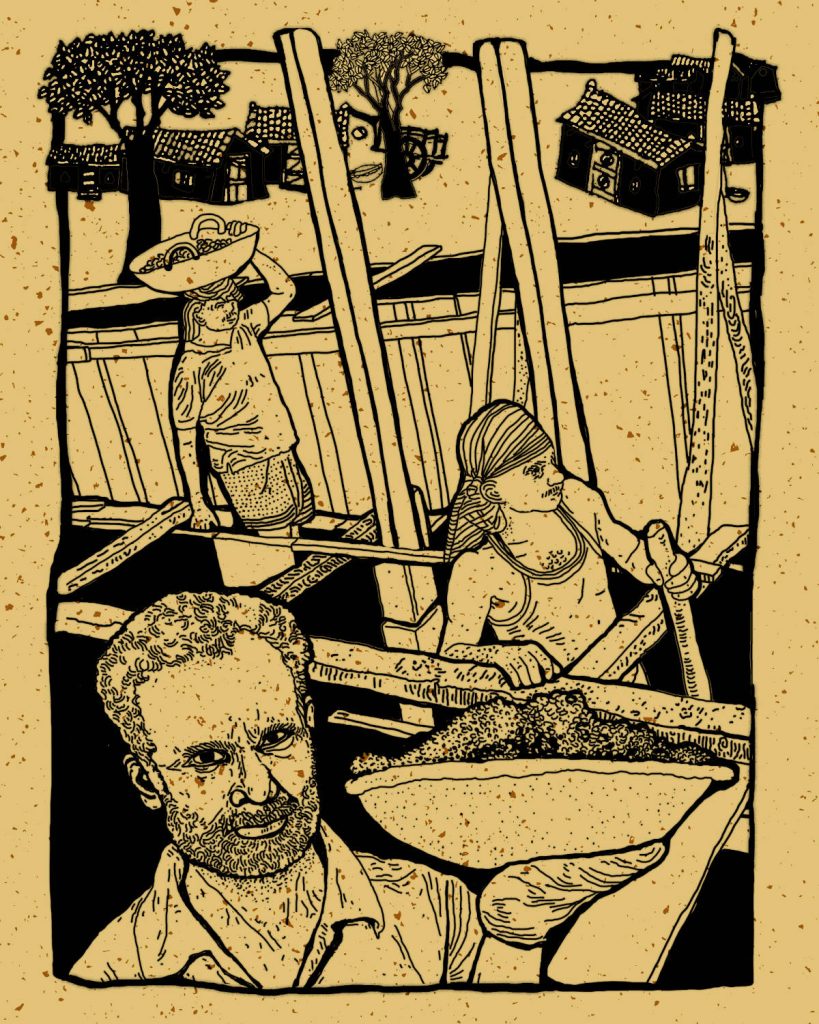
Vanshika Babbar (Young Socialist Artists), Udayapuram Cooperative Workers, 2025.
The Uralungal Labour Contract Cooperative Society
In 1925, before the communist movement was established in southwestern India, the followers of the social reformer Vayaleri Kunhikannan Gurukkal, also known as Sri Vagbhatananda Guru, (1885–1939) founded the Uralungal Labour Contract Cooperative Society (ULCCS) to provide construction workers with social protection. Today, the ULCCS is Asia’s largest workers’ cooperative, and it was ranked second in the 2021 World Cooperative Monitor list of industry and utilities cooperatives. United Nations Development Programme Resident Coordinator in India Lise Grande calls it a model cooperative whose success provides ‘great lessons for the rest of the world’.23 From its origins amongst a group of labourers, ULCCS, located in a rural part of Malabar in northern Kerala, now constructs roads and bridges, buildings, and software systems. The cooperative’s commitment to social harmony and inclusion as well as worker cooperation has allowed it to succeed in areas of social production that are often challenging for cooperatives.
The ULCCS was formed at a time when work was difficult to come by and when forms of caste and class discrimination were even more severe than they are today. In 1917, Sri Vagbhatananda Guru’s followers started the Atma Vidya Sangham school, whose members formed the United Credit Cooperative in 1922 to help each other if any of them faced financial problems due to discrimination in the credit market, which was controlled by the dominant castes. They also founded a school for their children, who had been denied education by the dominant castes in the region. Taking the advice of Vagbhatananda, they decided to form the Mutual Aid Society of Daily Wage Labourers in 1924 to circumvent the labour ban that the elite had imposed on them in an effort to curtail their struggle against caste discrimination. Then, on 13 February 1925, the workers created the Uralungal Kooli Velakkaarude Paraspara Sahaaya Sahakarana Sangham (Uralungal Labourers’ Mutual Aid and Cooperative Society, now ULCCS). Slowly, more and more workers joined the ULCCS, which now has a presence across Kerala.
During its initial years, the ULCCS was seldom able to obtain contracts, and when it did, the tender (or contract) amounts were set at a very low level. In order to compete, the ULCCS underbid private contractors, offering 27.5% less than the private bids. Though this enabled them to get some contracts, the profit margins were negligible. Inexperience with road work and other forms of large-scale construction led to problems for the ULCCS. The cooperative sustained itself by obtaining minor contracts from local governments and by receiving short-term loans from the better-off members of the cooperative. The ULCCS also received funds from microfinance systems such as payattu (money-gathering games) and kurikkalyaanam (marriage announcements)24 and used its growing prestige to provide assistance for its members’ basic needs by collecting donations from local merchants.
As time went by, ULCCS workers improved their skills and became more adept at basic business practices. The increased efficiency and quality of their work in turn attracted more lucrative contracts, and their work ethic introduced a new culture of excellence in Kerala’s construction industry. By the 1940s, they began to receive funding from the Malabar Cooperative Central Bank as well as fixed deposits by the public in ULCCS schemes.
Over the past century, the ULCCS has grown from a collective with an initial capital of INR 0.37 (USD 0.13 in 1925 dollars) to an annual revenue of INR 25 billion (USD 300 million) in 2023. It is comprised of 18,000 workers, including more than 1,000 engineers and 1,200 technicians. The cooperative not only advances the well-being of its workers and the surrounding community, fulfilling thirteen out of the seventeen United Nations Sustainable Development Goals, but also ensures that the quality of the work (including its timely completion) is balanced by reasonable costs. These factors, alongside the ULCCS’s modern construction techniques, allow it to compete against private corporations and win major contracts, such as those from the National Highway Authority of India, the Union Ministry of Road Transport and Highways, and the Government of Kerala. The ULCCS has completed over 7,500 major projects and is currently working on 500 projects worth INR 6.5 billion. Since it operates as a cooperative, the ULCCS has been able to provide better pay for its workers than they would earn in the private or even government sectors.
As part of its effort to keep pace with workers’ aspirations, the ULCCS has entered various sectors of the knowledge economy such as software development, diversifying from its initial form as a construction workers’ cooperative to take on the challenges facing cities and work in our times. These initiatives include:
- UL CyberPark in Kozhikode, the first cyberpark in India’s cooperative sector and part of one of the central government’s Coastal Economic Zones.
- UL Technology Solutions, a next-generation digital solutions firm located in the UL CyberPark.
- The arts and craft villages Sargaalaya (in Iringal) and the Kerala Arts & Crafts Village (in Kovalam), which the ULCSS manages on behalf of the Government of Kerala. These villages help artisans produce handicrafts for the domestic and international markets.
- UL Housing, which uses the cooperative’s construction skills to build apartment projects under the brand name UL SpaceUs. The first such building, called One Anthem, is in the UL CyberPark.
- The high-tech Matter Material Testing and Research Laboratory, or MatterLab, an outgrowth of the ULCCS’s construction work created in 2021 to develop and test new sustainable construction materials.
- The Indian Institute of Infrastructure and Construction, which ULCCS manages on behalf of the Government of Kerala in collaboration with national and international educational institutions.
- UL Education, which develops students’ skills through a range of institutions and projects, such as:
- The Madappally Academic Project for Learning and Empowerment
- The Vagbhatananda Edu Project
- The Scholastic Excellence Programme for Students
- The UL Space Club (for young aspiring astronauts).
- The ULCCS Centenary LP School, an aided lower primary school in Muttungal managed by the ULCCS which offers classes from kindergarten to the 4th standard.
- ULCCS Charitable and Welfare Foundation, the cooperative’s social responsibility wing, which runs three key projects under the name UL Care:
- The Prasanthi School for Children with Special Needs
- The Nayanar Sadanam Institute of Vocational Training and Placement for Adults with Intellectual Challenges
- The Madithattu Geriatric Centre
- UL Insight, a management consultancy firm jointly managed with Insight Advisory and Consulting India
As a workers’ cooperative, the ULCCS does not allow non-workers to become members. Its board – which is elected by and represents the workers – has thirteen directors, each of whom has between thirty and thirty-five years of experience in various sectors of the construction industry. Each worksite, including the project’s management, is overseen by a board member who evaluates the work at the end of each day.
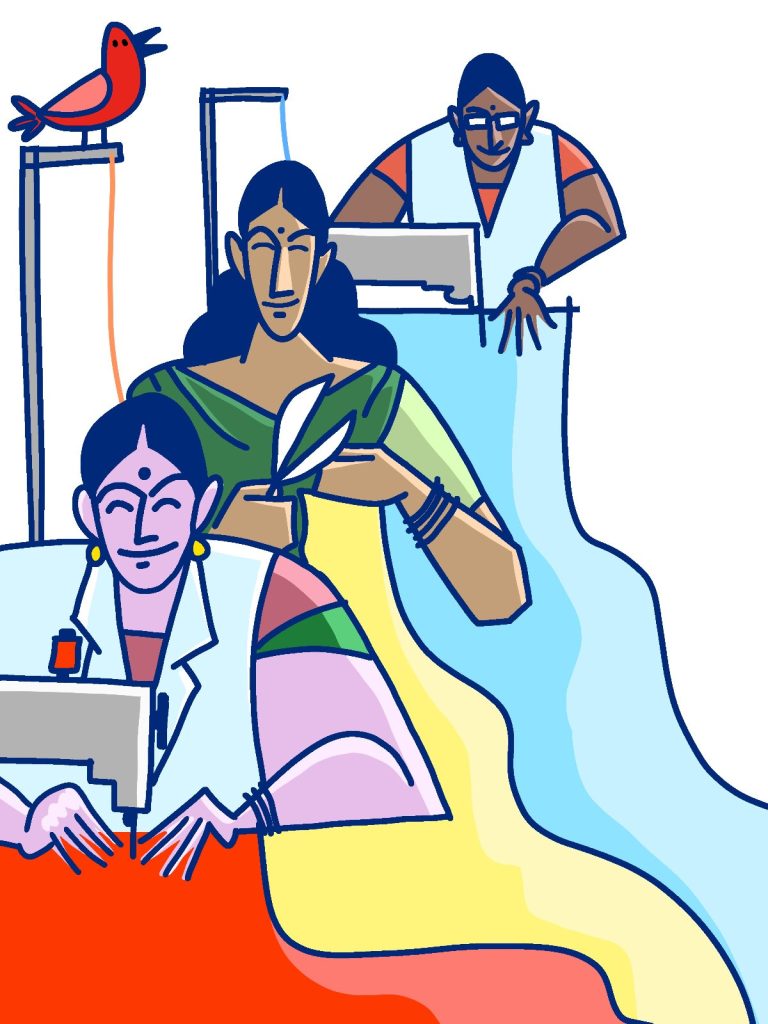
Navin S. (Young Socialist Artists), Tailors of Dinesh Apparels, 2025.
Credit Cooperatives in Kerala
Credit cooperatives – member-owned financial institutions that provide affordable credit and financial services to rural and marginalised populations – were formed in Kerala even before the state was established in 1956. They largely service small-scale farmers and workers, often where private commercial banks are absent or insufficient. In Kerala, they have historically played a vital role in supporting land reform beneficiaries and preventing the re-concentration of land ownership. For instance, the Trivandrum Central Cooperative Bank was set up in 1915 to provide finance to the emerging cooperative sector in the area. Later, similar credit cooperatives were established across the northern Malabar region and in Cochin. In 1956, the Trivandrum Central Cooperative Bank became the Kerala State Cooperative Bank, anchoring the credit cooperatives of the new state. Today, there are 4,146 credit cooperatives in Kerala, accounting for over one-third of the total lending institutions in the state.25 These credit cooperatives have played a vital role in economically uplifting the people, particularly in rural Kerala. For example, when the communist ministry initiated land reforms in 1957, small-scale farmers who received land needed finance to begin cultivation, but this credit was not available from the private sector in sufficient volumes. It was the credit cooperatives that stepped in, providing the necessary capital and sparing farmers from having to borrow from moneylenders and the feudal class. Without the presence of credit cooperatives, a substantial portion of the distributed land in Kerala would have returned to the feudal class and moneylenders in the form of mortgages.
Though private commercial banking has emerged in rural Kerala, credit cooperatives continue to provide a vital function. Kerala is the fifth-best connected state in India in terms of coverage by commercial bank branches, yet there is a wide rural-urban gap in the distribution of these branches. Reserve Bank of India data from 2024 shows that only 5.3% of these branches are located in rural areas, while 22.5% are in urban areas and 72.2% are in semi-urban areas.26 However, if cooperative credit institutions are added into these figures, 25% of the bank branches in the state are located in rural areas.
The Structure of Credit Cooperatives in Kerala
Kerala’s credit cooperative sector is structured into two parallel systems: short-term cooperatives, which provide seasonal working capital loans for agriculture, and long-term cooperatives, which offer investment credit for rural infrastructure and agricultural development. Each system has its own institutional structure, including banks operating at village, district, and state levels.
Short-term cooperatives have historically operated through a three-tier structure consisting of Primary Agricultural Credit Societies (PACSs) at the village level, district cooperative banks at the district level, and the Kerala State Cooperative Bank at the state level. In 2019, this structure was simplified to two tiers by merging the district- and state-level banks into a single entity now known as Kerala Bank. This simplified structure has strengthened the integration and efficiency of the short-term cooperative network. Broadly speaking, this structure can be visualised as a pyramid: PACSs form the base, and Kerala Bank serves as the apex. Long-term cooperatives form a separate structure anchored by the Kerala State Cooperative Agricultural and Rural Development Bank at the state level and supported by primary cooperative agriculture and rural development banks at the district and block levels.
At the foundation of the short-term cooperative structure are the PACSs, popularly known as ‘societies’. Each village in Kerala has at least one PACS, making them the most accessible and familiar financial institutions in rural Kerala. These PACSs also form the backbone of the state’s broader cooperative movement. With 30.3 million members in 2022, Kerala’s PACSs account for the largest membership in India – more than double that of West Bengal, the state with the second highest membership.27 Most members come from small and marginal farming households or other economically and socially disadvantaged communities. This large membership base has enabled PACSs in Kerala to mobilise INR 1.217 billion in deposits – over two-thirds of the total deposits held by PACSs across India.28
The vibrant role that Kerala’s PACSs have played in enhancing credit availability and accessibility for the rural poor and other marginalised sections of the population underserved by commercial banks is illustrated by several Kerala-based empirical studies.29 These studies show that socially and economically deprived groups perceive cooperative societies as their friendly neighbourhood institutions and, therefore, as the most approachable banking institutions. Half of the low-income households in rural Kerala rely on the cooperative sector for loans, while 25% borrow from commercial banks. The studies also note a higher dependence of Dalit and Adivasi borrowers and extremely poor households on credit cooperatives compared to other socioeconomic categories and point to the barriers that stand between poor people and commercial banks. Further, the specific characteristics of financial cooperatives – familiarity between customers, employees, and the members of the boards of directors, as well as the right of anyone in the locality to secure membership – make these institutions easily accessible to marginalised populations. Complex forms, complicated procedures, and even the attire and sophisticated nature of commercial bank staff often instil a feeling of ‘otherness’ among the poor towards commercial banks.
The potential of credit cooperatives in Kerala to free socially and economically vulnerable groups from the clutches and exploitation of moneylenders is evident from the story of Mannarkkad Rural Service Cooperative Bank Ltd, located in the district of Palakkad.
Mannarkkad Rural Service Cooperative Bank Ltd
The Mannarkkad Rural Service Cooperative Bank Ltd (MRSCB) began operating in 1989 with just 305 members and a share capital of INR 30,000. Over the last three decades, the bank has made tremendous progress in terms of membership, deposits, and share capital. Currently, the bank has more than 16,000 members, a share capital of INR 40 million, and an annual turnover of INR 7.5 billion. It has mobilised a total of INR 2.7 billion as deposits, distributed a total of INR 2.5 billion as loans, and consistently earned a profit since 1994. It pays a dividend of 25% to its members, which is the maximum permitted amount by the Kerala Cooperative Societies Act. In 2018, the bank launched a microfinance scheme called Muttathe Mulla (Jasmine in Your Yard) for poor villagers who live near the bank in order to save them from illegal moneylenders and private microfinance companies that charge exorbitant interest rates. Under this scheme, a person is eligible for bank loans at a discounted rate, which enable them to pay off older loans taken from moneylenders. The scheme has been implemented with the support of Kudumbashree neighbourhood groups, which are entrusted with the responsibilities of identifying those in need, distributing the loans, and collecting the weekly payments from borrowers at their doorsteps. Seeing the success of this scheme, the Government of Kerala adopted it at the state level and decided to implement it all over the state through PACSs.
Apart from providing traditional banking services, PACSs are also making diverse interventions to advance the development of rural local economies, thus acting as the backbone of the rural financial sector in Kerala. The institutions undertake a range of activities, such as distributing credit and inputs at subsidised rates; supporting farming, animal husbandry, and small-scale industries; and arranging facilities for processing, branding, and marketing local produce.
Palliyakkal Service Cooperative Bank Ltd
The Palliyakkal Service Cooperative Bank Ltd (PSCB) was established in 1943 in the Ezhikkara grama panchayat (village panchayat) of Ernakulam district. Predominantly an agrarian village, Ezhikkara is known for the cultivation of pokkali rice (a salt-tolerant rice variety) and fish farming, both of which serve as the local community’s major income sources. During its first decades of its existence, the PSCB engaged in traditional banking activities such as lending money and accepting deposits. However, its financial performance turned out to be very poor with a very low recovery rate. In 2000, the PSCB’s board of directors conducted an in-depth analysis of the bank and found that the low profitability and reduced employment opportunities in the region’s farming sector were the major contributing factors to borrowers’ low repayment. The bank recognised the need to enhance the local community’s income in order to improve its financial viability.
With this in mind, the PSCB decided to address the agrarian crisis facing farmers in its area. It held consultations with its members and the local community and developed a strategic plan for achieving local self-sufficiency in food production, ensuring local food security, and driving local economic development. Mutual aid groups were formed under the aegis of the PSCB in seven sectors: pokkali rice cultivation, horticulture, floriculture, milk production, poultry, pisciculture, and herbal plant cultivation. To increase agricultural production, the PSCB regularly provided these community-based farmer groups with training, accessible (such as low-interest or easy-to-access) credit, and forward and backward linkages (connections to input suppliers and to markets for selling their produce). The bank also provided farmers with continuous agricultural consultancy through its agricultural officer, as well as financing, and introduced innovative agricultural practices. In addition, it offered facilities to procure and market produce and arranged its own distribution centre for agricultural inputs such as organic seeds, organic fertiliser, and agricultural equipment. The PSCB organised agricultural labourers into the Green Army, a service through which it provided farmers with a sufficient labour force, and set up a pokkali rice mill to improve the processing of pokkali products. It also organised markets where fruits, vegetables, milk, and eggs procured from the farmers were sold at some of the highest prices in Kerala. Landowners in the area supported these initiatives by allowing the bank to use their land for farming. Presently, more than a thousand families in the locality are involved in activities initiated by the bank, whose concerted efforts and achievements in reviving the local economy are widely recognised.
Over the past few years, the bank has won several performance awards in the cooperative sector. In the 2020 state budget, then Finance Minister of Kerala Dr T. M. Thomas Isaac announced the virtual Kerala Food Platform, which enables farm products to be purchased directly from farmers and delivered to consumers, ensuring not only more widely accessible and healthier products but also better returns for the farmers by avoiding intermediaries. In recognition of the PSCB’s interventions in the area, the bank was selected to implement the programme.
Cooperative Development
Kerala’s extensive network of credit cooperatives has received international acclaim for its achievements furthering the development of rural economies. Free of the rigidities and cumbersome procedures that characterise commercial banks, these ‘people’s banks’ play a key role in making several state programmes a success. Such initiatives include the Care Home project, which built safe and better homes for families affected by the floods and landslides of 2018, and welfare pension schemes. Furthermore, these grassroots credit institutions played a key role in helping the state recover from the massive floods of 2018 and the COVID-19 pandemic by extending financial support to the people of Kerala. Between the long-term process of development and the short-term dynamic of relief, these institutions have proved themselves vital to progress in Kerala.
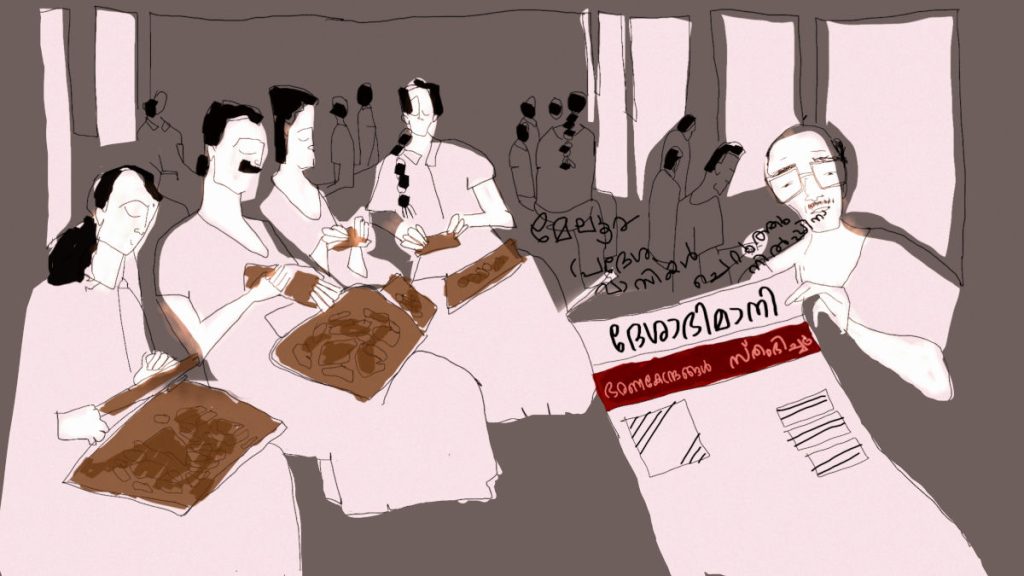
Kadambari (Young Socialist Artists), Dinesh Beedi’s Read Aloud Programme, 2025.
Kerala Dinesh Beedi Workers’ Central Cooperative Society
On 15 February 1969, the Kerala Dinesh Beedi Workers’ Central Cooperative Society (Dinesh Beedi) was registered with the State Registrar of Cooperative Societies. Initially, the cooperative established one central society and twenty primary production units, where the workers rolled beedi (a type of thin hand-rolled cigarette). The cooperative was formed after a sustained period of agitation by the workers, whose demands to improve their working conditions were also taken up by the communists. In 1966, the efforts of communist leader AK Gopalan led to the passage of the Beedi and Cigar Workers (Conditions of Employment) Act in the Indian parliament, which laid out a minimum guarantee for the well-being of beedi workers, including decent wages and social security, and left the responsibility to implement the act to the discretion of state governments. It was worker agitation and the passage of this act that provided the impetus for the formation of Dinesh Beedi three years later.
When the communists won the 1967 state elections in Kerala by a landslide, EMS Namboodiripad, the new chief minister, implemented the Beedi and Cigar Workers Act. Private owners of the beedi factories protested, with some of them – such as Ganesh Beedi – going as far as abruptly shutting down their factories. They refused to negotiate with workers because they wanted the government to withdraw from implementing the legislation. When workers from the districts of Kannur and Kasaragod in northern Kerala began to suffer from the social impacts of these closures, trade unions and communists came together in a united front to demand support for them. ‘Workers knew only beedi-making, and it was not easy to find alternative jobs for such a large number of them’, wrote GK Panikkar, who later became the chairman of Dinesh Beedi from 1969 to 1996. ‘The economy of the district was shaken’, he said.30 It was at this point that the unionised workers decided to organise a cooperative for beedi production.
The formation of this workers’ cooperative became not only a solution to the crisis created by factory closures and an antidote to capital flight, but also an expression of the dignity of labour and the spirit of collective action. ‘The emergence of Dinesh Beedi was not as simple as many think’, said KP Sahadevan, who led the united front and helped establish the cooperative. ‘It was the result of the continuous struggle waged by the working class and by the overall militancy of the period’.31
The idea to form Dinesh Beedi was inspired by the Indian Coffee Workers’ Cooperative Society, formed in 1958 under the initiative of AK Gopalan. That earlier experience gave confidence that such worker-run schemes could work, which – alongside support from Kerala’s communist ministry – helped turn the beedi workers’ idea into reality nearly a decade later.
Capital for Dinesh Beedi came from the workers themselves. They fixed a share value of INR 20 in 1969, but many of them could not afford to buy their shares since the daily wage at that time was less than INR 3. To solve this problem, the state government provided INR 19 as a loan to each prospective worker-owner. Workers repaid the loan through instalments that were deducted from their wages. Though the project could not initially accommodate the 12,000 workers who lost their jobs, the 3,000 workers who first joined were accompanied by another 1,000 workers within a month. In other words, a third of the unemployed beedi workers entered the cooperative. The class-conscious beedi workers of northern Malabar made it clear that no divisions would be allowed between those who entered the cooperative as worker-owners and those who did not, and they educated all workers, whether employed in the cooperative or not, about how the cooperative worked.
From the onset, Dinesh Beedi faced a number of challenges. For instance, it had to struggle to gain a foothold against customers’ longstanding loyalty to older private brands. In the early period, the cooperative was stuck with unsold beedi packets, and it seemed like the new venture would not succeed, despite the workers’ efforts to produce high-quality beedi. At this point, through collective discussion, the workers decided to launch a mass campaign to promote Dinesh Beedi at every shop, requesting that they purchase their brand. This mass campaign gradually made Dinesh Beedi the preferred brand among Kerala’s working class and peasantry. Within a few years, Dinesh Beedi emerged as one of the most popular beedi brands in India and the largest beedi producer in southern India. The cooperative, which had started with 3,000 workers in 1969, employed 42,000 workers by the 1980s, becoming one of the largest worker cooperatives in Asia. As a result, they were able to pay themselves higher wages and social security than was provided in the private sector.
However, the point of a cooperative is not just to survive in the capitalist system but to use its democratic structure to expand the social horizons of its workers. Dinesh Beedi’s worker-owners both created a dignified work culture and eliminated the private contract system, which did not honour established workers’ rights – one of the main complaints during the agitations of the 1950s and 1960s. It was also among the first firms to provide its workers with paid time off, bonuses, and bereavement benefits. At the workplace, Dinesh Beedi encouraged both trade unionism and political discussion, such as through a ‘read aloud’ programme in which a designated worker read important literary works or texts on contemporary affairs to the other workers. It also organised arts and sports clubs in villages to provide workers, their families, and the community at large with necessary leisure activities. These reforms had a profound impact on the beedi industry, and some of them were even adopted by private firms. Dinesh Beedi became a symbol of resistance and of workers’ unity and dignity.
In the 1990s, a crisis in the beedi industry threatened Dinesh Beedi’s existence. The crisis stemmed from several developments, including the emergence of new private-sector beedi firms that paid wages below the government-mandated minimum and offered higher margins to retailers; a shift among younger consumers from beedis to cigarettes; and government anti-tobacco campaigns. Dinesh Beedi supported the government campaigns, which gained momentum as public awareness of tobacco’s health risks grew. Because of this new consciousness, the cooperative stopped hiring new workers after 1993 and consumer demand declined year after year. Dinesh Beedi workers’ hours were reduced, and many left the cooperative to seek employment elsewhere.
In this context, Dinesh Beedi’s worker-owners began to discuss diversifying production in order to save the cooperative. To support this initiative, Kerala’s Industries Minister Susheela Gopalan, a leader of the communist movement, held a state-wide workshop on diversification on 30 August 1996 in which many scientists provided their inputs to the cooperative’s worker-owners. Soon after, Dinesh Beedi launched a set of pilot products such as coconut milk (1997) and curry powder (1998). In the late 1990s, Dinesh Beedi expanded into five new ventures:
- Dinesh Foods manufactures and retails spice powders, coconut milk, virgin coconut oil, coconut milk ice cream, fruit squash, fruit jam, syrup, and pickles, mostly employing former beedi workers. The cooperative has four manufacturing units in Kannur district, ensuring round-the-year employment for its workers.
- Cafe Dinesh operates cooperative restaurants and catering services in Kannur, Payyannur, Pinarayi, and Thalassery. Dinesh Foods’ products are available at these outlets.
- Dinesh Information Technology Systems (DITS), established in 1999, provides IT support for the cooperative sector in Kerala, including the cooperative banking sector. In 2001, DITS established the Dinesh Software Park in Kannur.
- Dinesh Auditorium in Kannur rents out a large hall with capacity for 1,000 people and is available for conferences and weddings.
- Dinesh Apparel, created in 2007 in Kannur and Kasaragod, produces clothes for local and export markets. It employs more than 400 people.
By diversifying into Kerala Dinesh, as it became more popularly known by the early 2000s, the cooperative was able to thrive and reduce its reliance on a harmful product. Democratic decision-making and a belief in prioritising workers’ interests have led to the creation of a cooperative ecosystem that continues to capture the imagination of workers across the world.
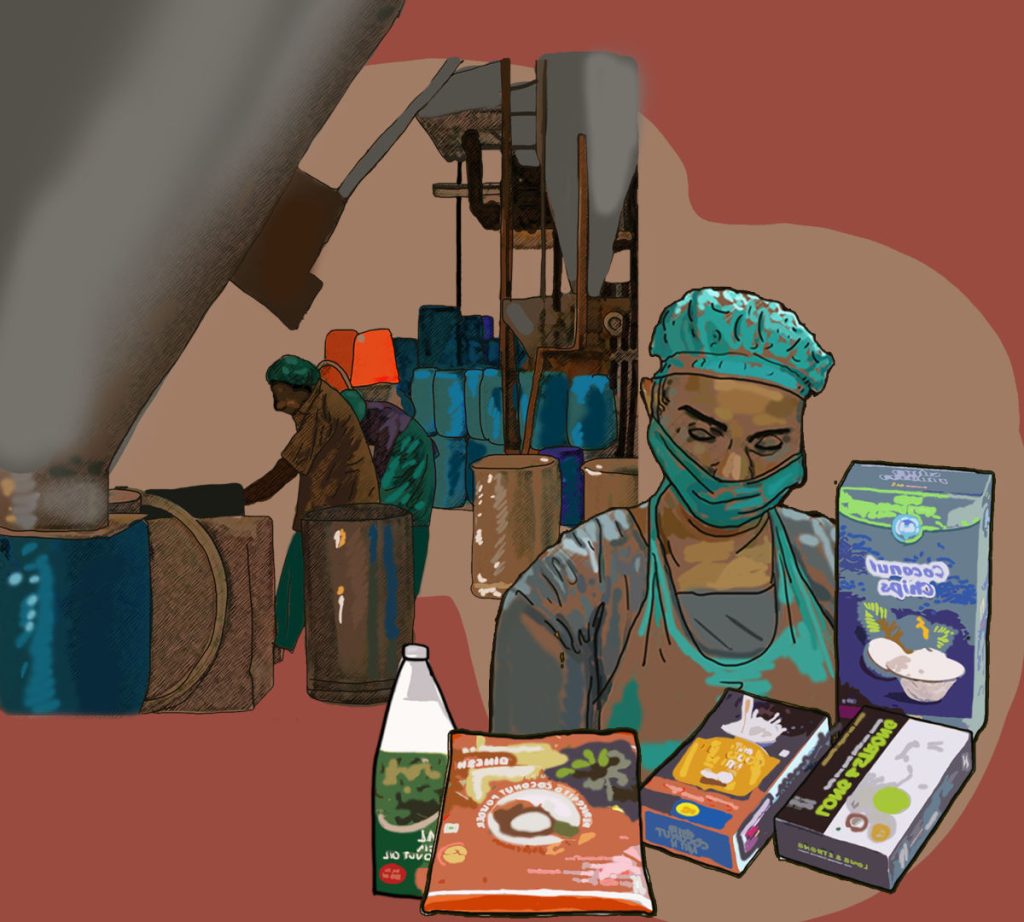
Vanshika Babbar (Young Socialist Artists), Dinesh Foods, 2025.
A Small Village Builds Its Own Labour Cooperative
Kodom Belur, a village panchayat located in a remote part of Kerala’s northern Kasaragod district, had long been marked by deep socioeconomic disparities rooted in feudal landlordism. The material conditions of its people were shaped both by the land reforms of the decades following Kerala’s formation in 1956 and by remittances from migrants to the Persian Gulf, which gave rise to a new wealthy class. Yet large sections of the population did not benefit from either the land reforms or the remittances and remained unemployed, socially bereft, and frustrated by rampant corruption in publicly funded projects. Construction labourers were often denied their rightful wages while contractors seized public funds without completing projects.
Construction is a demand-driven sector. The need for infrastructure depends on the level of economic development, and the quality of physical infrastructure is unevenly distributed across regions. Construction work does not always take place where labour is available, nor is the need for labour constant. Workers go from one job site to another based on the availability of contracts, with the amount of labour and capital required dependent upon the size and value of each project. At each stage of construction, different skill sets are needed and new workers are brought in, giving capital investors the upper hand throughout the entire construction process. In large-scale projects, multiple layers of subcontracting further increase workers’ vulnerability. Altogether, the structural characteristics of construction activity create ample conditions for labour exploitation.
In 1996, Kerala’s Left Democratic Front government launched the People’s Campaign for Decentralised Planning, which built an impressive process to decentralise planning by drawing large sections of Kerala’s population into discussions about the problems and unmet potential in the state. These efforts galvanised the people of Kodom Belur to organise against exploitative construction companies and boycott the privately contracted public works in the area. They built an action group that began executing public contracts independently. However, technical backwardness, limited capital, pressure from private builders, and obstruction by corrupt officials – especially in the Public Works Department – undermined their efforts to assert popular control over these projects.
In 1997, a local elected leader and the panchayat standing committee chairman for Kodom Belur, AC Mathew, galvanised the members of the action group to organise themselves into the Hosdurg Labour Contract Cooperative Society. The society aimed to pool its members’ skilled labour and raise capital through their own savings so that they could bid for public works. In 2004, the society was renamed Udayapuram Labour Contract Cooperative Society. The society has grown from 221 initial members to 2,981 today, including 235 permanent Class A members (those with full voting rights and long-term participation in the cooperative), about one-quarter of whom belong to the Scheduled Tribes category. The Udayapuram Society secures construction contracts from the Kerala Public Works Department, local self-governing bodies, and other government departments. It is owned and maintained by its members and receives funding from the National Cooperative Development Corporation, district cooperative banks (now Kerala Bank), and the Kerala Financial Corporation.
The cooperative’s model is rooted in mutual aid and ultimately aims to improve the quality of life of its members. Before the creation of the Udayapuram Society, construction work was largely carried out by private builders. It was through the Udayapuram Society that labourers were able to overcome wage exploitation and dependency on private contractors.
The increased volume of work has gradually led to better socioeconomic conditions for its members. From 2011 onwards, the society began to undertake large-scale construction projects. It also diversified its activities to include agriculture and other industries in order to stabilise growth and make better use of available human resources. By creating productive job opportunities, the society became an engine of growth in the regional economy.
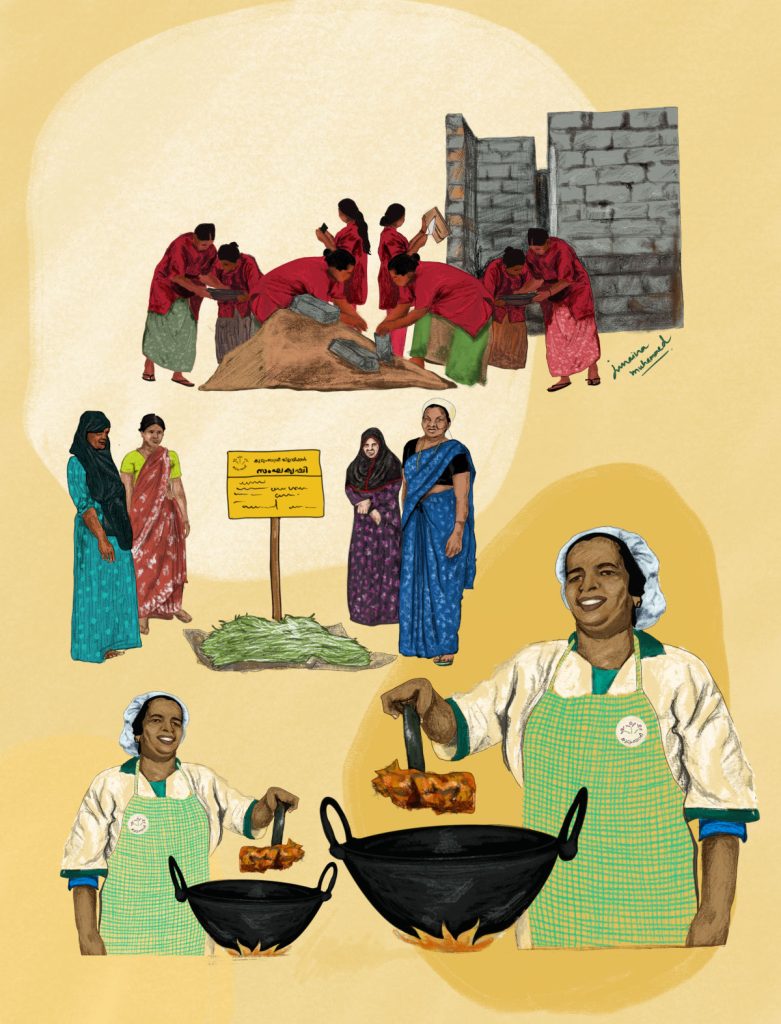
Junaina Muhammad (Young Socialist Artists), Kudumbashree, 2025.
Kudumbashree
One of the most striking things about Kudumbashree is its sheer size: 4.8 million women – about one-third of adult women in Kerala – are members of this network.32 Although Kudumbashree (which means ‘prosperity of the family’ in Malayalam) began in May 1998 as a state-initiated programme to eradicate poverty among women, it has since become a transformative force in Kerala’s social and political life. ‘Partly a movement and partly a government programme’, as V. K. Ramachandran describes it, today Kudumbashree is engaged in a wide range of activities, from microfinance and collective farming to manufacturing apparel and running restaurants.33 It has become a ubiquitous presence in Kerala society.
Though Kudumbashree is not organised under the laws that govern cooperatives in Kerala, it is imbued with a cooperative spirit – the basic units of the Kudumbashree community network are controlled and run by its members in a democratic manner based on the ‘one member, one vote’ rule.34 The community network has a three-tier structure:
- The lowest tier is the Neighbourhood Group or NHG (Ayalkkoottam in Malayalam), consisting of ten to twenty members. All adult women in the neighbourhood are eligible to become members, and there is a focus on including women from economically and socially disadvantaged sections of the population.
- The second tier is the Area Development Society (ADS), which is formed by federating all the NHGs in a ward of the relevant local self-government institution (LSGI, also known as local body or local government), such as a panchayat or municipality.
- The third tier is the Community Development Society (CDS), which is formed by federating all the area development societies in the local body.
The Kudumbashree community network is supported by a government structure called the Kudumbashree Mission (officially the State Poverty Eradication Mission). The mission is led by a governing body chaired by the state minister for local self-governments, an executive committee chaired by the additional chief secretary of the department of local self-government, and a government official who serves as executive director. There are fourteen district Kudumbashree missions (one for each district in Kerala) under the state mission.
Origins
Previous local experiments in community development served as precursors to Kudumbashree.35 One such experiment was the Community-Based Nutrition Programme, initiated by the United Nations Children’s Fund (UNICEF) in the town of Alappuzha in 1991 to improve the health and nutritional status of women and children. The programme established women’s community development societies at three levels: NHGs, ADSs, and CDSs. A similar project was implemented in Malappuram district from 1994 onwards with a five-tier structure (NHGs, ADSs, CDSs, block-level CDSs, and district-level CDSs), though it was eventually reduced to three, like the one in Alappuzha. Thrift and credit societies, which mobilised the small savings of poor women members of the community development societies and provided loans to their members, became an integral part of the community organisation.
The early 1990s were also a time when the Kerala Sasthra Sahitya Parishad (Kerala Forum for Science Literature, or KSSP, Kerala’s biggest people’s science movement) was leading new experiments in a participatory model of planning for local development. The formation of NHGs, which participated in resource mapping and planning at the local level, was part of these experiments. The most prominent among them was implemented by KSSP at the Kalliasseri village panchayat in Kannur district in 1993, where nearly two hundred NHGs were formed.
In 1996, the Left Democratic Front government came to power in Kerala and launched the People’s Campaign for Decentralised Planning (also known as the People’s Plan Campaign) that same year. The campaign led to a much greater devolution of funds and powers to local governments, and NHGs were formed to strengthen the process of decentralised planning.36 As part of the campaign, the state government also made it mandatory for local governments to earmark 10% of their annual plan funds exclusively for various projects that targeted the social advancement of women.
All of these processes and experiments informed the creation of Kudumbashree.
In 1997, a special government task force recommended forming the State Poverty Eradication Mission (the Kudumbashree Mission). The mission was announced in the 1997–1998 Kerala state budget and inaugurated on 17 May 1998. Its aim was to eradicate absolute poverty through concerted community action under the leadership of local governments.37
Today, Kudumbashree’s major programmes include microfinance, income-generating economic activities such as agriculture and microenterprises, and the implementation of various welfare and development initiatives of local governments.
All members of Kudumbashree are part of its thrift and credit programme. Members of Kudumbashree neighbourhood groups meet once a week and make small contributions to a thrift fund, which is then used to give small loans to members who need them. Most neighbourhood groups are also linked to banks, which provide loans to the groups. The groups then use these loan amounts for livelihood activities such as collective farming and setting up microenterprises.38
Collective Farming
One of Kudumbashree’s most noteworthy initiatives is collective farming.39 Groups of four to ten NHGs members who are interested in farming are organised into Joint Liability Groups, also known as sangha krishi (collective farming) groups, which identify land (often land that is lying fallow) suited for cultivation in their village and surrounding areas. With the help of the panchayat and the Kudumbashree District Mission, they take the land on lease from landowners and cultivate it. Group members also pool their own land and cultivate it. Active sangha krishi groups are linked with banks, and loans are made available to them with subsidy on interest. The Kudumbashree Mission also supports the collectives by providing them with farm machinery, seeds, fertilisers, and pesticides at subsidised prices. The state agriculture department provides periodic training and technical support. Funds from various central government initiatives are also used to support the collective farming efforts. Ten thousand skilled women farmers from the sangha krishi groups have been designated as ‘master farmers’ who function as resource persons who provide training to the rest of the sangha krishi group members.
As of 30 June 2025, the number of women farmers who are part of the Kudumbashree sangha krishi groups in Kerala has reached 439,255. There are 96,177 sangha krishi groups, which have brought 21,457 hectares of land under cultivation.40 The main crops they grow are rice, vegetables, tubers, and bananas. The produce is first used for consumption among the women farmers’ families, and the surplus is then sold in village markets. Kudumbashree’s collective farming efforts have strengthened the food security of members’ families, and improved their incomes and living standards.
Local Governments
The Kudumbashree community network plays a crucial role in the development initiatives of the local governments under decentralised planning in Kerala. While local governments are responsible for planning and implementing programmes for economic development, social justice, and poverty alleviation, Kudumbashree’s core mission is poverty eradication.41 From the beginning, this shared focus has meant that Kudumbashree NHGs, ADSs, and CDSs work in tandem with the local governments.
Kudumbashree acts as the implementation agency for several poverty eradication schemes and development initiatives of the state government. For instance, the Destitute-Free Kerala programme, aimed at eradicating extreme poverty in the state, is implemented by Kudumbashree, and the beneficiaries of the programme are identified by Kudumbashree members. The programme is intended to provide food, medical treatment, clothing, welfare pensions, schooling, land, and housing to those identified as destitute.42
As part of the planning process, Kerala’s local governments establish working groups for key development sectors such as health, education, poverty reduction, development of women and children, and social security, and it is mandatory that at least one Kudumbashree CDS member be included in every such working group.43 These working groups are tasked with surveying existing resources, analysing local conditions, exploring development potential, and identifying people’s needs. Moreover, people’s development needs are assessed at ward-level assemblies (known as grama sabhas in villages and ward sabhas in towns and cities). Kudumbashree members are the most active section of such assemblies and play a crucial role in keeping the assemblies vibrant.
In February 2020, Kerala’s left government announced that it was opening one thousand restaurants, to be run by Kudumbashree, where food would be provided at subsidised rates.44 During the COVID-19 lockdowns that year, Kudumbashree began setting up these restaurants, christening them ‘people’s restaurants’. During these months, Kudumbashree – along with local governments and employees’ unions – was also involved in running community kitchens across the state. As of 1 March 2025, there were 1,198 people’s restaurants functioning in the state, run by 5,104 Kudumbashree members.45
Microenterprises
Microenterprises set up by Kudumbashree units are involved in a wide range of sectors, including the production of packaged foods, apparel, sanitary napkins, umbrellas, bags, pottery, floor mats, soaps, and toiletries. There are Kudumbashree initiatives that brand and market agricultural products produced by tribal farmers in various districts in the state to ensure that the producers receive higher incomes. The Home Shop network, which takes the products of Kudumbashree microenterprises directly to households, has been established in all fourteen districts in the state. There are also units that engage in rearing livestock and poultry and running fish farms.
Kudumbashree units run restaurants and canteens across the state; manage parking at railway stations; process coconut oil, cashew, and tamarind; and make snacks, pickles, and pappadam (a thin, crisp lentil-based snack). They run fitness centres, women’s hostels, daycare centres for children, driving schools, coir (coconut fibre) units, book binding units, printing centres, medical labs, tailoring units, and supermarkets. There are also units that manufacture LED bulbs and electronic products.
There are Kudumbashree all-women construction teams consisting of supervisors, masons, plumbers, and electricians who have been trained by the Kudumbashree Mission with the support of various other agencies. Kudumbashree also has a Haritha Karma Sena (Green Task Force) which collects plastic waste from houses and businesses, transports the waste to shredding units for recycling, and assists in household biowaste management. Amrutham Nutrimix, the cereal-based powder given to children aged six months to three years at Kerala’s childcare centres, is also manufactured by 241 Kudumbashree units in the state.46
As of 1 March 2025, there were a total of 157,097 Kudumbashree microenterprises in the state, run by 318,265 Kudumbashree members.47 Out of these, 69,484 enterprises were in the production sector, 49,381 in the service sector, and 35,646 in the trade sector.48
Impact
Kudumbashree has transformed the lives of its members, helping them improve their living standards, gain income-generating work outside their homes, strengthen their confidence and self-esteem, and increase their visibility in the public sphere. Kudumbashree members have also become a major presence in the activities and leadership of local governments in the state.
According to a 2015 sample survey carried out across Kerala by the Laurie Baker Centre for Habitat Studies, Thiruvananthapuram (henceforth LBC Survey), 54.1% of Kudumbashree members were engaged in some form of income-generating economic activity.49 This was double the work participation rate of adult women in the state (26.3%). The LBC Survey also showed that before joining Kudumbashree, 66.1% of its members were engaged solely in household work and were not involved in any income-generating activity outside their homes or in studies. This dropped to 37% after they joined Kudumbashree.50
Another sample survey conducted by Ambika Devi R in 2008–2009 as part of her PhD work at the University of Kerala showed that Kudumbashree helped nearly 50% of its members gain access to income-generating activities.51 As part of this survey, Kudumbashree members were asked how much control they had over their income, the options being ‘to a great extent’, ‘to some extent’, and ‘no control’. As much as 88.8% of the women reported that they had control over their income ‘to a great extent’ after they joined Kudumbashree. The percentage of women who had the same level of control over their income before they joined Kudumbashree was much lower: 66.7%.52 A 2016 survey in Ernakulam district by Taramol KG as part of her PhD work at Bharathiar University showed that the incomes of Kudumbashree members increased significantly after they became part of the community network.53
Households with Kudumbashree members have also reported an increase in their acquisition of consumer durables and household assets as a result of their improved incomes. The 2015 LBC Survey showed that the percentage of Kudumbashree members living in kutcha houses (made of less durable materials such as mud, leaves, straw, and grass) was 6.7 percent, down from 22.9 percent before they joined Kudumbashree.54 Furthermore, Kudumbashree members reported that their improved incomes helped them provide higher education to their children, secure better healthcare, and improve their houses or construct new ones.
A substantial proportion of the women who joined Kudumbashree (27.4%, according to Ambika Devi’s study; 36%, according to the LBC Survey) have reported that their public speaking skills have improved since they joined the network. A significant proportion of women (38.4%, according to the LBC Survey) gained the confidence and skills to demand services or facilities from government offices.55 Similar gains have been made in their confidence to participate and express their views in meetings, and to take part in local government functions. The collective nature of Kudumbashree activities also helped improve the spirit and practice of mutual help among Kudumbashree members.56
As mentioned earlier, Kudumbashree members are among the most active sections in the activities of local governments in Kerala. This has directly translated into greater representation of Kudumbashree members among elected representatives to local self-government institutions (LSGIs): of the 21,854 people elected as LSGI members in Kerala in the 2020 local government elections, 7,058 were active members of Kudumbashree.57
To sum up, Kudumbashree has become a vital element of Kerala’s social and political life. It has helped women – particularly those from economically and socially disadvantaged backgrounds – improve their living conditions. Kudumbashree has enhanced their status within their families and enabled them to participate more effectively in the public sphere, including the political arena. Unsurprisingly, it has been referred to as one of the ‘greatest gender justice and poverty reduction programmes in the world’.58
Notes
1Karl Marx, ‘Inaugural Address of the Working Men’s International Association’, London, 21 October 1864, https://www.marxists.org/archive/marx/works/1864/10/27.htm.
2In 1964, the Communist Party of India split into the Communist Party of India (Marxist), or CPI(M), and the Communist Party of India (CPI). The government in Kerala has been led by the CPI(M) and has included the CPI and other left and democratic parties as coalition partners in the following periods: 1967–1969, 1980–1981, 1996–2001, 2006–2011, and 2016–present. The period from 1969 to 1977 saw a coalition government that included the CPI and the Indian National Congress as the main partners; the CPI(M) was in the opposition.
3Karl Marx, Capital. A Critique of Political Economy, vol. 3 (New Delhi: LeftWord Books, 2010), 440.
4For more on the Paris Commune, see: Tricontinental: Institute of Social Research, Paris Commune 150, (New Delhi: LeftWord, 2021), https://thetricontinental.org/text-paris-commune/.
5Karl Marx, ‘The Civil War in France’, in Collected Works, vol. 22 (Progress Publishers, 1986), 335.
6‘Number Statement 2025’, Department of Cooperation, Government of Kerala, 31 March 2025, https://cooperation.kerala.gov.in/wp-content/uploads/2019/04/Number-statement-2025.pdf.
7Ashique Ali Thuppilikkat, ‘A Short History of the Cooperative Movement in Northern Malabar, Kerala’, Economic and Political Weekly 59, no. 30, 3 August 2024.
8Malayala Manorama, 29 December 1929.
9Beedi are a type of hand-rolled cigarette.
10In India, the government has ‘schedules’, or lists, of castes and tribes that are the most socioeconomically disadvantaged or historically oppressed. People belonging to Scheduled Castes and Scheduled Tribes are entitled to certain rights and benefits.
11Karl Marx, ‘Letter to Wilhelm Bracke’, in Marx/Engels Selected Works, vol. 3 (Moscow: Progress Publishers, 1970), 11.
12A panchayat is a local self-government body in India that is primarily responsible for governance and development in rural areas. It operates at the village, block, or district level as part of India’s decentralised administrative system.
13Pyaralal Raghavan, ‘Growth and Performance of Cooperatives in Kerala: A Preliminary Analysis’, AK Gopalan Centre for Cooperative Enterprises and Alternative Politics, Kannur University, Kerala, 2019, https://papers.ssrn.com/sol3/papers.cfm?abstract_id=4031735.
14The stage of World War II after the Soviet Union entered the war is referred to as The People’s War.
15EMS Namboodiripad, With the Ploughshare and the Sickle: Kisan Sabha in the Campaign for More Food (Bombay: People’s Publishing House, 1943).
16Camila Piñeiro Harnecker, Cooperatives and Socialism: A View from Cuba (New York: Springer, 2012).
17E Gopalakrishna Menon, Cooperatives Movements and Communists (Ernakulam: Prabhat Book House, 1956).
18Financial Staff, ‘Tata Tea Pays £271m for Tetley’, The Guardian, 28 February 2000, https://www.theguardian.com/business/2000/feb/28/2.
19Natalie J Langford, ‘From Global to Local Tea Markets: The Changing Political Economy of Tea Production within India’s Domestic Value Chain’, Development and Change 52, no. 6 (2021): 11.
20Policy Report to Support Development of Small Tea Growers in India, Solidaridad Network Asia Limited, February 2023.
21Kingshuk Sarkar, ‘Trends and Price Formation Mechanism in Indian Tea Auctions’, NRPPD Discussion Paper 23 (2013), https://cds.edu/wp-content/uploads/2021/02/NRPPD23.pdf.
22Roopak Goswami, ‘Small Tea Growers Report Looks at Farming Issues in India, Better Pricing Models, the Future of Tea’, World Tea News, 7 June 2023, https://www.worldteanews.com/origins/small-tea-growers-report-looks-farming-issues-india-better-pricing-models-future-tea.
23‘Kozhikode ULCCS a Role Model for Labour Cooperatives, Says UN Official’, The Hindu, 19 September 2013, https://www.thehindu.com/news/cities/kozhikode/kozhikode-ulccs-a-role-model-for-labour-cooperatives-says-un-official/article5144802.ece.
24Panam payattu and kurikkalyaanam are popular methods in rural areas of Malabar to collect money to build homes, pay for weddings, send sons to work in the Persian Gulf region, and meet other financial needs. The person in need holds an event where they serve tea and snacks to attendees, who contribute money. The organiser of the event pays back the money at another event organised by another person, and so on.
25Kerala State Planning Board, Economic Review 2024, Volume 2 (Thiruvananthapuram: Government of Kerala, January 2025), http://www.niyamasabha.org/codes/15kla/session_13/Economic%20Review/Economic%20Review_2024%20Eng_Vol%202.pdf.
26‘Quarterly Statistics on Deposits and Credits of Scheduled Commercial Banks’, Reserve Bank of India, March 2024.
27‘Performance of Primary Agricultural Credit Societies (April 1, 2022 to March 31, 2023)’, National Federation of State Cooperative Banks Ltd, 2023, https://nafscob.org/master/basic/images/fb749ee5ab92865a06a82bc450403466_1.pdf.
28‘Performance of Primary Agricultural Credit Societies (April 1, 2022 to March 31, 2023)’.
29See: KK George et. al. and KUB Rao et. al., How the Poor Manage Their Finances: A Study of the Portfolio Choices of the Poor Households in Ernakulam District, Kerala (Reserve Bank of India and Centre for Socio-economic and Environmental Studies, 2013); Aswathi Rebecca Asok et. al., Indebtedness Among the Rural Poor in Kerala (Kochi: Centre for Socio-economic and Environmental Studies, 2020).
30Kerala Dinesh Beedi Golden Jubilee Souvenir, 2019, Kannur, Editor: Narayanan Kavubayi.
31Kerala Dinesh Beedi Golden Jubilee Souvenir, 2019, Kannur, Editor: Narayanan Kavubayi.
32‘Data on Kudumbashree’, Kudumbashree, accessed 1 September 2025, https://kudumbashree.org/pages/518 (See the IBCB-Organisation tab); Technical Group on Population Projections, Census of India 2011: Population Projections for India and States, 2011–2036 (New Delhi: National Commission on Population, Ministry of Health and Family Welfare, July 2020).
33VK Ramachandran (Vice-Chairperson, Kerala State Planning Board), interviewed by Subin Dennis, 2020.
34Kudumbashree is a state-initiated programme with a community network as its core. The community network, which on its own is also commonly referred to as Kudumbashree, is run by its members based on the ‘one member, one vote’ rule. In contrast to companies in the private sector, where the voting rights of shareholders are in proportion to the number of shares they own, cooperatives uphold the principle of ‘one member, one vote’. According to the International Cooperative Alliance, ‘Cooperatives bring people together in a democratic and equal way. Whether the members are the customers, employees, users or residents, cooperatives are democratically managed by the “one member, one vote” rule. Members share equal voting rights regardless of the amount of capital they put into the enterprise’. (‘What is a cooperative?’, International Cooperative Alliance, https://ica.coop/en/cooperatives/what-is-a-cooperative).
35‘History and Evolution’, Kudumbashree, accessed 25 October 2022, https://kudumbashree.org/pages/178; Paloli Mohammed Kutty, ‘Kudumbashree: Sthree Shaaktheekaranathil Oru Nishabda Viplavam’ [Kudumbashree: A Silent Revolution in Women’s Empowerment], interview by K. P. Jayendran, Chintha Weekly, 15 July 2022.
36In 1950, the Government of India set up the Planning Commission to lead the process of economic planning for the country’s development. It remained in place until 2014, when it was dissolved by the government following the acceleration of neoliberal reforms. The state of Kerala, however, continues to have a planning board which formulates development plans at the state level. With the launching of the People’s Campaign for Decentralised Planning (or People’s Plan campaign), significant funds and powers were transferred from the state government to the local governments, with the latter making their own development plans.
37‘Overview’, Kudumbashree, accessed 25 October 2022, https://www.kudumbashree.org/pages/7 (See the tab ‘The Mission Setting Up’).
38KP Kannan and G Raveendran, Poverty, Women and Capability: A Study of the Impact of Kerala’s Kudumbashree System on Its Members and Their Families (Thiruvananthapuram: Laurie Baker Centre for Habitat Studies, October 2017), 5, 57.
39Benny Kuruvilla, ‘Kerala’s Web of Cooperatives: Advancing the Solidarity Economy’, in Public Finance for the Future We Want, eds. Lavinia Steinfort and Satoko Kishimoto (Amsterdam: Transnational Institute, The Democracy Collaborative, Change Finance, Focus on the Global South, New Economics Foundation, Fairfin, MOBA Housing Network, and Tellus Institute, June 2019), https://longreads.tni.org/public-finance-chapter-4.
40‘Data on Kudumbashree’.
41Manu Sankar (Programme Manager of Kudumbashree National Resource Organisation in Trivandrum), interviewed by Subin Dennis, 22 August 2022.
42Manu Sankar, interviewed by Subin Dennis.
43Manu Sankar, interviewed by Subin Dennis.
44Azhar Moideen, ‘People’s Restaurants in Kerala Step in to Feed the Hungry’, NewsClick, 21 October 2021, https://www.newsclick.in/People-Restaurants-Kerala-Step-Feed-Hungry.
45‘Data on Kudumbashree’, Kudumbashree, https://kudumbashree.org/pages/518 (See the NFL-ME tab and scroll down to find ‘Janakeeya Hotels’ [People’s Restaurants]). For further reading on Kerala’s response to the Covid-19 pandemic, see: Tricontinental: Institute for Social Research, CoronaShock and Socialism, Studies on CoronaShock, 8 July 2020, https://thetricontinental.org/studies-3-coronashock-and-socialism/.
46‘Data on Kudumbashree’ (See the NFL-ME tab in the web page).
47‘Data on Kudumbashree’ (See the NFL-ME tab in the web page).
48‘Data on Kudumbashree’ (See the NFL-ME tab in the web page).
49KP Kannan and G Raveendran, Poverty, Women and Capability, 99.
50KP Kannan and G Raveendran, Poverty, Women and Capability, 130.
51Ambika Devi R, ‘A Study on Women Empowerment with Special Reference to Kudumbashree’ (PhD Thesis, Department of Commerce, University of Kerala, Thiruvananthapuram, 2010), 143.
52Ambika Devi R, ‘A Study on Women Empowerment with Special Reference to Kudumbashree’, 132.
53Taramol KG, ‘The Impact of Kudumbashree Projects in Ernakulam District with Special Reference to Their Role in the Eradication of Poverty and Unemployment’ (PhD Thesis, Research and Development Centre, Bharathiar University, Coimbatore, 2018), 178.
54KP Kannan and G Raveendran, Poverty, Women and Capability,175.
55Ambika Devi R, ‘A Study on Women Empowerment with Special Reference to Kudumbashree’, 201; KP Kannan and G Raveendran, Poverty, Women and Capability, 195–196.
56KP Kannan and G Raveendran, Poverty, Women and Capability, 206.
57‘One-Third of Women Elected in Kerala Local Body Polls Are Active Kudumbashree Members’, NewsClick, 23 December 2020, https://www.newsclick.in/one-third-women-elected-kerala-local-body-polls-active-kudumbashree-members.
58P Sainath, ‘Kerala’s Women Farmers Rise above the Flood’, People’s Archive of Rural India, 24 September 2018, https://ruralindiaonline.org/en/articles/keralas-women-farmers-rise-above-the-flood/.
Backed by powerful working-class and peasant movements as well as left governments that have been in power intermittently, Kerala’s cooperative movement has sprouted thousands of cooperatives, each one an incubator of possible futures beyond capitalism. Read More