

ABSTRACT
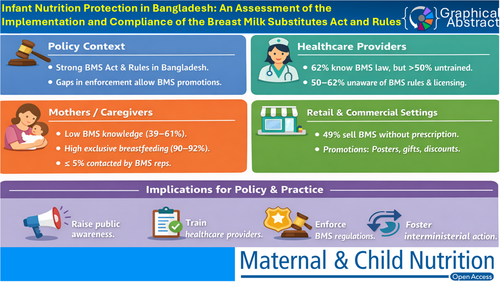
Breastfeeding is critical for infant survival, growth, and development; however, inappropriate marketing of breast-milk substitutes (BMS) continues to undermine optimal feeding practices. Bangladesh has adopted the International Code of Marketing of BMS through the BMS Act 2013 and its Rules 2017, yet evidence on implementation and compliance remains limited. This mixed-methods study assessed knowledge, implementation, and compliance with the BMS Act and its Rules across healthcare and retail settings in Bangladesh. Quantitative data were collected between September 2023 and June 2024 through interviews with 272 healthcare providers (HCPs), 136 pregnant women, 304 mothers/caregivers of children under 5 years, and observations of 150 retail shops and pharmacies. Qualitative data included in-depth interviews with HCPs and focus group discussions with mothers, caregivers, shopkeepers, and journalists. Knowledge of the BMS Act and its Rules was reported by 62.1% of HCPs but was substantially lower among pregnant women (39.4%), mothers/caregivers (38.2%–38.7%), and retail sellers (26.3%). Implementation of the legislation was constrained by limited formal training of HCPs and inconsistent counselling on BMS-related issues. Compliance was further undermined by continued promotional activities and non-prescription sales of BMS products, indicating persistent gaps between the legal framework and its implementation. Fewer than half of HCPs had received formal training, and important knowledge gaps persisted regarding promotional restrictions and penalties. Qualitative findings highlighted weak enforcement, limited counselling on BMS during maternal care, and social and clinical pressures contributing to inappropriate BMS use. Despite favourable breastfeeding practices, implementation and compliance with the BMS Act and its Rules remain suboptimal. Stronger enforcement, including consistent application of Section 18 through the Mobile Court Act, routine monitoring, mandatory HCPs’ training, and institutionalized WHO NetCode monitoring are needed to improve compliance.
Maternal &Child Nutrition, Volume 22, Issue 4, October 2026. Read More