
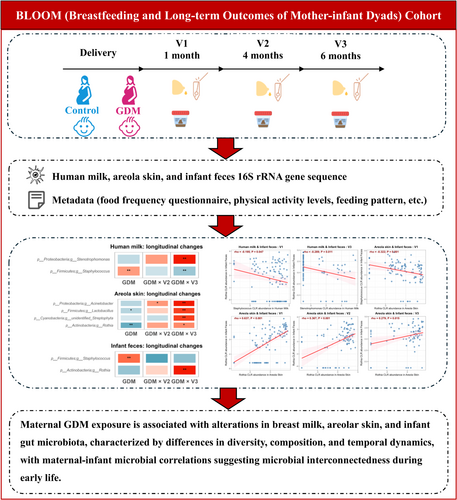

Gestational diabetes mellitus (GDM) exposure is associated with alterations in breast milk, areolar skin, and infant gut microbiota, characterised by differences in diversity, composition, and temporal dynamics, with maternal-infant microbial correlations suggesting microbial interconnectedness during early life.
ABSTRACT
Gestational diabetes mellitus (GDM) has been associated with alterations in maternal and infant gut microbiota. However, it remains unclear whether these associations extend to other maternal-infant microbial niches and persist during early infancy. This study aimed to characterise longitudinal associations between GDM and microbiota across human milk, areolar skin, and infant faecal niches during early life. We followed 104 mother-infant pairs (52 GDM and 52 controls) from delivery through 6 months postpartum. Human milk, areolar skin, and infant faecal samples were collected at 1, 4, and 6 months postpartum and profiled using 16S rRNA gene sequencing. Longitudinal associations were evaluated using mixed-effects models, permutational multivariate analysis of variance, and Spearman correlation. GDM was associated with differences in maternal and infant microbiota across all three niches. Reduced alpha diversity was observed in areolar skin, whereas significant GDM-by-time interactions were identified in human milk and infant faecal microbiota. Beta-diversity analyses revealed persistent differences in microbial community composition. At the genus level, GDM was associated with enrichment of Staphylococcus and temporal changes in Stenotrophomonas in human milk, decreases in Rothia in areolar skin, and an increase in Staphylococcus in infant faeces. Significant associations were also observed between several GDM-related maternal taxa and corresponding infant faecal taxa. In conclusion, GDM was associated with persistent and niche-specific microbial differences across interconnected maternal-infant microbial niches during early life. These findings provide new insights into maternal-infant microbiota in the context of GDM and support future mechanistic investigations.
Maternal &Child Nutrition, Volume 22, Issue 4, October 2026. Read More