
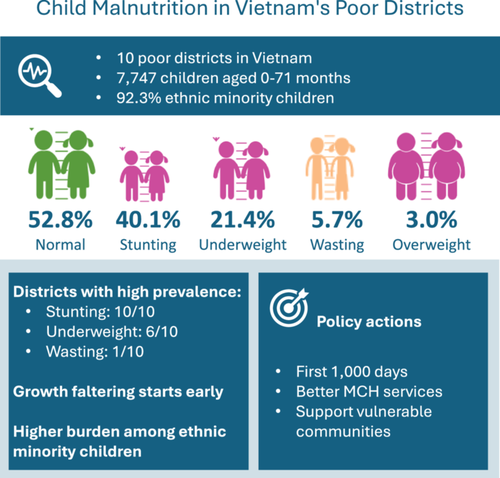

Stunting affected 40.1% of children in Vietnam’s poor districts and exceeded high public health significance thresholds across all districts. The burden was greatest among ethnic minority children, supporting targeted interventions during the first 1000 days of life.
ABSTRACT
Despite progress in improving nutritional status in Vietnam, persistent disparities among ethnic minority populations and children in poor districts remain, underscoring the need for context-specific evidence to inform equitable nutrition policies. This study assessed the prevalence and determinants of malnutrition among children under 6 years of age in poor districts of Vietnam. A cross-sectional study was conducted among 7747 children aged 0–71 months and their mothers from ten poor districts selected through multistage random sampling. Anthropometric measurements and nutritional status were classified following WHO protocols. Survey-adjusted logistic regression accounting for clustering by district and commune examined factors associated with stunting, underweight, wasting, and overweight. Nearly half of households were classified as poor (48.8%), and access to improved water and sanitation was limited. Ethnic minorities comprised 92.3% of participants, namely Hmong, Dao, Thai, and Ra Glai. The prevalence of stunting, underweight, wasting, and overweight was 40.1%, 21.4%, 5.7%, and 3.0%, respectively, with stunting exceeding high public-health-significance thresholds in all 10 districts. Substantial ethnic disparities were observed, with Hmong (aOR = 2.74) and Ra Glai (aOR = 2.11) children showing markedly higher odds of stunting than Kinh children, and Ra Glai children uniquely at higher risk of wasting (aOR = 3.27) and coexistence of stunting-wasting (aOR = 8.47). Fewer than four antenatal care visits, low birthweight (< 2500 g), male sex, and older age were independently associated with higher odds of stunting and/or underweight, while birthweight ≥ 3000 g was protective. Child undernutrition remains highly prevalent in Vietnam’s poor districts and is marked by persistent ethnic, geographic, and biological disparities, underscoring the need for targeted, equity-focused nutrition interventions in this population.
Maternal &Child Nutrition, Volume 22, Issue 4, October 2026. Read More